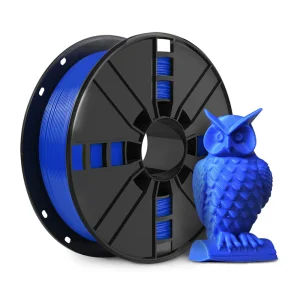
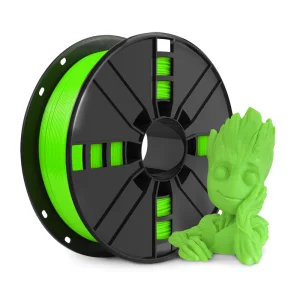
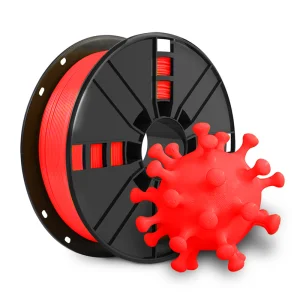
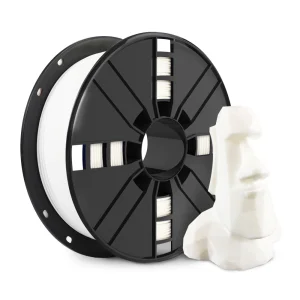
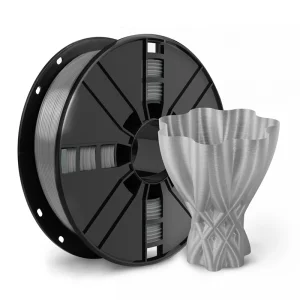
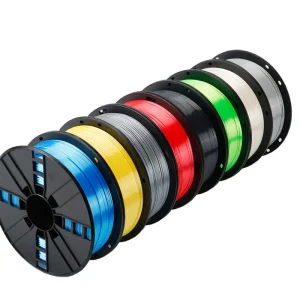
Precision-extruded thermoplastic spools engineered for high-speed FDM/FFF 3D printing platforms. Checked with quad-axis laser diameter monitoring for zero-clog reliability.
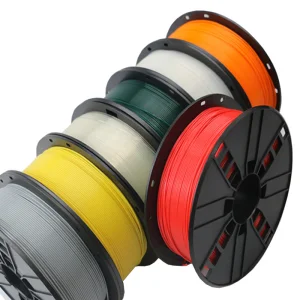
The additive manufacturing landscape is undergoing a paradigm shift. Poly Lactic Acid (PLA), historically viewed as a rapid prototyping material for hobbyists, has morphed into a cornerstone polymer for industrial prototyping, architectural scale modeling, educational STEAM infrastructure, and commercial print-farm production lines. Driven by global decarbonization mandates and volatile petroleum supply chains, bio-based thermoplastics synthesized from fermented plant starches (such as corn starch and sugarcane) have gained unmatched commercial traction.
Modern commercial print farms operating hundreds of high-speed Fused Deposition Modeling (FDM) units running at speeds exceeding 500 mm/s to 600 mm/s demand unprecedented material consistency. Under high volumetric flow rates, legacy PLA formulations often exhibit thermal degradation, nozzle clogging, micro-void bubbling, or severe layer delamination. As leading PLA filament manufacturers and direct factory suppliers, our engineering teams have restructured the polymer crystallization profile and melt flow dynamics to align with next-generation automated printing hardware.
Modified shear-thinning indices allow rapid liquefaction within hotends without thermal degradation, supporting volumetric melt rates up to 32 mm³/s on modern CoreXY machines.
Incorporating elastomeric impact modifiers transforms brittle unmodified PLA resin into high-impact PLA+, yielding superior flexural strength and interlayer adhesion under mechanical strain.
Formulated with 100% pure virgin L-lactide resins. Fully compliant with EU REACH regulations, RoHS directives, and global decarbonization goals for reduced carbon footprints.
Achieving exact spatial accuracy and zero nozzle jam during prolonged industrial print cycles requires tight polymer physics control. PLA is an aliphatic polyester featuring glass transition temperatures ($T_g$) ranging from 55°C to 65°C and melting points ($T_m$) between 150°C and 180°C. Extrusion consistency is governed by Melt Flow Index (MFI), moisture titration control, and draw-down ratio physics during thread cooling.
| Physical / Thermal Property | Standard Test Method | Unmodified Standard PLA | Engineered High-Speed PLA+ |
|---|---|---|---|
| Density (g/cm³) | ISO 1183 / ASTM D792 | 1.24 g/cm³ | 1.23 - 1.25 g/cm³ |
| Melt Flow Index (MFI @ 210°C/2.16kg) | ISO 1133 / ASTM D1238 | 6 - 9 g/10 min | 14 - 22 g/10 min (High Flow) |
| Tensile Strength at Yield (MPa) | ISO 527 / ASTM D638 | 55 - 60 MPa | 62 - 68 MPa |
| Charpy Impact Strength (kJ/m²) | ISO 179 | 2.8 - 3.5 kJ/m² | 8.5 - 12.0 kJ/m² |
| Heat Deflection Temp (HDT @ 0.45MPa) | ISO 75 / ASTM D648 | 55°C | 65°C - 110°C (Post-Annealed) |
| Moisture Content Threshold | Karl Fischer Titration | < 0.05% (< 500 ppm) | < 0.02% (< 200 ppm) |
During high-throughput extrusion, molten polymer filaments experience swell upon exiting the die head. To prevent diameter drift that causes under-extrusion or hotend jams, our automated lines utilize high-frequency inline laser gauges monitoring diameter continuously along X and Y axes at 1,000 Hz. Standard production holds a tight ±0.02 mm tolerance window across 1.75 mm and 2.85 mm spools.
PLA resins are inherently hygroscopic, absorbing ambient humidity that hydrolytically cleaves ester bonds during hotend heating. This yields severe stringing, popping noises, and weak interlayer bonds. Our extrusion infrastructure employs closed-loop desiccant hoppers drying raw resin pellets to below 200 ppm moisture concentration before melting, followed by immediate inline vacuum heat sealing with active desiccant pouches.
As a trusted OEM/ODM manufacturing partner for global 3D printing brand owners, distributors, and Amazon sellers across North America, Europe, and Asia-Pacific, we provide complete supply chain infrastructure. Procurement officers require more than competitive per-spool costs; they demand strict batch-to-batch color consistency, flexible packaging customization, regulatory documentation, and dependable shipping lead times.
Using advanced spectrophotometers, our laboratory formulates custom masterbatches matching exact Pantone, RAL, or physical color samples. We ensure a color deviation profile of Delta E (ΔE) < 1.0 across multi-ton production batches.
Choose between ultra-lightweight, 100% recyclable cardboard spools or high-durability polycarbonate transparent spools designed specifically for multi-material automatic spool switching systems (AMS).
Complete private label customization: branded inner spool stickers, moisture-proof metallic vacuum barrier bags, customized user manuals, barcode/FNSKU labeling, and reinforced master shipping cartons.
FDM additive manufacturing is no longer restricted to simple conceptual models. Specialized PLA material grades are tailored to distinct industrial performance requirements, optimizing thermal, mechanical, and visual properties across enterprise domains.
High-density print farms running 24/7 require consistent spooling without overlapping or tangling. Our precision automatic tension-controlled spooling lines eliminate crossover loops, mitigating print failures during 50+ hour print runs. High-speed PLA variants feature minimal thermal expansion coefficient ($CTE$), preventing part warping on unheated print surfaces.
Safety and air quality are primary concerns in educational and classroom settings. Virgin PLA emits negligible volatile organic compounds (VOCs) and zero hazardous ultrafine particles (UFPs) during thermal melt compared to styrenic polymers like ABS. Its low printing temp (190°C–210°C) makes it ideal for educational labs and maker spaces.
For decorative lighting, cosplay armor, luxury packaging prototypes, and aesthetic display models, our specialized Silk PLA, Dual-Color Coextrusion, and Matte PLA options hide layer lines. Micro-coatings and optical modifiers diffuse light across surfaces, providing metallic sheen or stone-like texture straight off the print bed.
Architectural firms and automotive tooling centers utilize high-rigidity PLA+ for rapid validation of geometric scale models and assembly line alignment fixtures. Low shrinkage properties ensure large prints spanning up to 500 mm maintain flat build plate adhesion without corner lifting or dimensional drift.
Navigating international import regulations requires stringent documentation and product compliance. Every spool manufactured in our ISO 9001:2015 certified factory undergoes rigorous batch testing before export clearing. We maintain comprehensive documentation libraries to protect our global brand partners during customs inspections and market auditing.
Fully compliant with EU REACH (SVHC high concern substance restriction) and RoHS 3 Directive 2015/863. Certified heavy-metal free (no lead, cadmium, mercury, or hexavalent chromium).
Complete Material Safety Data Sheets (MSDS), Technical Data Sheets (TDS), and food-contact compliance declarations available for immediate integration into your brand's regulatory archive.
Flexible trade terms (FOB, CIF, DDP, DDU) supported by automated pallet loading density planning to maximize container space (FCL/LCL) and reduce per-spool ocean freight costs.
As FDM 3D printing hardware transitions toward higher print speeds, automated multi-toolhead changing systems, and AI-driven camera inspection, material science must keep pace. Our R&D laboratory is actively developing next-generation polymer matrix technologies focused on bio-composite performance, circular economy closed loops, and inline smart quality monitoring.
Compounding PLA with bio-based fillers such as micro-cellulose fibers, recycled carbon fiber flour, and wood nanostructures to achieve high tensile modulus while retaining 100% industrial compostability.
Developing post-industrial and post-consumer recycled PLA (rPLA) formulations purified through chemical depolymerization back to monomeric lactide, restoring virgin-grade tensile and thermal characteristics.
Deploying computer vision defect tracking along extrusion lines to detect micro-inclusions, ovality deviations, and surface irregularities in real-time, enforcing automated reel reject protocols.
Explore our full range of specialty aesthetic, transparent, high-toughness, and vibrant color formulations available for bulk factory order.
Our standard production holds a strict target diameter tolerance of ±0.02 mm for both 1.75 mm and 2.85 mm spools. Every line utilizes high-frequency quad-axis inline laser measuring system running continuous real-time ovality tracking to ensure seamless feeding in all FDM print heads.
We offer end-to-end OEM/ODM private label solutions: custom color formulation matched to Pantone/RAL codes, custom sticker artwork on spool hubs, customized user boxes, vacuum sealed bags, inner desiccant packs, barcode labeling, and reinforced master shipping cartons built to your specs.
Our 2,500 m² automated facility operates 6 high-speed extrusion lines yielding a monthly output between 50,000 kg and 60,000 kg. Standard OEM container orders (20ft FCL) are typically fulfilled within 15 to 20 business days upon sample proof approval.
Before spooling, raw resin pellets undergo desiccated hoppers drying until moisture content drops below 200 ppm. Instantly after automatic winding, spools are heat-sealed inside multi-layer aluminum or clear vacuum barrier film alongside fresh active silica gel desiccant packs to guarantee multi-year shelf life.
Yes. Our spools feature smooth flange outer rims and exact width specifications engineered for compatibility with multi-material systems such as Bambu Lab AMS and multi-spool feed units, available in both recyclable cardboard and high-rigidity plastic spool options.
We provide full technical documentation packages including Safety Data Sheets (SDS), Technical Data Sheets (TDS), EU REACH compliance certificates, RoHS 3 heavy-metal screening reports, and FDA food-contact resin safety declarations.