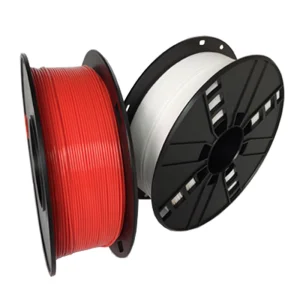
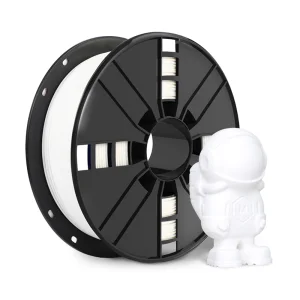
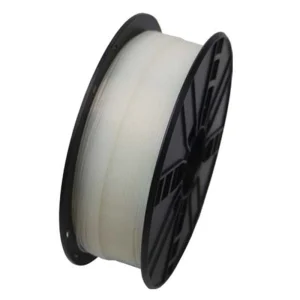
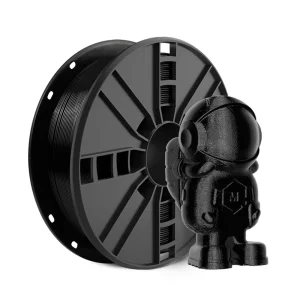
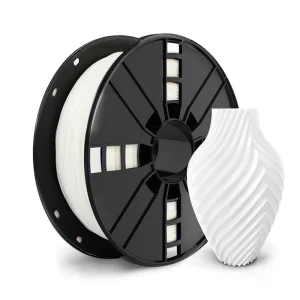
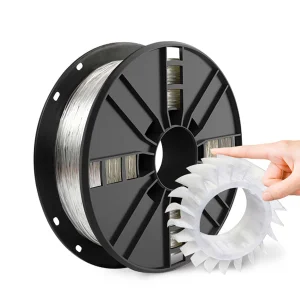
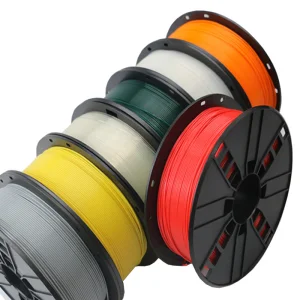
Direct factory extrusion engineered for industrial compliance, tight dimensional tolerances, and high-speed print stability.
Acrylonitrile Butadiene Styrene remains the workhorse polymer of additive manufacturing, bridging consumer rapid prototyping and enterprise functional production.
In the evolving landscape of 3D printing materials, Acrylonitrile Butadiene Styrene (ABS) filament holds a foundational role in Fused Deposition Modeling (FDM) and Fused Filament Fabrication (FFF) technologies. As global industries shift from traditional subtractive manufacturing toward digital, on-demand additive production, the global demand for engineering-grade ABS filament has surged. Unlike commodity thermoplastics such as standard PLA, ABS is a terpolymer synthesized by polymerizing styrene and acrylonitrile in the presence of polybutadiene.
This tri-monomer chemical structure delivers a unique equilibrium of mechanical properties: Acrylonitrile contributes chemical resistance, hardness, and thermal stability; Butadiene provides exceptional impact resistance and low-temperature toughness; while Styrene imparts rigidity, surface luster, and processing fluid balance during extrusion. As a result, commercial enterprise buyers across automotive, aerospace, consumer electronics, and industrial tooling sectors rely on accredited ABS filament suppliers to deliver high-yield batch consistency for critical components.
| Polymer Grade | Impact Strength (kJ/m²) | Heat Deflection (HDT @ 0.45MPa) | Print Chamber Requirement | Post-Processing Ability | Primary Commercial Risk |
|---|---|---|---|---|---|
| Industrial Grade ABS | 15 - 22 | 85°C - 98°C | Enclosed (45°C - 60°C) | Vapor Smoothing, Machining, Glue | Thermal Shrinkage & Warping |
| Standard PLA | 3 - 5 | 52°C - 55°C | Open Air / Unheated | Sanding, Acrylic Painting | Thermal Creep & Brittleness |
| PETG Structural | 8 - 12 | 68°C - 72°C | Open / Semi-Enclosed | Mechanical Fastening | Stringing & Surface Scratches |
| ASA Outdoor Grade | 12 - 18 | 90°C - 100°C | Enclosed Chamber | Acetone / Chemical Bonding | Higher Raw Material Unit Cost |
| Carbon Fiber ABS Compound | 6 - 10 (Flexural High) | 100°C - 110°C | Enclosed Heated Chamber | Abrasive Post-CNC Milling | Nozzle Wear & Lower Elongation |
How state-of-the-art automated polymer compounding and direct supplier integration deliver unparalleled price-performance efficiency to international distributors.
Partnering directly with global polymer refiners (such as SINOPEC, Formosa Plastics, and Chi Mei) allows our production lines to utilize prime, un-recycled virgin ABS resin stock. Bulk monomer procurement mitigates price volatility and guarantees consistent resin Melt Flow Index (MFI) across multi-ton production runs.
Extrusion accuracy relies on real-time feedback loops. Our automated lines integrate quad-axis high-frequency laser micrometers that measure filament diameter 1,000 times per second. Strands exceeding ±0.02 mm variation are automatically rejected before spool winding, avoiding nozzle clogs.
ABS is hygroscopic and retains trace volatile monomers. Our continuous-feed vacuum dehumidifying hoppers dry virgin pellets down to under 0.02% moisture content prior to melting, virtually eliminating micro-foaming, bubbling, and pops during hotend extrusion.
Real-world industrial deployment of production-grade ABS filament across heavy engineering, consumer goods, and rapid manufacturing hubs.
Automotive tier-1 and tier-2 suppliers utilize ABS filament to construct durable assembly fixtures, custom ducting, sensor housings, and interior trim prototypes. High heat deflection temperatures (HDT) allow components to endure under-hood ambient heat without structural deformation, while acetone post-smoothing yields injection-mold-like surface finishes.
OEM hardware startups and electronics manufacturers implement flame-retardant low-warpage ABS formulations to house printed circuit boards (PCBs), power supply units, and handheld field analyzers. Excellent dielectric strength combined with impact-resistant wall structures ensures long-term operational shielding against drop damage.
Contract prototyping agencies convert high-density ABS prints into short-run vacuum thermoforming tooling, silicone casting cores, and sheet metal press brake dies. The mechanical compressive strength of 3D printed ABS resists hydraulic cycle stress without cracking.
Industrial clients choose ABS specifically for its chemical solvent compatibility. Unlike PLA or PETG, ABS easily dissolves in acetone, enabling cost-effective vapor smoothing that seals layer lines for fluid-tight containers, custom plating (electroplating with nickel/chrome), and chemical cold welding.
Addressing legacy FDM challenges through polymer modification, eco-spool packaging, and high-speed motion system compatibility.
With modern CoreXY 3D printers operating at speeds up to 500 mm/s to 600 mm/s, legacy ABS resins suffer from melt starvation and structural layer delamination. Next-generation ABS formulas incorporate specialized rheology modifiers to enhance thermal conductivity and lower melt viscosity, maintaining solid layer adhesion at high volumetric extrusion rates.
Historical styrene outgassing during heat processing posed odor challenges in unventilated office settings. Modern additive modification relies on zero-VOC organoclay stabilizers and styrene-acrylonitrile matrix optimization, reducing thermal expansion coefficients by 35% and minimizing warping without compromising inter-layer bond strength.
Global ESG mandates require enterprise procurement teams to reduce virgin plastic waste. Manufacturers are responding by offering PCR (Post-Consumer Recycled) ABS lines wrapped on 100% recyclable cardboard spools or spool-less refill coils, reducing carbon footprint throughout shipping logistics.
Key parameters, quality assurance criteria, and compliance protocols for global distributors, OEM brands, and high-volume print farms.
When evaluating global ABS filament suppliers for OEM branding or commercial distribution, procurement managers must evaluate suppliers beyond unit pricing. Consistency across high-volume orders dictates total operational efficiency:
Expand your product matrix with our full line of PLA, PETG, TPU, and specialty structural filaments manufactured under strict quality standards.
Direct technical guidance from our polymer engineering team regarding print optimization, storage, OEM customization, and bulk ordering.