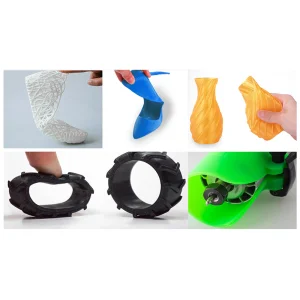
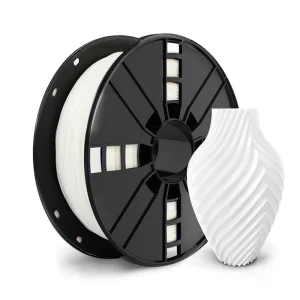
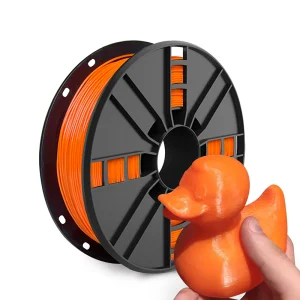
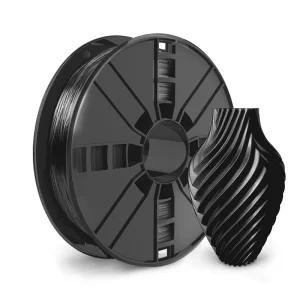
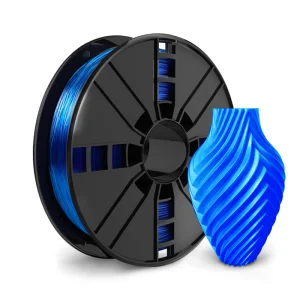
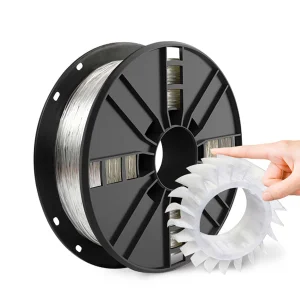
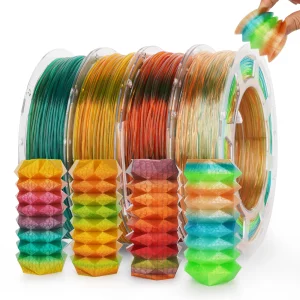
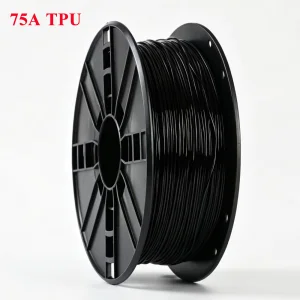
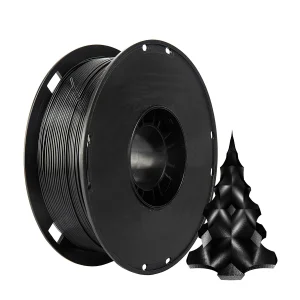
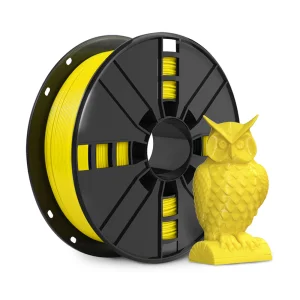
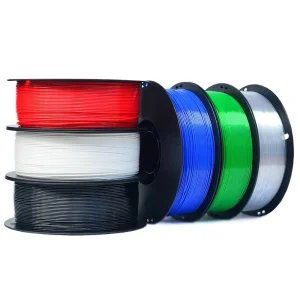
Explore our core flexible 3D printing filaments engineered for industrial prototyping, functional end-use components, and volume commercial applications.
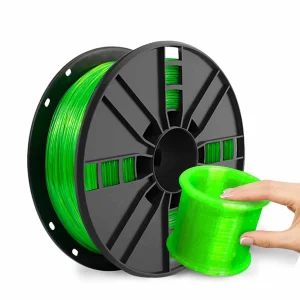
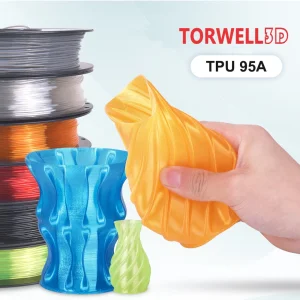
Thermoplastic Polyurethane (TPU) and Thermoplastic Elastomers (TPE) represent the pinnacle of flexible additive manufacturing polymer materials. As global industries accelerate the transition from rigid prototyping to functional elastic end-use components, the demand for high-grade 1.75mm and 2.85mm flexible filaments has surged exponentially across North America, Europe, and the Asia-Pacific region.
TPU polymers consist of linear block copolymers containing alternating hard segments (diisocyanates) and soft segments (long-chain polyols). This unique dual-phase architecture gives TPU exceptional tear strength, high dynamic load-bearing resistance, and superior elasticity compared to conventional rubber.
Ester-based TPUs deliver extraordinary abrasion resistance and mechanical tensile properties ideal for dry industrial tooling, whereas Ether-based TPUs excel in low-temperature flexibility, micro-fungal resistance, and hydrolytic stability for outdoor or bio-fluid environments.
Navigating the hardness gradient—from ultra-flexible Shore 70A and 75A to standard 85A, 95A, and semi-rigid 64D—requires deep compounding mastery. Exact control over phase separation ensures precise flexural modulus and column strength during extrusion.
The global 3D printing filament market is undergoing a structural evolution. Tier-1 automotive manufacturers, consumer electronics brands, orthotic specialists, and automated print farms are increasingly replacing traditional compression-molded rubber parts with Fused Deposition Modeling (FDM) flexible filaments. This shift enables rapid customization, localized supply chain resilience, and zero-tooling cost production. Global procurement teams now demand strict inline diameter tolerances ($\pm 0.02\text{ mm}$), verified melt flow consistency, and low-tack surface finishes that feed flawlessly through high-speed direct-drive and Bowden extruders without buckling or nozzle clogging.
China's manufacturing ecosystem provides an unbeatable competitive advantage in advanced polymer synthesis, rapid scale production, and cost optimization. At our state-of-the-art production facilities, we synthesize raw elastomer resins and extrude high-grade filaments with unrivaled efficiency.
Choosing the correct Shore hardness and material chemistry is vital for industrial design success. Below is a comprehensive engineering specification guide comparing our core TPU & TPE product grades.
| Material Grade | Shore Hardness | Tensile Strength (MPa) | Elongation at Break (%) | Tear Strength (kN/m) | Rec. Nozzle Temp (°C) | Primary Feature |
|---|---|---|---|---|---|---|
| Ultra-Soft TPU | 70A - 75A | 28 - 32 | > 650% | 65 | 200 - 220 | Rubber-like flexibility, high dampening |
| Standard Soft TPU | 85A - 90A | 35 - 42 | > 550% | 90 | 210 - 230 | Ideal balance of flex & ease of print |
| Industrial TPU 95A | 95A | 45 - 52 | > 480% | 120 | 220 - 240 | High printing speed, chemical resistance |
| Semi-Rigid TPE/TPU | 64D | 58 - 65 | > 350% | 160 | 230 - 250 | High dynamic fatigue, structural seals |
| Carbon Fiber TPU | 95A + 10% CF | 55 - 62 | > 180% | 140 | 235 - 255 | ESD anti-static, structural stiffness |
Thermoplastic Polyurethane filaments have evolved far beyond hobbyist novelty prints. Today, our engineering-grade TPU & TPE filaments drive critical functional components across diverse global industries.
Utilized for rapid manufacturing of custom automotive dust boots, wiring harness grommets, intake hose dampeners, anti-vibration bushings, and interior dashboard trim components resistant to oils, greases, and engine heat.
Custom flexible pneumatic grippers, non-marking robot end-effectors, protective bellows, anti-collision bumpers, dynamic vacuum suction cups, and flexible drive belts tailored for automated assembly lines.
Patient-specific 3D printed orthotic shoe insoles, flexible prosthetic socket liners, customized orthopedic braces, and wearable sensor straps requiring skin-safe non-allergenic bio-compatible polymer formulations.
Rugged military-grade protective smartphone cases, drone camera gimbals, shockproof action camera mounts, waterproof sealing gaskets, and soft-touch ergonomic tool handles.
Pioneering lattice-structure sneaker midsoles, lightweight energy-return outsoles, custom cleat components, and flexible decorative elements printed directly onto textiles.
High-durability O-rings, hydraulic fluid seals, flange gaskets, dynamic diaphragms, and flexible pipe connectors capable of maintaining seal integrity under fluctuating system pressures.
Procuring TPU and TPE filaments for commercial redistribution or industrial print farms requires solving specific technical friction points. As a premier Chinese manufacturer, we design our filaments to eliminate common operational hurdles.
Flexible filaments tend to buckle or wrap around extruder drive gears when pushed into constricted pathways. Our proprietary polymer lubrication treatment reduces surface coefficient of friction ($\mu$), allowing smooth feeding through PTFE tubes and Bowden systems.
Additionally, our rigid tolerance control ($\pm 0.02\text{ mm}$) prevents sudden diameter swells that cause hotend jams. For high-speed CoreXY 3D printers (printing at 200–350 mm/s), our TPU 95A high-flow grade provides optimal melt velocity without sacrificing inter-layer adhesion strength.
Polyester and polyether TPUs actively absorb moisture from ambient air, causing severe stringing, hydrolytic degradation, void formation, and aesthetic flaws during printing. We implement a mandatory 4-stage vacuum packaging protocol:
As additive manufacturing moves toward ultra-fast multi-material printing and sustainable circular supply chains, our factory R&D lab continues to push the boundaries of elastomer material science.
Engineered with modified rheological properties and high shear-thinning response, enabling reliable flexible printing at speeds exceeding 300 mm/s on modern high-acceleration 3D printers without layer separation.
Synthesized utilizing bio-based polyols derived from renewable castor oil, reducing carbon footprint by up to 45% while maintaining full mechanical recyclability within circular industrial loops.
Incorporating functional carbon nanotubes (CNT) for anti-static ESD-safe electronic manufacturing, alongside UL94 V-0 flame-retardant TPUs tailored for aerospace and railway interiors.
Find precise engineering and procurement answers regarding our wholesale TPU & TPE 3D printer filament manufacturing services.
Explore our broader range of engineering-grade and decorative 3D printing filaments manufactured with identical factory precision.
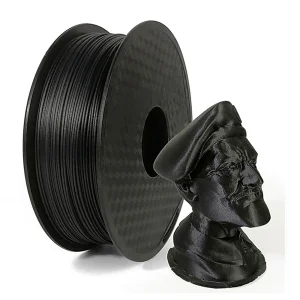
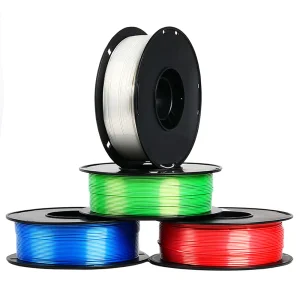
Looking for competitive factory-direct wholesale pricing, OEM private labeling, or custom masterbatch formulation? Request a instant quote or free technical sample spool today.
Request B2B Quotation & TDS