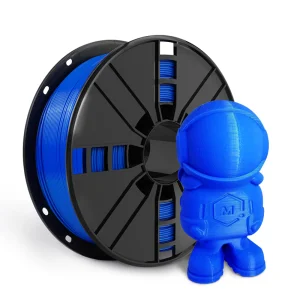
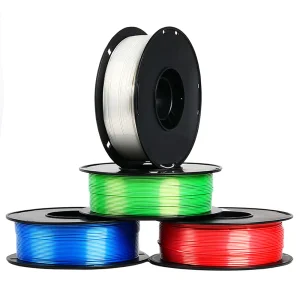
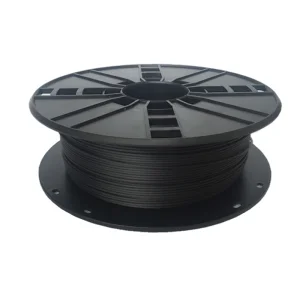
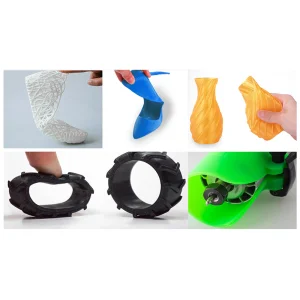
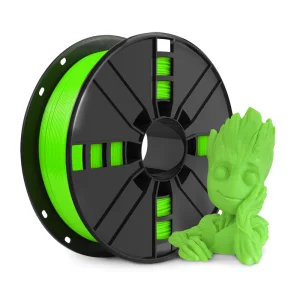
Direct factory manufacturing of precision carbon fiber composite filaments alongside versatile thermopolymer lines, engineered for advanced desktop and industrial FDM/FFF 3D printers.
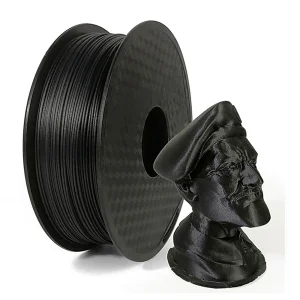
Understanding the physics behind carbon fiber filament manufacturing, structural aspect ratios, anisotropic stress distribution, and rheological tuning.
As a specialized carbon fiber filament manufacturer, we engineer micro-milled and chopped carbon fibers with controlled aspect ratios (L/D > 20). This ensures optimal stress transfer across the polymer-fiber interface without causing nozzle clogging during molten extrusion.
During the FDM extrusion process through narrow nozzles (0.4mm–0.8mm), shear forces align carbon micro-fibers parallel to the bead direction. This axial fiber orientation delivers extraordinary tensile strength along the print path and virtually eliminates thermal warping.
The addition of high-modulus carbon fibers significantly reduces the Coefficient of Thermal Expansion (CTE) of the base matrix. Parts exhibit microscopic shrinkage upon cooling, allowing zero-warpage production of large-scale industrial fixtures and tight-tolerance housings.
E-E-A-T Technical Insights: Standard polymer filaments often suffer from high thermal deformation under structural loads. Integrating high-purity carbon fibers creates a rigid internal skeleton. However, uncalibrated compounding causes fiber agglomeration and brittle shear failure. Our proprietary twin-screw compounding lines optimize interfacial coupling agents, achieving uniform fiber dispersal and maximum impact damping.
| Material Variant | Base Matrix Polymer | Carbon Fiber Mass Content (%) | Tensile Modulus (GPa) | Heat Deflection Temp (HDT @ 0.45MPa) | Primary Industrial Use Case |
|---|---|---|---|---|---|
| Carbon Fiber PLA | Poly-Lactic Acid (PLA+) | 15% Short CF | 4.8 GPa | 65 °C | Rigid prototypes, drone arms, aesthetic matte models |
| Carbon Fiber PETG | Polyethylene Terephthalate Glycol | 20% Micro CF | 6.1 GPa | 82 °C | Chemical containers, outdoor brackets, snap-fit jigs |
| Carbon Fiber PA (Nylon) | Polyamide 6/66 & PA12 Matrix | 20% - 25% High-Aspect CF | 8.5 GPa | 155 °C | Automotive under-hood parts, functional gear systems |
| Carbon Fiber ABS | Acrylonitrile Butadiene Styrene | 15% Short CF | 5.2 GPa | 98 °C | Impact-resistant housings, electronics enclosures |
| Carbon Fiber PEEK | Polyether Ether Ketone | 30% High-Purity CF | 14.2 GPa | 280 °C | Aerospace structural brackets, oil & gas components |
Replacing traditional CNC-machined aluminum with lightweight, ultra-rigid 3D printed carbon fiber composites across key global industrial sectors.
Weight reduction is critical in drone chassis and aerospace brackets. Our Carbon Fiber filaments provide extreme flexural strength and vibration damping, replacing heavy aluminum parts while maintaining strict dimensional tolerances during rapid maneuvers.
Engineers utilize CF-PETG and CF-PA for custom air intake manifolds, brake cooling ducts, and racing interior brackets. High heat deflection temperatures combined with chemical resistance against oils and fuels allow direct functional testing under operational conditions.
In automated assembly lines, reducing robot arm payload weight directly increases speed and operational longevity. Carbon fiber composite grippers offer high mechanical stiffness with low inertia, boosting factory efficiency and reducing motor wear.
Patient-specific orthotic braces demand lightweight structural rigidity and skin-safe durability. Carbon fiber reinforced PLA and PETG enable custom-fitted prosthetic sockets that reduce patient fatigue without sacrificing load-bearing safety factors.
Inside our state-of-the-art 2,500 m² automated extrusion facility: how raw material science transforms into high-yield, world-class filament rolls.
Every line is equipped with real-time, non-contact dual-axis laser micrometers. Tens of thousands of measurements per minute ensure strict adherence to standard 1.75mm and 2.85mm diameters, flagging micro-ovality instantly for automatic extrusion speed compensation.
Hydrophobic and hygroscopic resins (such as Nylon and PETG) undergo multi-stage desiccant drying down to moisture levels under 0.02% prior to melt compounding. This avoids hydrolytic degradation, steam micro-voids, and surface popping during 3D printing.
Tangled filament leads to catastrophic multi-hour print failures. Our automated tension-controlled spooling systems guarantee neat, layer-by-layer parallel winding. Compatible with modern high-speed automatic material systems (AMS).
Factory Scalability: Operating 6 fully automated extrusion lines around the clock, our facility delivers over 50,000 to 60,000 kg per month. By leveraging integrated raw material supply networks in China, we offer competitive bulk factory pricing without sacrificing chemical quality or dimensional consistency.
Pioneering the next horizon of additive manufacturing composites through sustainable raw materials, nano-reinforced hybrids, and smart functional filaments.
To support circular economies, our R&D team is standardizing reclaimed carbon fiber streams from aerospace manufacturing offcuts. Re-compounded into bio-based PLA and recycled PETG matrices, rCF lowers carbon footprints by 45% while preserving mechanical stiffness.
Integrating multi-walled carbon nanotubes (MWCNTs) and graphene nanoplatelets alongside chopped carbon fibers creates multi-scale reinforcement. This hybrid architecture drastically improves inter-layer z-axis adhesion and delivers ESD-safe electrical dissipation.
Transitioning from short-chopped fibers to continuous carbon tow co-extrusion technology. Future filament formulations will allow standard FDM desktop printers to deposit continuous carbon strands, achieving strength-to-weight ratios rivaling structural titanium.
Empowering global brands, regional distributors, and print farms with end-to-end custom material compounding, white-label packaging, and turnkey manufacturing.
We tailor carbon fiber weight concentration (from 5% up to 30%) to suit your target market balance between flexibility, tensile modulus, printability, and cost per roll.
Complete branding customization including custom-printed spool sides, cardboard spools, specialized outer cartons, custom vacuum bags, and serialized batch stickers.
From 250g mini spools to 1kg standard retail rolls, up to 3kg, 5kg, and 10kg industrial print farm spools. Available in standard matte black, as well as tinted fiber matrices.
Ensuring smooth international customs clearance and frictionless deployment across North American, European, and Asia-Pacific markets.
All Carbon Fiber and standard filament lines comply with RoHS and REACH regulations, certified free of dangerous heavy metals, SVHCs, and halogenated flame retardants. UL94 V-0 flame retardant versions available upon request.
Every shipment is accompanied by detailed Technical Data Sheets (TDS), Safety Data Sheets (SDS), and standardized print profiles (.json / .3mf presets) for Bambu Lab, Prusa, Creality, and Raise3D ecosystem integration.
Our dedicated export logistics team provides optimized HS Code classifications, DDP/FOB/CIF international shipping terms, and secure palletization to prevent moisture degradation during ocean transit.
Expert answers addressing nozzle wear, print parameters, moisture management, and structural mechanical performance for enterprise buyers.
Direct sourcing from an experienced carbon fiber filament manufacturer guarantees tight control over polymer formulation, raw fiber quality, and extrusion parameters. Generic distributors often source from disparate batch producers, leading to inconsistent fiber loading ratios, erratic diameter tolerances, and unexpected nozzle clogging. A dedicated factory provides direct technical support, customized TDS/SDS documentation, batch traceability, and tailor-made OEM options.
Micro-chopped carbon fibers are highly abrasive. Standard brass nozzles will experience severe orifice erosion within printing just 100g to 300g of material, resulting in diameter loss and poor print quality. We strongly recommend using Hardened Steel, Tungsten Carbide, or Ruby-Tipped nozzles with an orifice diameter of 0.4mm or larger (0.6mm recommended for high-volume fiber loading to eliminate nozzle clogging).
Because short carbon fibers orient horizontally along the X-Y print path during extrusion, they do not cross layer boundaries. This increases X-Y tensile modulus dramatically, but can slightly reduce Z-axis tensile adhesion if printed at improper temperatures. To maximize Z-axis strength, increase print nozzle temperatures by 10-15 °C above standard base polymer settings, disable cooling fans for industrial polymers, and maintain a dry printing environment.
While base PLA has lower hygroscopy, materials like PETG-CF and PA-CF (Nylon Carbon Fiber) absorb atmospheric moisture rapidly. Moist filament causes steam bubbles, severe stringing, popping noises during extrusion, and loss of mechanical properties. We dry all spools prior to vacuum packaging with high-capacity desiccant. Prior to printing technical filaments like PA-CF, pre-dry spools in a dedicated filament dryer at 70–80 °C for 6–8 hours.
Yes. While standard carbon fiber filaments present a dark matte grey or deep charcoal appearance due to black carbon micro-fibers, our compounding lines can color-match base polymer matrices (such as Dark Blue, Army Green, or Crimson Red) to produce uniquely tinted industrial composite finishes for private label customers.
For standard stocked catalog lines, our minimum order quantity starts as low as 100 spools. For custom matrix formulations, specialized carbon fiber loading ratios, or branded custom cardboard spools, the baseline MOQ is typically 500 to 1,000 kg per SKU. Contact our sales engineering team for personalized quotes and sample testing packages.
Explore our full manufacturing portfolio, ranging from high-toughness PLA+ and weather-resistant ABS to specialty flexible and carbon composite lines.