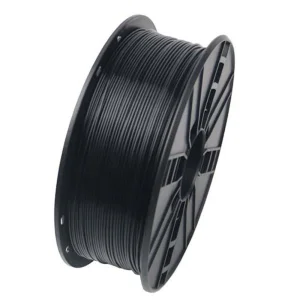
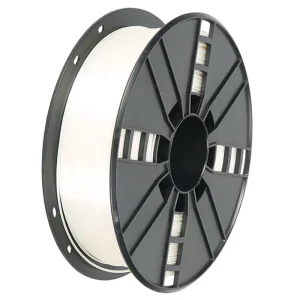
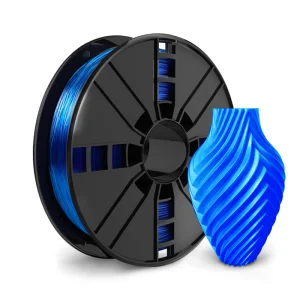
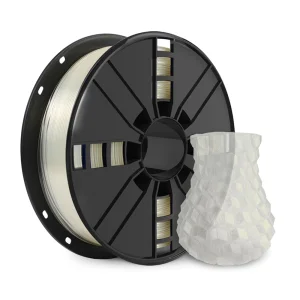
Direct factory supply of precision-extruded 1.75mm filaments engineered for industrial print farms and wholesale distributors.
Understanding the molecular modifications, elastomeric co-polymers, and viscoelastic properties driving next-generation flexible FDM printing.
Rubberized PLA blends poly-lactic acid with thermoplastic elastomeric (TPE) phase modifiers. This hybrid structure delivers rubber-like tactile flexibility while retaining the low thermal shrinkage and easy printing characteristics inherent to eco-friendly PLA resin bases.
Extruded through high-speed twin-screw machinery featuring dual-axis laser diameter monitoring. Controlling raw strand variance to within ±0.02mm ensures consistent volumetric extrusion, preventing feed-gear slippage and hot-end clogging in direct-drive setup.
Formulated with optimized melt-flow indexes (MFI) that promote rapid thermal diffusion across adjacent layers. This results in superior Z-axis tensile adhesion and isotropic elasticity under dynamic bending, torque, and repetitive mechanical impacts.
While standard Thermoplastic Polyurethane (TPU) offers extreme elongation, its high coefficient of friction often leads to feeding buckling in Bowden-style extruders. Rubber Filament 1.75mm PLA co-polymers incorporate internal lubricity additives and modified flexural moduli, allowing seamless feeding through PTFE tubes while maintaining superior vibration damping and impact resistance in final printed components.
B2B buyer imperatives for high-volume 3D printing filament procurement, risk mitigation, and OEM contract manufacturing.
The global additive manufacturing ecosystem is undergoing a structural shift toward production-grade functional materials. Commercial enterprises, high-speed print farms, and regional distributors demand predictable polymer behaviors to maintain low unit rejection rates. Sourcing Rubber Filament 1.75mm PLA directly from Tier-1 Chinese manufacturers grants strategic cost efficiencies, guaranteed raw resin traceability, and customizable spooling parameters tailored to automated production lines.
Industrial printing operations cannot tolerate variance in glass transition temperatures ($T_g$) or viscosity across different production batches. Torwell’s continuous closed-loop extrusion lines utilize pure raw polymer resins, eliminating secondary recycled fillers that cause print failure during long operational cycles.
We provide end-to-end OEM brand creation, including custom Pantone masterbatch color matching, branded spool design (cardboard or recyclable polycarbonate), dual-layer vacuum sealing with active silica desiccant, and barcoded retail carton packaging ready for global distribution.
| Performance Metric | Rubber Filament 1.75mm PLA | Flexible TPU (Shore 95A) | Standard Rigid PLA |
|---|---|---|---|
| Shore Hardness Spectrum | 80A – 88A (Flexible-Soft) | 90A – 95A (Semi-Flexible) | 85D (Rigid) |
| Bowden Extruder Compatibility | High (Low friction surface) | Moderate (Requires slow speed) | Excellent |
| Elongation at Break (%) | > 350% | > 450% | < 10% |
| Print Speed Range | 40 – 90 mm/s | 20 – 40 mm/s | 60 – 250+ mm/s |
| Vibration & Acoustic Damping | Exceptional | High | Negligible |
| Bed Temperature Requirement | 30°C – 60°C (No enclosure) | 50°C – 70°C | 0°C – 60°C |
Deploying flexible rubberized PLA across automotive, robotics, medical prototyping, and ergonomic consumer products.
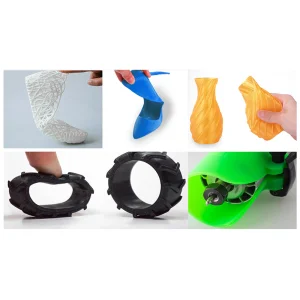
Rapid functional verification of door gaskets, wire harness grommets, interior dampening pads, and custom dust covers. Rubber PLA withstands cyclic compressive forces without permanent compression set.
Creating pneumatic end-effectors, soft robotic fingers, and compliant mechanism components. High elasticity allows intricate internal air channels to inflate without layer bursting or micro-fracturing.
Surgical planning models requiring realistic soft-tissue tactility. Surgeons utilize rubberized PLA prints to practice preoperative incisions, organ manipulation, and medical device placement testing.
Custom shoe outsoles, orthotic midsoles, wrist guards, and shock-absorbing power tool handles. Provides tactile non-slip grip and non-marking rubber performance with simple print parameters.
Next-generation polymer research driving faster print speeds, high-temp elasticity, and sustainable bio-based elastomeric formulation.
Developing advanced rheology modifiers to lower high-shear viscosity inside modern high-speed CoreXY 3D printers. Target printing speeds of >150 mm/s without sacrificing inter-layer mechanical shear strength.
Incorporating fully compostable PLA polyesters with non-toxic bio-elastomers. Achieving 100% closed-loop industrial circularity for flexible prototypes while meeting stringent European sustainability standards.
Engineered surface friction coefficients designed specifically for automated material switching systems (AMS). Eliminates retraction jams during multi-color or multi-hardness structural prints.
Leveraging Guangdong's supply chain ecosystem for scalable, cost-efficient 3D material manufacturing.
As the pioneer of additive manufacturing materials since 2011, Torwell Technologies operates a standardized 2,500 m² factory equipped with 6 automated extrusion lines. Situated in China's manufacturing heartland, our facility integrates raw resin synthesis, precision extrusion, inline monitoring, and global logistics under one rigorous quality management system.
All Torwell Rubber Filament 1.75mm PLA products comply fully with international environmental and safety standards, including RoHS, REACH, and ISO9001:2015 quality management certifications. Chemical safety data sheets (SDS) are provided for seamless customs clearance.
We provide FOB, CIF, DDP, and Express shipping options to over 75 countries. Filaments are vacuum-sealed with high-capacity desiccant packs and shipped in reinforced corrugated outer boxes designed to survive ocean transit and humid tropical warehouse storage.
Eliminating material defects before spools leave our Shenzhen production facility.
Virgin PLA resin pellets are dried in industrial desiccant hoppers to below 0.02% moisture content prior to heat extrusion.
High-density melt screens remove micro-impurities down to 50 microns, ensuring zero nozzle clogging during fine detail printing.
Dual-axis continuous laser micrometers measure roundness and diameter 100 times per second, automatically auto-correcting extrusion speed.
Precision tension-controlled auto-winders layer the filament neatly to prevent overlapping loops, tangles, or cross-winds.
Expert answers to operational, procurement, and printing parameters for Rubber Filament 1.75mm PLA.
We recommend a hot-end nozzle temperature between 200°C and 225°C, combined with a heated bed temperature of 40°C to 60°C. If printing on textured PEI or blue painter's tape, heated bed usage can be minimal. Ensure cooling fan speed is set to 80%-100% after the first 2 layers for optimum bridging and overhang resolution.
Yes. Unlike soft Shore 70A TPU which requires direct-drive extruders, our Rubber Filament 1.75mm PLA co-polymer is formulated with enhanced column rigidity. It feeds reliably through PTFE Bowden tubes at speeds up to 50 mm/s. For best results, keep retraction distance under 3.5mm and retraction speed around 25-35 mm/s.
Rubber PLA exhibits lower hygroscopic sensitivity than standard TPU or PA-Nylon materials. However, prolonged exposure to ambient humidity (>50% RH) can cause stringing and micro-void popping. We ship all spools vacuum-sealed with active silica desiccant. We advise storing opened spools in sealed dry boxes at <20% humidity.
Absolutely. As a direct China manufacturer, we offer custom color formulation matching Pantone codes or physical color plaques. Standard spool size is 1kg (2.2 lbs), but we also supply 250g sample spools, 500g, 3kg, and 5kg industrial master spools compatible with automated manufacturing systems.
Printed parts can be trimmed with standard flash knives, heat-treated with hot air guns to clear surface stringing, or bonded using cyanoacrylate (super glue) or polyurethane-based adhesives. Mechanical sanding should be done wet to prevent localized thermal softening.
Explore our complete catalog of industrial engineering, high-gloss silk, transparent, and ultra-flexible 1.75mm filaments.