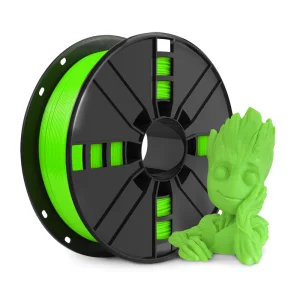
Explore our factory-direct 3D printer material lineup engineered with inline laser precision control and optimized for global OEM/ODM brands.
Decoding global buyer intent, material science transitions, and the rise of dark architectural aesthetics in fused deposition modeling (FDM).
Traditional marble filaments relied on stark white PLA matrices loaded with sparse grey/black specks to mimic classic Carrara stone. Modern industrial design has shifted toward high-end dark granite, obsidian, and dark basalt aesthetics. Black Marble Filament satisfies the commercial demand for rich, tactile surfaces with subtle white or metallic micro-flashes that completely obscure FDM layer lines.
From architectural scale models to luxury consumer electronics enclosures and automotive interior prototypes, enterprise buyers require materials that yield an immediate matte, injection-molded look without costly post-processing. China manufacturers have responded by refining polymer-filler dispersion technologies to prevent nozzle clogging while maintaining high visual density.
China's manufacturing ecosystem, centered around the Pearl River Delta (specifically Shenzhen and Dongguan material hubs), accounts for over 70% of global FDM consumable volume. Sourcing Black Marble Filament from established Chinese tier-1 factories guarantees scale resilience, strict raw material traceability, and competitive volume pricing.
An in-depth technical analysis of high-purity virgin PLA matrix engineering, micro-particulate distribution, thermal rheology, and nozzle wear dynamics.
The core foundation of premium Black Marble Filament relies on high-molecular-weight Poly-Lactic Acid (PLA) or toughened PETG copolymer resins. Virgin PLA resins sourced from leaders like NatureWorks or TotalEnergies Corbion provide low thermal shrinkage (below 0.3%), minimal warpage, and excellent dimensional stability.
To achieve the deep charcoal-to-pitch-black baseline, specialty organic carbon black pigments are masterbatched under high shear stress. This ensures total opacity without compromising the polymer chain length or reducing tensile strength.
Achieving an authentic "marble" texture in a dark matrix requires precision micro-particulate additives. Low-grade suppliers use coarse calcium carbonate ground stone, which causes nozzle abrasion and thermal dead zones during melting.
Advanced Chinese compounding facilities utilize non-abrasive, high-melt-point polymer micro-particles or surface-treated natural mineral powders (grain size controlled precisely between 20 to 50 microns). This microscopic dispersion guarantees seamless flow through standard 0.4mm brass nozzles without micro-clogs or thermal degradation.
| Physical / Mechanical Property | Testing Method (ASTM / ISO) | Standard PLA Black Marble Value | Toughened PETG Black Marble Value |
|---|---|---|---|
| Monofilament Diameter | Dual-Axis Laser Gauge | 1.75 mm ±0.02 mm (2.85 mm optional) | 1.75 mm ±0.02 mm |
| Density | ISO 1183 / ASTM D792 | 1.25 g/cm³ | 1.29 g/cm³ |
| Melt Flow Index (MFI) | ISO 1133 (190°C/2.16kg) | 7 – 11 g / 10 min | 12 – 16 g / 10 min (230°C/2.16kg) |
| Tensile Strength at Yield | ISO 527 / ASTM D638 | 58 – 65 MPa | 48 – 54 MPa |
| Flexural Strength | ISO 178 / ASTM D790 | 85 – 92 MPa | 72 – 78 MPa |
| Charpy Impact Strength (Notched) | ISO 179 / ASTM D256 | 4.5 – 5.8 kJ/m² | 7.2 – 9.0 kJ/m² |
| Heat Deflection Temp (HDT @ 0.45MPa) | ISO 75 / ASTM D648 | 56 °C | 68 °C |
| Recommended Printing Temp | Direct Extrusion Testing | 190 °C – 220 °C | 230 °C – 250 °C |
| Recommended Bed Temp | PEI / Glass Bed | 45 °C – 60 °C (BuildTak / PEI) | 70 °C – 85 °C |
How advanced extrusion automation, closed-loop QC, and supply chain density give Chinese manufacturers an unassailable global competitive advantage.
Modern Chinese extrusion lines operate high-frequency non-contact dual-axis laser calipers placed immediately post-cooling bath. If monofilament diameter drifts past ±0.02mm, servo motors automatically adjust melt pump speed in real time, pulling non-compliant segments off line to guarantee zero jam rates on high-speed Bambu Lab, Voron, or Creality systems.
PLA and PETG are inherently hygroscopic materials. China's top tier-1 suppliers run centralized multi-stage desiccant air drying towers before polymer melting. The moisture content is driven down below 0.05% (500 ppm) prior to spooling, preventing hydrolysis, brittleness, and bubbling during printhead extrusion.
Tangling is the leading cause of failed long-duration commercial prints. Factory 4.0 winding arms utilize high-precision optical tension sensors to lay down perfectly ordered, side-by-side filament rows. Finished spools immediately pass into automated vacuum sealing lines with active silica gel desiccants and oxygen absorbers.
Where design studios, industrial engineers, and premium consumer brands deploy dark marble composites to displace injection molding costs.
Architectural firms worldwide prefer Black Marble PLA for presenting high-concept urban developments, museum models, and interior mockups. The deep stone texture delivers a feeling of weight, structural permanence, and mineral realism that plain white or black plastic cannot achieve. The matte finish diffuses studio spotlights perfectly during client presentations.
High-end audio manufacturers, boutique smart speaker makers, and luxury tech hardware startups deploy custom PETG Black Marble components. The micro-speckled surface hides micro-scratches and fingerprint oils while offering superior acoustical dampening properties compared to standard un-filled ABS enclosures.
Tier-1 automotive design centers use heat-resistant ABS or PETG-based Black Marble formulations to prototype dashboard trims, center console inserts, and gear shift bezels. The visual similarity to polished slate or dark carbon-composite trims accelerates executive design approval cycles.
Galleries and museum gift shops utilize Black Marble materials to produce limited-edition sculptures, replica busts, and heritage artifacts. The finished prints closely replicate polished basalt, dark obsidian, or black Nero Marquina marble while remaining lightweight and durable for international shipping.
A structured compliance checklist for international distributors, brand owners, and high-volume print farms conducting factory audits in China.
Ensure supplier materials comply with global chemical standards: RoHS (EU 2015/863), REACH SVHC list, and halogen-free certifications. For food-contact applications (like marble coasters or bowls), verify FDA 21 CFR or EU 10/2011 compliance reports issued by SGS or TÜV Rheinland.
A reliable manufacturer must offer full OEM support: custom spool weight options (250g, 500g, 1kg, 3kg, 5kg spools), eco-friendly cardboard spool customization, custom Pantone color matching for base matrices, and branded artwork for boxes and labels.
Evaluate factory production throughput. Torwell Technologies operates 6 automated extrusion lines across a 2,500 m² footprint, yielding 50,000 to 60,000 kg monthly. This guarantees container-load FCL shipments within 15-20 days from PO confirmation.
Expert answers to common technical, printing, and supplier selection questions for Black Marble Filament procurement.
From engineering ABS and high-temp PC to flexible TPU and stiff Carbon Fiber composites, explore our factory export range.