Explore our top-tier engineering and commodity filaments, manufactured with automated extrusion lines under rigid ISO quality standards.
An authoritative breakdown of molecular chain integrity, carbon black pigmentation masterbatching, and thermal stability in industrial FDM additive manufacturing.
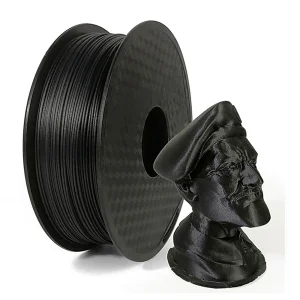
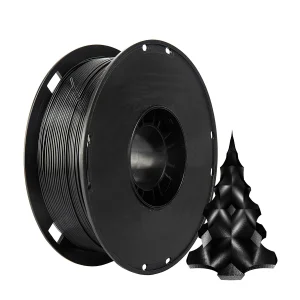
Polycarbonate (PC) is an amorphous engineering thermoplastic characterized by carbonate groups (–O–C(=O)–O–) linking bisphenol A chemical units. In its natural form, PC exhibits exceptional optical transparency and high impact strength. However, for industrial FDM applications, Black PC Filament represents the pinnacle of structural utility.
Achieving true jet-black pigmentation without compromising the mechanical integrity of the polymer chain requires sub-micron carbon black micro-dispersion. Premium Chinese PC filament factories utilize twin-screw compounding extruders to achieve uniform carbon distribution, preventing micro-agglomerations that typically introduce stress concentration points and brittle failure under mechanical loads.
Polycarbonate possesses a high glass transition temperature (Tg ≈ 147°C to 150°C), allowing printed components to retain structural rigidity in elevated thermal environments where standard PLA, PETG, and ABS deform. Black PC filament exhibits low thermal expansion coefficients when properly annealed, making it indispensable for automotive under-hood enclosures, electrical terminal housings, and functional aerospace tooling.
Because PC exhibits non-Newtonian shear-thinning viscoelastic behavior, melt flow index (MFI) control during raw pellet devolatilization and filament extrusion is crucial to guarantee smooth flow through 0.4mm and 0.6mm hardened steel nozzles without stringing or thermal degradation.
| Material Metric | Standard Black PC Filament | Carbon Fiber Reinforced PC | Standard ABS | Standard PETG |
|---|---|---|---|---|
| Tensile Strength (MPa) | 65 – 72 | 75 – 90 | 40 – 45 | 48 – 53 |
| Flexural Modulus (GPa) | 2.3 – 2.5 | 5.5 – 7.2 | 2.1 – 2.3 | 2.0 – 2.2 |
| Heat Deflection Temp (HDT @ 0.45 MPa) | 135°C – 140°C | 145°C – 150°C | 95°C – 98°C | 70°C – 75°C |
| Notched Izod Impact (kJ/m²) | 55 – 68 | 15 – 25 | 20 – 30 | 8 – 12 |
| Dielectric Strength (kV/mm) | 30 – 35 | 18 – 22 (Conductive) | 20 – 25 | 22 – 26 |
| Moisture Absorption (24h Saturation) | 0.20% | 0.25% | 0.30% | 0.15% |
Leveraging modern polymer extrusion infrastructure, economies of scale, and robust OEM/ODM private-label capabilities.
Leading Chinese PC filament suppliers deploy advanced quad-axis laser micrometers integrated directly into the water cooling bath puller lines. High-speed optical sensors capture 1,000 readings per second, adjusting melt pump screw speeds in real-time to maintain strict 1.75mm and 2.85mm diameter tolerances within ±0.02 mm, guaranteeing smooth extrusion without nozzle clogs or under-extrusion.
Polycarbonate is extremely hygroscopic. Water molecules absorbed at room temperature cause hydrolytic degradation during melt extrusion at 280°C–310°C, causing polymer chain scission, micro-void bubbles, and brittle prints. OEM factories utilize multi-stage desiccant dehumidifying dryers to lower resin moisture content below 0.02% prior to extrusion, followed by immediate inline vacuum sealing.
Scale your brand presence effortlessly. Certified wholesale suppliers offer complete private label production—including customized cardboard or polycarbonate spools, branded foil vacuum barrier bags, high-absorption silica gel desiccant packs, color-coded spool labels, and customized master carton packaging optimized for FBA or global warehouse drop-shipping.
Ensuring full compliance with international environmental standards, material safety mandates, and supply chain audit protocols.
Global distributors and enterprise buyers require full regulatory compliance documentation before releasing PC filament into competitive markets across North America, Europe, and Asia-Pacific. Partnering with top-tier Chinese manufacturers guarantees compliant supply lines:
To eliminate batch-to-batch variation, tier-1 wholesale factories execute a rigorous 5-step quality audit for every bulk production batch:
How high-speed printing, composite formulations, and eco-friendly polymer synthesis are transforming PC filament demand.
Next-generation FDM printers (CoreXY architectures) demand high volumetric flow rates ($>30\text{ mm}^3/\text{s}$). Polymer formulators are tailoring PC molecular weight distribution to maintain structural layer bonding at high linear print speeds.
Integrating 15% micro-carbon fibers or carbon nanotubes into Black PC matrix increases flexural modulus while dramatically dampening thermal shrinkage—enabling warp-free printing of large industrial parts.
Sustainability mandates are accelerating demand for certified recycled polycarbonate filaments. Advanced optical sorting and re-compounding deliver eco-conscious filaments with near-virgin mechanical performance.
Automated industrial print farms rely on custom spools fitted with RFID/NFC chips that pass optimal drying temperature, melt profile, and remaining material weight to automated printer ecosystems.
From automotive engineering to aerospace component prototyping, explore how enterprise clients utilize polycarbonate additive manufacturing.
Automotive tier-1 suppliers utilize Black PC filament for functional prototypes and short-run production parts exposed to elevated engine temperatures ($>120^\circ\text{C}$). Applications include custom air intake duct connectors, electrical junction box covers, and sensor mounting brackets that resist thermal warpage and oil splash.
With high dielectric strength and chemical resistance, Black PC is widely specified for custom server rack components, electrical transformer insulators, high-voltage battery module end-plates, and ruggedized hand-held terminal enclosures requiring UL94 compliance.
Manufacturing plants replace expensive CNC-machined aluminum fixtures with heavy-duty PC printed tooling. End-of-arm robotic grippers (EOAT), assembly alignment jigs, and drill guides benefit from PC's extreme impact energy absorption and high flexural yield strength.
Direct practical recommendations from polymer extrusion engineers to eliminate warping, layer delamination, and stringing.
Clear, authoritative answers to common inquiries from wholesale buyers, print farm managers, and OEM partners.
Our standard factory MOQ for stock wholesale filament spools starts at 100 kg per order. For custom OEM private label requests—including specialized spool colors, custom carton printing, or custom reel sizes (2.5kg, 5kg, 10kg spools)—the minimum order quantity is typically 500 kg per material formulation.
While ASA (Acrylonitrile Styrene Acrylate) offers superior resistance to long-term UV weathering and photo-oxidation color fading, Black PC Filament offers significantly higher tensile yield strength, impact resistance, and heat deflection temperatures (HDT ~138°C vs ASA ~95°C). The addition of sub-micron carbon black pigment in Black PC provides substantial UV shielding compared to natural clear PC resin.
Standard inventory includes 1.0 kg (2.2 lbs) spools in 1.75 mm and 2.85 mm diameters. For industrial print farms and enterprise customers, we supply large-format spools in 2.5 kg, 5.0 kg, and 10.0 kg configurations designed to reduce reel changeover frequency during continuous manufacturing cycles.
Every individual spool undergoes continuous desiccant drying prior to automated packaging. Spools are immediately heat-sealed inside thick multi-layer aluminum-laminated or vacuum barrier bags alongside high-capacity silica gel packs. Sealed spools are packed in reinforced corrugated inner boxes and double-wall master cartons capable of withstanding prolonged maritime humidity and transit vibration.
Yes. We offer specialized compounding options incorporating halogen-free flame retardant additives engineered to meet UL94 V-0 flame test standards (self-extinguishing within 10 seconds on vertical flame exposure without dripping). Complete technical data sheets (TDS) and safety data sheets (SDS) are provided upon request.
From engineering polycarbonate to high-durability TPU and decorative Silk PLA, source directly from our automated production lines.