Precision-extruded materials engineered for high structural rigidity, thermal stability, and seamless automated 3D printing workflows.
An authoritative technical breakdown for B2B buyers, printer OEM manufacturers, and industrial print farm operators seeking structural integrity.
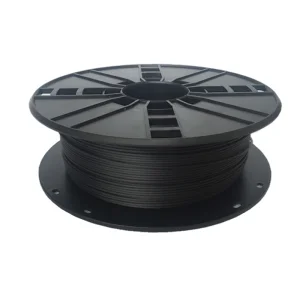
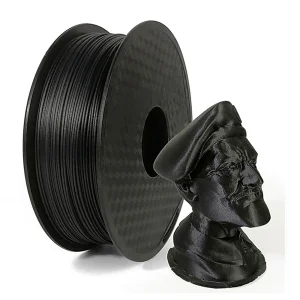
In standard Fused Deposition Modeling (FDM) / Fused Filament Fabrication (FFF), unreinforced polymers such as neat PLA, PETG, or PA experience non-uniform volumetric thermal shrinkage during cooling, resulting in micro-warping and dimensional inaccuracies. By compounding microscopic chopped carbon fibers (average fiber length: 100–300 μm, diameter: 7 μm) into thermoplastic matrices at optimized mass fractions (15% to 30%), carbon fiber filament transforms thermal and mechanical performance. The high aspect ratio of the embedded carbon fibers creates an internal mechanical skeleton, significantly restricting longitudinal polymer chain expansion and reducing isotropic shrinkage down to near-zero levels.
Empirical laboratory testing data comparing neat polymer bases versus high-modulus carbon fiber filled matrix variants:
| Material Formulation | Tensile Modulus (MPa) | Heat Deflection Temp (°C @ 0.45MPa) | Flexural Strength (MPa) | Z-Axis Interlayer Adhesion | Matte Finish Quality |
|---|---|---|---|---|---|
| Standard Neat PLA | 2,850 ± 120 | 55 °C | 68 ± 4 | High (Isotropic) | Glossy / Semi-Gloss |
| Torwell Carbon Fiber PLA (CF-PLA) | 4,920 ± 150 | 68 °C | 92 ± 5 | Optimized Thermal Bonding | Rich Satin Matte (Hides Layer Lines) |
| Standard Neat PETG | 2,100 ± 100 | 70 °C | 58 ± 3 | Very High | Transparent / High Gloss |
| Torwell Carbon Fiber PETG (CF-PETG) | 4,150 ± 140 | 88 °C | 81 ± 4 | Chemical Cross-Linked | Engineered Deep Matte |
| Industrial CF-Nylon (PA6/PA12-CF) | 6,800 ± 210 | 165 °C | 135 ± 8 | Anisotropic Shear Resistant | Textured Industrial Gray-Black |
Why global 3D printer manufacturers, factory print farms, and B2B distributors are shifting toward composite filaments.
Additive manufacturing is transitioning from aesthetic rapid prototyping to direct functional manufacturing. Automotive aftermarket parts, drone (UAV) airframes, robotic end-effectors, and custom assembly jigs require lightweight materials with high tensile strength-to-weight ratios that match aluminium alloy performance.
Modern CoreXY 3D printers achieve print velocities exceeding 500 mm/s and accelerations above 20,000 mm/s². High-speed print farms require composite filaments with ultra-stable melt flow index (MFI), immediate thermal stiffness upon deposition, and zero nozzle back-pressure clogging.
High-volume procurement teams are phasing out low-tier suppliers due to hidden failure costs: diameter variance inducing under-extrusion, layer delamination, and humidity degradation. Factories require guaranteed ±0.02 mm tolerance, pre-dried spools, and moisture-proof barrier packaging to maintain 99.8% printing yield rates.
How Torwell Technologies solves industrial extrusion challenges across our 2,500 m² modern manufacturing facility.
Every meter of Torwell Carbon Fiber Filament passes through high-frequency dual-axis laser diffraction gauges during melt extrusion. The system automatically adjusts pulling speed in real-time, locking diameter tolerance to strict ±0.02 mm and rejecting ovality drift before spooling.
Extruding carbon fiber filled resins causes extreme shear friction on standard machinery. Torwell utilizes specialized bimetallic hardened steel screws and tungsten-carbide lined extrusion dies engineered to prevent alloy contamination and guarantee zero carbon fiber micro-clumping.
Tangled spools cause print failure and extruder motor burnout in continuous 24/7 print farm operations. Our automated tension-controlled spooling systems layer the filament with precision pitch control, guaranteeing smooth unwinding even in multi-material automatic material systems (AMS).
Turnkey white-label solutions, global certification standards, and customized packaging options tailored for global procurement partners.
All raw resin polymers, carbon fiber reinforcement powders, and processing additives comply strictly with EU RoHS 2.0, REACH SVHC, and CE environmental safety regulations. Technical Data Sheets (TDS) and Safety Data Sheets (SDS) are provided for every batch.
Fully customized branding options: customized die-cut retail boxes, eco-friendly cardboard spools, high-barrier vacuum seal bags, custom Pantone-matched masterbatches, custom spool weights (250g, 500g, 1kg, 3kg, 5kg industrial reels), and RFID tag embedding.
With established containerized sea freight, air express, and DDP/DAP door-to-door delivery pathways across North America, Europe, the Middle East, and Southeast Asia, Torwell guarantees reliable lead times and customs compliance handling.
Torwell R&D is continuously pioneering advanced formulation technologies to meet the demands of aerospace, automotive, and industrial additive manufacturing.
Expanding the performance threshold into high-temperature ultra-polymers (PEEK-CF, PEKK-CF, PA66-CF) capable of resisting continuous working temperatures above 200 °C, replacing machined titanium and stainless steel parts.
Synthesizing multi-wall carbon nanotubes (MWCNT) and graphene nanoplatelets with chopped carbon fiber to unlock ESD (Electrostatic Discharge) safety properties, perfect for electronics housing and semiconductor handling.
Integrating recycled aerospace carbon fiber tow with bio-derived polymer matrices (such as high-Tg modified PLA base resins) to lower carbon footprint while maintaining high tensile modulus.
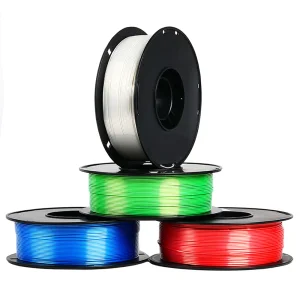
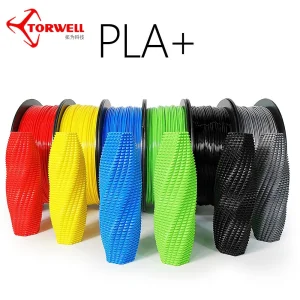
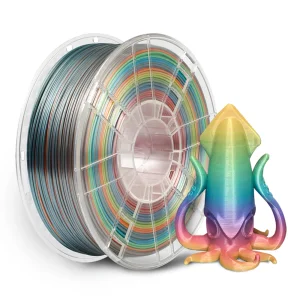
Discover our complete range of technical PLA+, flexible TPU, heat-resistant PETG-CF, and aesthetic silk 3D printer materials.
Clear, direct responses to critical questions regarding performance, nozzle requirements, OEM capabilities, and global logistics.