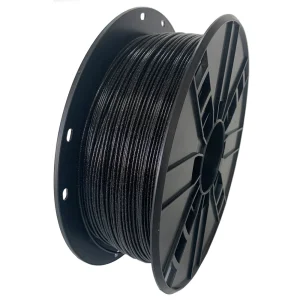
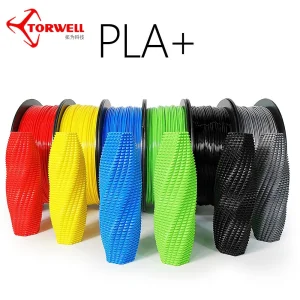
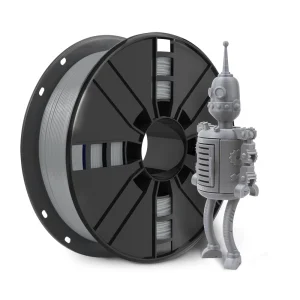
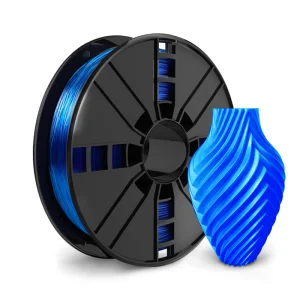
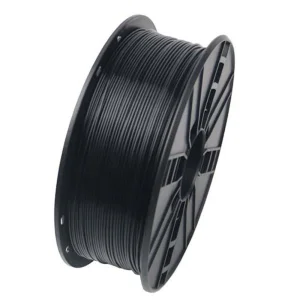
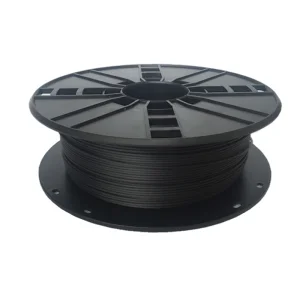
Direct factory supply of high-precision FDM/FFF 3D printing spools for global brands, enterprise print farms, and regional distributors.
Acrylonitrile Styrene Acrylate (ASA) represents a critical evolutionary leap over traditional Acrylonitrile Butadiene Styrene (ABS). While ABS utilizes a polybutadiene rubber phase that contains vulnerable carbon-carbon double bonds prone to solar ultraviolet (UV) degradation, Black ASA Filament replaces polybutadiene with a saturated acrylic ester rubber phase.
This structural difference renders ASA exceptionally resistant to solar radiation, photo-oxidation, atmospheric ozone, and environmental stress cracking. When compounders integrate high-purity, ultra-dispersed carbon black masterbatch (typically 1.0% to 1.5% mass concentration) into the SAN (Styrene-Acrylonitrile) matrix, the resulting polymer acts as a physical UV absorber and singlet oxygen quencher.
As an industry-leading manufacturer, Torwell controls polymer rheology to guarantee high thermal deflection temperatures (HDT up to 98°C at 0.45 MPa), low moisture absorption rates (< 0.2%), and consistent layer-to-layer weld strength during additive deposition.
Standardized comparative values tested under ISO 527 and ISO 179 lab conditions.
Achieving structural integrity and dimensional fidelity requires strict processing controls. Below are the manufacturer-tested parameters for enterprise extrusion.
| Physical / Mechanical Property | Test Standard | Metric Specification | Imperial Equivalent |
|---|---|---|---|
| Filament Diameter & Tolerance | Laser Gauge Dual-Axis | 1.75 mm / 2.85 mm (±0.02 mm) | 0.0689 in (±0.0007 in) |
| Density | ISO 1183 | 1.07 g/cm³ | 0.0386 lb/in³ |
| Melt Flow Rate (MFR 220°C / 10kg) | ISO 1133 | 12 – 16 g / 10 min | 12 – 16 g / 10 min |
| Glass Transition Temperature ($T_g$) | DSC (ISO 11357) | 105°C | 221°F |
| Flexural Modulus | ISO 178 | 2,300 MPa | 333,500 psi |
| Recommended Printing Nozzle Temp | Internal Quality Control | 240°C – 270°C | 464°F – 518°F |
| Heated Bed Temperature | Internal Quality Control | 90°C – 110°C | 194°F – 230°F |
| Enclosure / Chamber Temperature | Optimal Interlayer Bonding | 50°C – 75°C | 122°F – 167°F |
Black ASA exhibits moderate volumetric thermal contraction during crystallization. Utilizing a heated chamber (50°C+) and applying PEI sheets with specialized adhesive prevents edge curling on parts larger than 200mm.
Though ASA absorbs less water than Nylon or PETG, moisture levels exceeding 0.1% cause micro-foaming and stringing. We vacuum seal each spool with 15g active silica desiccant immediately post-extrusion.
Torwell's proprietary Black ASA formulation includes internal lubricant additives that maintain melt viscosity stability up to 300 mm/s print speeds on modern CoreXY industrial 3D printers.
Additive manufacturing is rapidly transitioning from rapid prototyping to direct digital manufacturing (DDM) of end-use functional components exposed to harsh environments.
In North America and Europe, regulatory mandates governing outdoor electronics enclosures (such as NEMA 4X and IP65/IP67 ratings) demand materials that retain impact strength under prolonged UV-B radiation exposure.
The Asia-Pacific region, led by China's advanced manufacturing clusters, serves as the primary supply engine for high-purity raw ASA resin compounding and precise filament extrusion.
Black ASA filament delivers uncompromising structural reliability across diverse industrial environments globally.
Used extensively for 3D printing custom side mirror housings, cowl grilles, roof rack end caps, and EV charger plug holsters. ASA maintains its deep black color and dimensional stability without fading or warping under continuous sun load up to 90°C.
Ideal for 5G micro-cell outer shell cases, solar panel junction box covers, and environmental monitoring sensor pods. ASA's natural RF transparency prevents signal attenuation while providing IP66-grade environmental sealing when combined with rubber gaskets.
Unlike metals susceptible to galvanic corrosion or polymers prone to hydrolytic cleavage, Black ASA filament resists marine environments, ocean salt fog, chemical runoff, and biological bio-fouling on commercial watercraft and navigation buoys.
Agricultural spraying drones and autonomous field robots require components that endure intense solar radiation and exposure to corrosive fertilizers. ASA custom spray nozzle brackets and battery latches provide high tensile strength and chemical inertness.
As industrial additive manufacturing speeds increase and environmental regulations tighten, polymer compounding must continuously evolve.
Integration of 15% chopped high-modulus carbon fibers into the ASA matrix to elevate HDT above 115°C while virtually eliminating thermal expansion ($\text{CTE} < 2.5 \times 10^{-5}/\text{K}$).
Development of halogen-free flame-retardant ASA formulations capable of self-extinguishing within 10 seconds, satisfying stringent aerospace (FAR 25.853) and railway (EN 45545-2) standards.
Pioneering post-industrial recycled ASA (rASA) streams paired with bio-attributed monomer synthesis to achieve a 45% reduction in carbon footprint without compromising tensile performance.
Torwell Technologies operates a state-of-the-art 2,500 m² standardized production facility, utilizing automated closed-loop extrusion machinery engineered for 24/7 continuous operation.
By locating our manufacturing operations within China's primary chemical and logistics corridor, we secure direct access to top-tier virgin ASA copolymer resin synthesis. This direct integration removes multiple middleman markups, enabling us to deliver premium-grade Black ASA filament at competitive factory-direct wholesale pricing.
We offer turnkey OEM solutions tailored for enterprise 3D printer manufacturers, chemical distributors, and e-commerce brand owners:
Navigating international chemical standards and import regulations is essential for enterprise procurement security.
Torwell Black ASA filament is rigorously tested to ensure full compliance with EU REACH Regulation (EC) No 1907/2006 and RoHS 3 Directive 2015/863/EU. Free from SVHCs (Substances of Very High Concern), heavy metals, phthalates, and brominated flame retardants.
Every bulk shipment includes complete Safety Data Sheets (SDS/MSDS) compliant with GHS standards, alongside comprehensive Technical Data Sheets (TDS) detailing mechanical testing according to ISO and ASTM international standards.
Our dedicated export team manages global shipping logistics, customs documentation, and HS Code classification (HS 3916.90.90) to streamline tariff calculations and expedite clearance through North American, European, and Asia-Pacific ports.
In-depth technical answers addressing common enterprise procurement, processing, storage, and application inquiries.
Standard ABS contains a polybutadiene rubber phase that undergoes rapid chemical degradation (photo-oxidation) when exposed to solar UV radiation, resulting in yellowing, surface chalking, micro-cracking, and severe loss of impact strength within 6 to 12 months.
In contrast, ASA replaces polybutadiene with an acrylate elastomer matrix containing saturated polymer chains. When combined with carbon black UV absorbers, Black ASA maintains structural integrity, tensile yield strength, and deep matte color aesthetic even after 10+ years of continuous outdoor exposure.
To minimize internal thermal stresses and warpage during large-scale FDM deposition of Black ASA:
ASA is mildly hygroscopic. If exposed to ambient humidity (> 40% RH) for extended periods, moisture trapped in the filament vaporizes inside the hotend, causing stringing, pops, and weak layer adhesion.
We recommend drying Black ASA spools in a dedicated blast-drying oven or active filament dryer at 70°C – 80°C for 4 to 6 hours prior to printing. For continuous industrial printing, feed the filament directly from a sealed dry box maintained below 15% RH.
For standard Torwell-branded spools, MOQ starts at 50 kg per specification. For custom OEM private label projects (including custom-printed cartons, branded spool labels, and specific color matching), the standard MOQ is 300 kg to 500 kg per batch.
Lead time for standard catalog inventory is 3 to 7 working days. Custom OEM production runs typically require 10 to 15 working days from artwork approval and sample verification.
During hotend processing (240°C – 270°C), ASA emits trace styrene gas VOCs. Therefore, 3D printers processing ASA should operate within well-ventilated spaces or utilize active HEPA and activated carbon air filtration systems.
While ASA resin itself is non-toxic and inert post-solidification, FDM printed parts feature microscopic layer crevices that can trap bacteria. Consequently, raw ASA prints without secondary food-grade resin sealing are not recommended for direct food contact.
Yes. In addition to standard retail 1 kg (2.2 lbs) spools, Torwell manufactures high-capacity industrial master spools including 2.5 kg, 3 kg, 5 kg, and 10 kg sizes designed for long-format continuous industrial production runs. We also support eco-friendly cardboard spools compatible with modern automatic material feed stations.
Discover our broad selection of engineering, flexible, decorative, and reinforced 3D printing filaments manufactured in our factory.