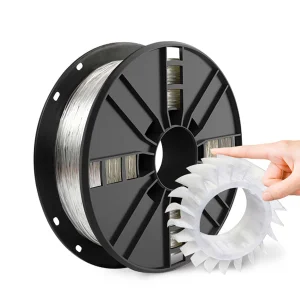
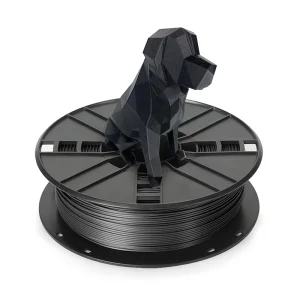
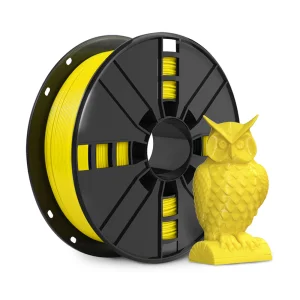
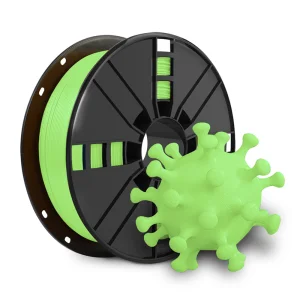
Explore our flagship OEM products manufactured under strict ISO 9001 quality controls with laser diameter monitoring.
Analyzing the rapid adoption of Acrylonitrile Styrene Acrylate in additive manufacturing across North America, Europe, and the Asia-Pacific region.
The global market for additive manufacturing thermoplastics has undergone a decisive structural shift. While entry-level polylactic acid (PLA) continues to lead consumer desktop 3D printing by sheer volume, industrial original equipment manufacturers (OEMs), engineering design firms, and commercial print farms are increasingly shifting toward engineering-grade polymers. Among these, ASA (Acrylonitrile Styrene Acrylate) filament in 1.75mm diameter White has established itself as the undisputed benchmark for functional outdoor parts, structural enclosures, automotive components, and public infrastructure fittings.
Chemically formulated as a terpolymer of acrylic rubber, styrene, and acrylonitrile, ASA was engineered specifically to overcome the fundamental chemical flaw of ABS (Acrylonitrile Butadiene Styrene): photolytic degradation caused by ultraviolet (UV) radiation. The butadiene phase in ABS contains unsaturated double bonds that rapidly oxidize, yellow, and embrittle under sunlight. ASA replaces butadiene with a synthetic acrylic ester rubber matrix, granting the polymer virtually permanent UV stability, high weatherability, and exceptional thermal resistance without compromising impact toughness.
Tier-1 automotive suppliers use 1.75 White ASA for rapid prototyping and end-use exterior components like mirror housings, side trim, sensor brackets, and roof rack fittings, avoiding costly injection tooling.
Deployment of 5G micro-cells, smart energy meters, and IoT environmental monitors requires RF-transparent, weather-proof enclosures. White ASA reflects solar radiation to prevent internal electronics overheating.
Standard white pigments in lower-tier thermoplastics suffer severe chalking in saltwater environments. Industrial-grade ASA white resists salt spray corrosion, acid rain, and ambient thermal cycling from -40°C to 95°C.
Understanding pigment loading, titanium dioxide ($\text{TiO}_2$) crystallization, and diameter dimensional consistency during precision extrusion.
Producing wholesale-grade ASA 1.75 White filament demands far more than mixing raw polymer pellets with generic color batch concentrates. High-brightness white ASA requires precise loading of high-purity Rutile Titanium Dioxide ($\text{TiO}_2$). Rutile $\text{TiO}_2$ possesses a high refractive index ($n = 2.73$), providing maximum optical opacity and solar reflectance while screening underlying polymer chains from photo-oxidation.
However, excessive or un-dispersed pigment agglomerates act as mechanical stress concentrators, degrading inter-layer adhesion (z-bond strength) and clogging 0.4mm nozzle orifices during extended high-speed print jobs. Leading manufacturers like **Torwell Technologies** utilize specialized twin-screw co-rotating compounding extruders to achieve microscopic dispersion of $\text{TiO}_2$ particles within the acrylic-styrene-acrylonitrile matrix, ensuring high impact resistance ($>20\text{ kJ/m}^2$ Izod notched) and flawless surface finishing.
| Performance Characteristic | White ASA 1.75mm | White ABS | White PETG | White PLA |
|---|---|---|---|---|
| UV & Weathering Resistance | Exceptional (ISO 4892 Tested) | Poor (Yellows/Chalks) | Moderate | Poor (Degrades) |
| Heat Deflection Temp (HDT @ 0.45MPa) | 95°C – 102°C | 94°C – 98°C | 68°C – 72°C | 52°C – 55°C |
| Tensile Strength (ISO 527) | 45 – 52 MPa | 40 – 48 MPa | 48 – 53 MPa | 55 – 65 MPa |
| Solar Heat Build-Up Resistance | Maximum (High Reflectance) | Low (Absorbs/Warp) | Moderate | Very Low (Melts in Sun) |
| Chemical Resistance | Alcohols, Dilute Acids, Salt | Weak to Solvents | Good Acids/Alkalis | Poor Chemicals |
| Diameter Tolerance Control | ±0.02 mm Inline Laser | ±0.03 mm | ±0.02 mm | ±0.03 mm |
How global industries deploy 1.75mm White ASA in harsh environmental conditions to replace traditional metal fabrication.
Automotive designers utilize 1.75 White ASA to 3D print customized roof scoops, camper van exterior port covers, agricultural vehicle lamp bezels, and electric vehicle charging port doors. The matte bright white finish can be painted directly or left untreated without risk of UV yellowing under intense desert sunlight.
Environmental sensors deployed on remote weather stations, solar array monitoring units, and agricultural irrigation controllers require materials that will not degrade under decades of sun exposure. White ASA 1.75 maintains structural integrity and keeps internal temperatures lower by reflecting infrared radiation.
Marine environments represent one of the most aggressive testing grounds for industrial polymers. White ASA withstands continuous exposure to marine salt spray, high humidity, UV reflection from water surfaces, and sea wind friction without micro-cracking or loss of tensile strength.
Because ASA shares a similar thermal shrinkage coefficient with ABS (~0.4% to 0.7%), precise processing controls are mandatory during printing. For wholesale print farms running high-speed CoreXY machines (Bambu Lab, Voron, Creality K1), we recommend a heated bed temperature of 90°C–110°C, an enclosed chamber temperature of 50°C–60°C, and smooth PEI or textured PEI build surfaces treated with specialized adhesion primers.
Empowering global 3D printing brands with custom spooling, private label packaging, and continuous batch repeatability.
Founded in 2011, **Torwell Technologies Co., Ltd.** stands as one of China's pioneer manufacturers dedicated to high-precision 3D printer filament extrusion. Operating out of a standardized **2,500 m² modern factory** equipped with **6 fully automated extrusion production lines**, Torwell maintains a monthly output of **50,000 to 60,000 kg**, exporting premium grade filaments to over **75 countries and regions** worldwide.
Every spool of 1.75 White ASA is continuously measured during extrusion using high-frequency dual-axis laser closed-loop feedback systems. Target diameter tolerances are locked at strictly ±0.02 mm with ovality under 1%.
Tangled filament leads to catastrophic nozzle starvation during 50-hour industrial prints. Torwell utilizes automated tension-controlled spooling to guarantee layer-by-layer neat winding compatible with automatic material systems (AMS).
ASA is hygroscopic and absorbs ambient humidity during transit. Torwell enforces pre-extrusion resin drying down to <0.05% moisture content, followed immediately by high-vacuum heat-sealing with active silica desiccant packs inside sturdy export cartons.
Next-generation formulations: High-Speed ASA, Bio-based ASA, and Flame-Retardant UL94 V-0 Grade White Filaments.
As the 3D printing industry transitions toward print speeds exceeding 500 mm/s (enabled by input shaping algorithms and high-volumetric flow hotends), polymer suppliers must re-engineer ASA filament formulations. Torwell’s R&D laboratory is currently pioneering three critical technological advancements in 1.75 White ASA extrusion:
Answers to technical, operational, and commercial sourcing inquiries for wholesale White ASA 1.75mm filament.
ABS contains a polybutadiene rubber phase with unsaturated double carbon bonds that rapidly degrade under UV radiation, causing yellowing, surface cracking, and embrittlement within months of outdoor exposure. ASA replaces butadiene with an acrylic ester rubber, offering superior weatherability, long-term optical white retention, and chemical resistance against environmental pollutants.
Optimal nozzle printing temperatures range between 240°C and 260°C. Heated bed temperature should be set between 90°C and 110°C, with cooling fans turned OFF or kept at a low speed (10–20%) to prevent layer delamination. Printing inside an enclosed chamber at 50°C–60°C is highly recommended for large-scale structural models.
Yes. Torwell Technologies provides complete OEM/ODM solutions, including custom Pantone color matching, private label spool branding, customized retail packaging boxes, branded sticker labels, and vacuum bag customization with low Minimum Order Quantities (MOQs) tailored for global distributors.
Our 6 production lines are integrated with continuous dual-axis laser micrometer gauges that scan the filament strand at high frequency. If the diameter strays beyond ±0.02 mm or detects ovality errors, the closed-loop system automatically adjusts extruder motor speeds or flags the section for automatic truncation.
Prior to spooling, raw resin pellets are thoroughly dehydrated in vacuum desiccant dryers. After precise winding, each spool is heat-sealed under vacuum with a fresh active desiccant packet inside a moisture-barrier bag, ensuring intact delivery during ocean transit spanning 30 to 45 days.
Yes. White ASA can be sanded easily with wet sandpaper and chemically smoothed using acetone vapor baths in a controlled environment to eliminate layer lines, yielding a glass-like glossy white surface finish ideal for end-use industrial display models.
Comprehensive additive manufacturing material solutions engineered for high performance, strength, and aesthetic appeal.
Contact our sales team today to request technical data sheets (TDS), safety data sheets (SDS), sample spools, or factory-direct price quotes.
Contact Torwell Technologies Export Team