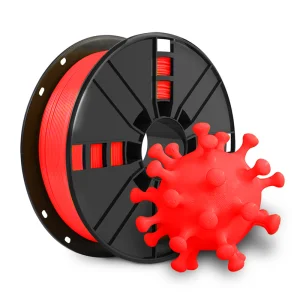
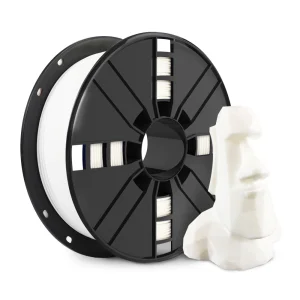
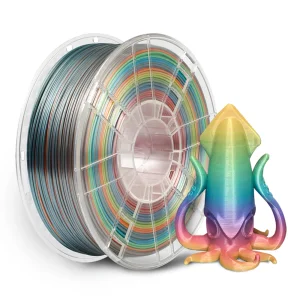
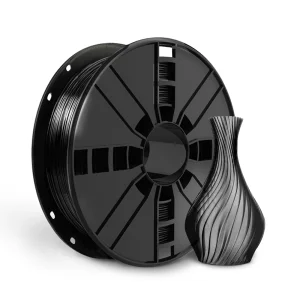
Explore our wholesale portfolio of precision 3D printer filaments, engineered for high print consistency, low degradation, and optimal mechanical bond strength.
Understanding the transition of Thermoplastic Polyurethane from low-volume rapid prototyping to mission-critical industrial manufacturing.
Thermoplastic Polyurethane (TPU) represents a unique class of linear block copolymers consisting of alternating hard segments (diisocyanates and short-chain diols) and soft segments (polyester or polyether polyols). This domain-separated microstructure yields exceptional mechanical flexibility, strain recovery, and impact dissipation impossible with rigid thermoplastics.
Polyester-based TPU delivers superior resistance to oils, greases, and physical abrasion, making it ideal for automotive seals and industrial drive belts. Conversely, Polyether-based TPU offers outstanding hydrolytic stability, fungal resistance, and low-temperature flexibility, making it the material of choice for medical orthotics, footwear midsoles, and marine wearables.
The global demand for elastomeric 3D printing filaments is growing at a compound annual growth rate (CAGR) exceeding 18.4%. Driving factors include the rapid adoption of high-speed FDM/FFF desktop print farms, customized orthopedic orthoses production, soft robotics end-effectors, and drone bumper armor systems across Western and Asian industrial sectors.
Technical Insight: Selecting the correct TPU shore hardness (ranging from ultra-soft 80A/85A to print-friendly 95A and semi-rigid 98A/55D) is the defining factor in balancing extrusion reliability against final part elasticity. China TPU manufacturers have optimized lower-friction surface formulations to eliminate gear binding in high-speed extrusion systems.
Overcoming viscoelastic buckling, moisture degradation, and batch-to-batch variation through advanced chemical synthesis and precision process automation.
Flexible materials naturally present melt-flow instabilities during Fused Filament Fabrication (FFF). When pushed through an extruder gear drive, low-durometer TPU acts like a flexible spring. Without precise constraint, the filament buckles inside the drive path, causing immediate jam conditions—especially in Bowden tube setups.
Torwell’s material engineering team mitigates this by modifying the melt volume index (MVI) and incorporating subtle slip additives into the raw resin compound. This creates a surface coefficient of friction that glides seamlessly through PTFE PTFE liners while maintaining exceptional inter-layer polymer diffusion upon deposition.
Our automated extrusion lines utilize continuous 1000Hz dual-axis laser micrometers. Diameter variances above ±0.02mm automatically trigger high-speed haul-off speed adjustments, preventing ovality and ensuring consistent volume deposition per step-motor pulse.
TPU polymers possess polar urethane linkages that render them inherently hygroscopic. Exposed ambient moisture degrades polyols during extrusion, producing steam micro-bubbles, severe stringing, and up to 40% reduction in tensile layer adhesion.
To eliminate moisture-induced hydrolytic cleavage, Torwell enforces a strict 5-stage moisture control protocol:
Widespread adoption of Shore 95A TPU as the industry standard for direct-drive FDM printers, offering high resilience but requiring slow print speeds (20–30 mm/s).
Development of rapid-solidification TPU chemistries optimized for next-generation CoreXY high-speed 3D printers (Bambu Lab, Creality K1, Voron), dramatically raising print farm productivity.
Integration of renewable polyols sourced from castor oil for carbon-neutral TPU production, alongside carbon-nanotube (CNT) doped conductive flexible filaments for embedded smart sensor additive manufacturing.
Why Tier-1 3D printing brands, global distributors, and enterprise print farms partner with Chinese factory infrastructure.
China hosts the world's dense chemical industrial clusters for MDI (Methylene diphenyl diisocyanate), BDO (1,4-Butanediol), and PTMEG polyols (Wanhua Chemical, Covestro Asian hubs). Direct raw material pipeline access ensures uncompromised resin purity, immunity to global supply bottlenecks, and unmatched cost-to-performance ratios.
Operating a 2,500 m² standardized manufacturing facility equipped with 6 automated extrusion lines, Torwell maintains a monthly output of 50,000 to 60,000 kg. This scale enables rapid containerized fulfillment (20ft/40ft HQ), steady stock availability, and predictable 12-to-15 day production lead times.
From custom Pantone/RAL color matching to private label spooling (recycled cardboard spools vs high-clarity polycarbonate spools), customized box printing, customized label barcoding, and SDS/TDS document preparation, China’s manufacturing ecosystem provides end-to-end turn-key brand building.
Real-world implementations across automotive prototyping, custom orthotics, robotics, and consumer electronics.
Custom 3D-printed orthopedic insoles utilize variable infill density mapping (gyroid or honey-comb lattice structures) to deliver localized arch support. Polyether TPU 85A/95A provides necessary flexural energy return, skin-safe inertness, and long-term dynamic fatigue resistance without flattening under mechanical cyclic stress.
Automotive engine compartments and chassis require flexible boots, wiring harness grommets, and dust covers capable of resisting oil splash and thermal cycling (-20°C to +80°C). Polyester TPU 95A filament allows rapid direct fabrication of short-run replacement gaskets, bypassing expensive injection mold tooling.
Pneumatic soft robotic grippers demand soft, airtight elastomeric walls that expand under pressure to hold delicate objects (fruit sorting, glass handling). TPU 85A filament delivers high tear strength and zero porosity when printed at optimized extrusion multiplier settings.
FPV drone racing frames and handheld field electronics rely on 3D-printed TPU camera mounts, antenna holders, and shock-absorbing corner bumpers. The material absorbs high-velocity impact energy, protecting fragile carbon fiber frames and micro-electronics during high-impact collisions.
A quick reference engineered for B2B buyers, distributors, and print farm operators to plan balanced product portfolios across entry-level and engineering polymers.
| Material Grade | Nozzle Temp | Bed Temp | Key Performance Attribute | Typical Application Field | Target Channel |
|---|---|---|---|---|---|
| PLA Filament | 190–220 °C | 0–60 °C | Low warp, rigid, low odor, easy print | Prototyping, educational models, display figures | Retail, E-commerce, Schools |
| PLA+ Filament | 200–230 °C | 50–60 °C | 3x higher impact resistance than standard PLA | Functional prototypes, jigs & fixtures | Prosumers, Makers, Print Farms |
| Silk PLA Filament | 200–230 °C | 50–60 °C | High metallic sheen, dual/tri-color options | Cosplay accessories, decorative art, giftware | Hobbyists, Gift Channels |
| PETG Filament | 230–250 °C | 70–80 °C | High toughness, chemical & water resistance | Enclosures, fluid containers, outdoor brackets | Print Farms, Engineers |
| TPU & TPE Flexible | 210–230 °C | 30–60 °C | Shore 95A flexibility, wear & impact damping | Gaskets, footwear, phone bumpers, drone parts | Industrial & Consumer |
| ABS Filament | 230–260 °C | 90–110 °C | High heat deflection, tough impact strength | Automotive interior trim, electron housings | Industrial Users |
| ASA Filament | 240–260 °C | 90–110 °C | UV stable, weather resistant, non-yellowing | Outdoor fixtures, marine trim, exterior signage | Outdoor Industrial |
| PC Filament | 260–300 °C | 100–120 °C | Extreme tensile strength & heat resistance | Engineering mechanical parts, structural covers | Technical Engineers |
| Carbon Fiber Filament | Base-dependent | Base-dependent | High stiffness-to-weight ratio, matte finish | Drone arms, RC racing parts, lightweight tooling | Advanced Engineering |
| 3D Pen & Filament | 160–190 °C | N/A | Kid-safe low melt temp options (PCL/PLA) | Education, 3D drawing, creative crafting | Toy Retailers, Education |
| Rainbow & Specialty | 190–220 °C | 50–60 °C | Glow-in-the-dark, marble, wood, thermochromic | Novelty prints, aesthetic designs, fashion | E-commerce, Retail |
Virgin polymer resin pellets are thoroughly dried to controlled moisture levels before extrusion, preventing micro-bubbles, foaming, and poor layer fusion.
Multi-zone temperature profiled screws and precision melt pumps maintain stable melt pressure, producing void-free filament strands.
Continuous dual-axis laser monitors measure filament diameter at 1000Hz, ensuring target ±0.02mm tolerances and flagging ovality automatically.
Neat, layer-by-layer winding eliminates crisscross tangles, ensuring flawless, smooth feeding in AMS multi-material print systems.
Spools are dried, tagged with individual batch tracking numbers, sealed with active silica desiccant, and carton-shielded for worldwide sea/air freight.
Expert answers regarding TPU printing profiles, factory specifications, MOQs, export logistics, and technical troubleshooting.
Yes. We fully support OEM and ODM custom manufacturing. This includes Pantone/RAL custom color matching, private label spool branding (custom sticker labels, laser engraving), customized inner cardboard packaging, branded vacuum bags, and customized spool weights (from 250g, 500g, 1kg up to 3kg/5kg industrial spools). Technical Data Sheets (TDS) and Safety Data Sheets (SDS) are provided for compliance in your destination market.
Standard 1.75mm and 2.85mm filaments are extruded with a strict target diameter tolerance of ±0.02 mm. Our extrusion lines integrate closed-loop dual-axis laser gauge feedback systems that continuously measure strand dimensions and automatically reject out-of-spec sections before spooling.
For standard TPU 95A, we recommend a nozzle temperature of 210°C–230°C, a heated bed temperature of 30°C–60°C (or unheated with PEI/PVP glue), and print speeds of 30–60 mm/s for traditional direct-drive extruders. For specialized High-Speed TPU formulations, print speeds up to 150–200 mm/s can be achieved on modern CoreXY machines with retract settings kept short (<1mm at 20mm/s).
Following precision extrusion and online drying, filaments are immediately sealed in heavy-duty vacuum bags containing active silica gel desiccant packs. Outer corrugated cartons protect individual spools against moisture penetration, puncture, and UV exposure during sea and air freight.
Our 2,500 m² factory operates 6 continuous automated production lines alongside an in-house quality control testing lab, yielding an approximate monthly output of 50,000 to 60,000 kg. We regularly export container load orders to distributors, OEM brands, and print farms across 75+ countries in North America, Europe, South America, the Middle East, and Asia.
While Direct Drive extruders are ideal for flexible materials, TPU 95A can be successfully printed on Bowden tube systems provided the tube path is tightly constrained, retracts are disabled or minimalized, and speed is restricted to 20–30 mm/s to prevent filament bending inside the PTFE tube.
Supplying globally certified materials with batch consistency, pristine surface finishes, and export-ready packaging.