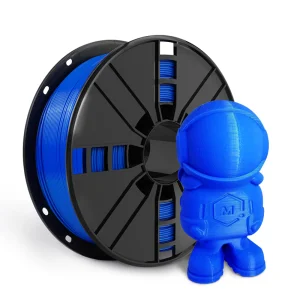
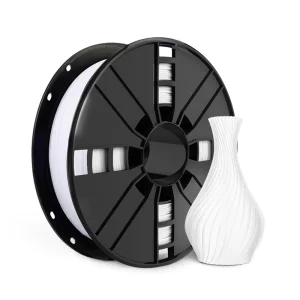
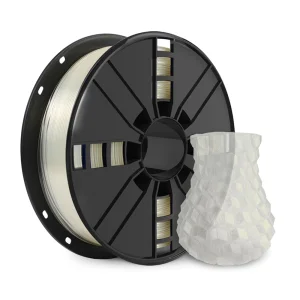
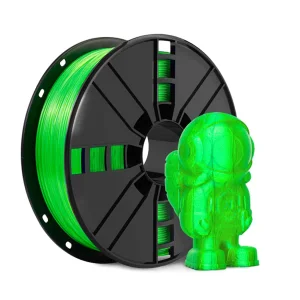
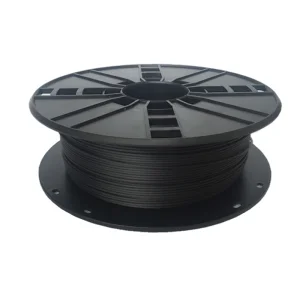
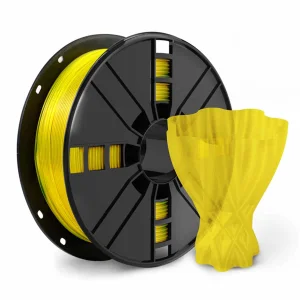
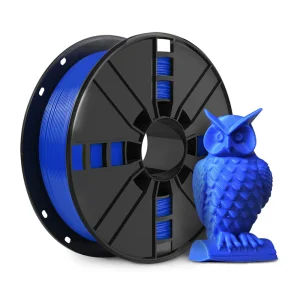
Explore our top-tier engineering polymers and flexible thermoplastic filaments manufactured under automated laser diameter gauge verification.
Analyzing global manufacturing trajectories, polymer formulation breakthroughs, and supply chain consolidations driving rubber 3D printer filament adoption across tier-1 industries.
Historically limited to visual mock-ups, elastomeric 3D printing filaments—specifically modified Thermoplastic Polyurethane (TPU), Thermoplastic Vulcanizates (TPV), and Thermoplastic Elastomers (TPE)—are now directly integrated into end-use production lines. Modern additive manufacturing requires rubber filaments with precise viscoelasticity, minimal compression set under sustained load, and high resistance to dynamic flex fatigue.
The rapid market proliferation of high-acceleration FDM/FFF printers operating at speeds exceeding 250–500 mm/s has created a strong industrial demand for high-flow flexible rubber filaments. Legacy soft filaments frequently buckle in high-speed extruders; next-generation rubber filaments engineered by Torwell utilize optimized melt rheology and friction-reducing surface treatments to maintain ultra-smooth extrusion at elevated volume speeds.
China has consolidated its position as the premier international manufacturing hub for rubber 3D printer filaments due to unmatched vertical integration across raw chemical synthesis, masterbatch coloring, and specialized extrusion machinery. B2B procurement leaders leverage direct China factory partnerships to secure custom Shore hardness grades (from ultra-soft 60A to rigid 95A) with significant cost efficiencies.
Unlike thermoset vulcanized rubber, which cannot be remelted due to covalent cross-linking, Thermoplastic Rubber 3D Printer Filaments (TPE/TPU) rely on physical cross-links of block copolymers. This allows for repeated thermal processing through standard FDM 3D printer nozzles while maintaining elastomeric memory, high tear strength (>120 N/mm), and elongation percentages often exceeding 600%. Torwell's proprietary compounding fine-tunes these physical block structures to prevent nozzle clogging and thermal degradation during long-duration print runs.
Selecting the appropriate elastomeric grade requires rigorous evaluation of Shore hardness, tensile modulus, printability metrics, and environmental chemical resilience.
| Elastomer Class | Shore Hardness | Tensile Strength (MPa) | Elongation at Break (%) | Extrusion Temp. (°C) | Extruder Type Compatibility | Primary Industrial Use Case |
|---|---|---|---|---|---|---|
| Ultra-Soft TPE Rubber | 60A – 70A | 12.5 – 18.0 | > 750% | 210 – 230 °C | Direct Drive (Short Path, Low Friction) | Medical dampening, soft tactile grips, anatomical simulation models |
| Medium Flexible TPE/TPU | 80A – 85A | 25.0 – 32.0 | > 650% | 220 – 240 °C | Direct Drive (Standard Speed) | Custom footwear soles, robotic vacuum seals, vibration isolators |
| Standard Industrial TPU | 95A | 42.0 – 55.0 | > 500% | 225 – 245 °C | Direct Drive & Optimized Bowden Systems | Automotive protective boots, industrial drive belts, protective phone cases |
| High-Rebound TPV Rubber | 88A – 92A | 20.0 – 28.0 | > 480% | 230 – 250 °C | Direct Drive High Speed | Chemical gaskets, weather-stripping seals, outdoor UV-exposed components |
| Carbon-Reinforced TPU | 55D / 98A | 60.0 – 78.0 | > 180% | 240 – 260 °C | Hardened Nozzle (Direct Drive) | ESD-safe electronics housing, lightweight drone bumpers, structural mounts |
Extruding flexible rubber filament requires ultra-tight control over the polymer melt index (MFI). If viscosity drops too severely at processing temperatures, stringing and oozing occur; if viscosity remains too high, backpressure builds inside the heatbreak, resulting in gear grinding and buckling. Torwell formulates rubber materials with a targeted shear-thinning response: decreasing viscosity under shear forces inside the nozzle tip while rapidly recovering structural body immediately upon deposition to preserve crisp overhangs and detailed layer geometry.
Thermoplastic elastomers contain polar urethane or ester bonds that naturally attract ambient moisture molecules. Absorbed water volatilizes into steam inside the high-temperature melting zone, creating micro-voids, bubbling, loud popping sounds, and severe layer delamination. Torwell applies a 4-hour continuous dehumidification process (< 0.02% water content moisture limit) prior to precision automated winding and immediate vacuum packaging with industrial silica desiccant packets.
Founded in 2011, Torwell Technologies Co., Ltd. operates a standardized 2,500 m² factory equipped with 6 automated extrusion lines, providing high-consistency supply to brands across 75+ countries.
Every single millimeter of rubber printer filament manufactured in our China facility passes through continuous high-frequency laser micrometers. Dimensional deviation, ovality, and diameter fluctuations beyond ±0.02 mm trigger immediate automated line rejection, ensuring absolute feeding consistency in customer 3D printers.
Soft rubber filaments are notoriously prone to overlap tangling during high-speed spool winding. Torwell utilizes fully automated servo-driven winding equipment that maintains steady linear tension, resulting in neat parallel spooled layers compatible with multi-material systems (AMS) and direct drive feed paths.
Each raw material batch undergoes extensive quality control checks: Melt Flow Index (MFI) verification, Shore hardness durometer testing, thermal gravimetric analysis (TGA), tensiometer pull tests, and mandatory 24-hour test printing across multiple commercial FDM printer brands before shipment authorization.
Discover how custom elastomeric formulations empower diverse engineering sectors to bypass expensive injection mold tooling and rapidly deploy durable flexible components.
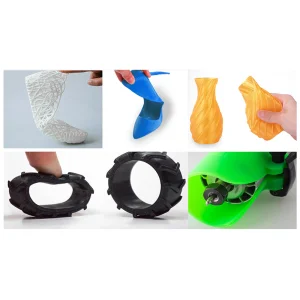
Direct printing of custom intake dampeners, dust boots, wiring harness grommets, vibration-isolation bushings, and flexible weather seals capable of withstanding oil exposure and temperature cycles from -40°C to 110°C.
Skin-safe (ISO 10993 compliant) patient-specific orthotic insoles, prosthetic socket cushioning liners, flexible surgical training models, and ergonomic medical instrument grips with high sterilizability.
Pneumatic soft-robotic grippers, compliant suction cups, high-friction conveyor belts, and custom protective shock-absorbing bumpers for automated manufacturing assembly cells.
Rapid additive manufacturing of customized shoe midsoles, wearable watch bands, high-impact protective phone armor, dynamic sport equipment grips, and noise-damping feet for home electronics.
Torwell Technologies acts as an extension of your enterprise brand, delivering fully customized private label filament spools backed by strict global regulatory documentation.
All raw elastomer formulations and color pigments strictly conform to EU RoHS 2.0 (Directive 2011/65/EU) and REACH SVHC regulations. Select food-contact and skin-contact grades are formulated to comply with FDA 21 CFR standards, with complete Safety Data Sheets (SDS) and Technical Data Sheets (TDS) supplied for rapid customs clearance.
Our chemical laboratory provides precise Pantone color matching and custom durometer tuning (e.g., matching a client's specific 75A rubber sample). Private label clients can specify custom spool weights (250g, 500g, 1kg, 3kg, 5kg industrial reels) and choose between recyclable cardboard spools or high-durability plastic spools.
With customers across 75+ countries, our packaging is engineered for transoceanic freight. Spools are vacuum-sealed with heavy-duty moisture barrier film, enclosed in individual corrugated inner boxes, and packed into reinforced master cartons (12 or 24 spools/carton) optimized for ocean container loading densities.
Torwell Technologies continuously reinvests in polymer R&D to unlock next-generation functionality in flexible and elastomeric 3D printing consumables.
Incorporating specialized conductive carbon black and multi-walled carbon nanotubes (MWCNTs) into rubber matrices allows for direct 3D printing of flexible strain sensors, embedded soft circuitry, and haptic feedback devices without secondary assembly steps.
Engineering eco-friendly flexible polymers formulated from plant-derived monomer feedstocks (up to 45% bio-based content) and establishing fully circular TPE recycling loops that allow printed industrial scraps to be re-granulated into premium extrusion line feedstock.
Developing self-healing elastomeric networks capable of repairing micro-cracks at elevated ambient temperatures, alongside UL94 V-0 certified flame-retardant flexible filaments tailored specifically for aerospace and high-voltage electric vehicle (EV) battery enclosures.
Complete portfolio options available for private label customization, international distribution, and direct factory procurement.
Expert responses regarding hardware setup, polymer rheology, OEM branding workflows, and international supply chain management.
Soft rubber 3D printer filaments require a fully constrained, short-path Direct Drive Extruder. The gap between the drive gears and the entrance of the heatbreak melt zone must be minimal (ideally < 1.0 mm) to prevent the flexible filament strand from buckling sideways under gear pressure. Dual-drive stainless steel or hardened steel gears with adjustable tension arms are recommended, alongside PTFE-lined hotends for lower internal friction during slow-speed extrusion (15–30 mm/s for 60A–70A; up to 60–100 mm/s for 95A TPU).
Our 2,500 m² factory employs automated extrusion lines equipped with inline closed-loop dual-axis laser micrometers. These sensors continuously scan the filament diameter in 360 degrees at thousands of measurements per second. Real-time feedback automatically adjusts the puller speed and melt pump extruder RPM. If any dimensional variance exceeds ±0.02 mm, the affected segment is automatically marked and discarded during spooling.
Yes. As a direct China manufacturer since 2011, we specialize in OEM/ODM services. We can custom-formulate specific Shore durometers (from 60A to 98A/55D), match custom Pantone color swatches, supply eco-friendly cardboard spools, design customized box artwork, and provide multi-language technical datasheets tailored to your regional market requirements.
Rubber filaments (TPE/TPU) are hygroscopic. Before printing, if the spool has been exposed to ambient humidity (>30% RH) for more than 4–6 hours, we recommend baking the spool in a dedicated filament dryer at 60°C–70°C for 4 to 6 hours. Torwell ships every spool in heavy-gauge vacuum bags with active silica desiccant to guarantee pristine out-of-the-box print performance with shelf lives exceeding 24 months in sealed storage.
TPE (Thermoplastic Elastomer) is a broad family offering ultra-soft flexibility (60A-80A) and high tactile rubber feel, ideal for grips and medical models. TPU (Thermoplastic Polyurethane) is a specific subset of TPE known for exceptional abrasion resistance, high tensile strength (up to 55 MPa), and superior resistance to oils and grease (typically 85A-95A). TPV (Thermoplastic Vulcanizate) features dynamically vulcanized rubber domains dispersed within a polyolefin matrix, delivering outstanding long-term UV/weather resistance and high thermal stability for automotive exterior trim.
For standard catalog products in stock colors, our minimum order quantity starts at just 100 kg. For custom OEM private label production (custom spool labels, custom boxes, tailored color formulation), our standard MOQ is typically 500 kg per SKU. Factory production lead times range between 10 to 15 business days following sample approval and deposit confirmation, with full FCL/LCL container loading arranged directly from our factory floor.