Direct factory supply of wholesale FDM 3D printer filaments extruded with tight tolerances and strict batch consistency for global distributors and industrial print farms.
An authoritative technical analysis on the micro-structural reinforcement of Polyethylene Terephthalate Glycol with high-modulus chopped carbon fibers for industrial additive manufacturing.
In modern industrial Fused Deposition Modeling (FDM) and Fused Filament Fabrication (FFF), standard thermoplastic resins frequently encounter mechanical limitations under multi-axial structural stress. As a leading premier China PETG Carbon Filament Manufacturer, Torwell Technologies addresses these structural deficits by engineering a specialized composite matrix: virgin Polyethylene Terephthalate Glycol (PETG) compounded with high-aspect-ratio premium chopped carbon fibers (typically 15% to 20% mass concentration).
Standard PETG is renowned for its ductility, chemical resistance against acids and alkalis, and low moisture absorption compared to Polyamides (Nylon). However, its modulus of elasticity (flexural modulus ~2.1 GPa) and heat deflection characteristics limit its utilization in load-bearing end-use parts. By homogenously compounding micro-scale carbon fibers into the glycol-modified polyester matrix, our compounding process increases tensile strength by up to 65% and flexural modulus past 5.5 GPa, while simultaneously imparting isotropic dimensional stability during melt crystallization.
To assist additive manufacturing engineers, enterprise procurement directors, and OEM brand partners in selecting optimal composite materials, the table below delineates the empirical mechanical baseline of Torwell PETG Carbon Filament against alternative engineering filaments.
| Polymer / Composite Grade | Tensile Strength (MPa) | Flexural Modulus (GPa) | Heat Deflection (HDT @0.45MPa) | Moisture Absorption (24h) | Z-Axis Interlayer Bonding | Recommended Nozzle Type |
|---|---|---|---|---|---|---|
| Torwell PETG Carbon Fiber | 68 - 75 MPa | 5.5 - 6.2 GPa | 82°C - 88°C | < 0.15% (Very Low) | High (Excellent Glycol Matrix) | Hardened Steel / Ruby (≥ 0.4mm) |
| Standard Unfilled PETG | 45 - 50 MPa | 2.0 - 2.2 GPa | 68°C - 72°C | < 0.20% (Low) | Very High | Brass / Stainless Steel |
| PLA Carbon Fiber (PLA-CF) | 60 - 65 MPa | 4.8 - 5.2 GPa | 58°C - 62°C | < 0.35% (Moderate) | Moderate | Hardened Steel (≥ 0.4mm) |
| Nylon Carbon Fiber (PA12-CF) | 85 - 110 MPa | 7.5 - 8.5 GPa | 145°C - 175°C | > 1.20% (Hygroscopic) | Moderate to High | Hardened / Carbide (≥ 0.4mm) |
| ABS Carbon Fiber (ABS-CF) | 52 - 58 MPa | 4.0 - 4.5 GPa | 92°C - 96°C | < 0.40% (Moderate) | Low (Prone to Delamination) | Hardened Steel (≥ 0.4mm) |
The primary advantage of Torwell's PETG Carbon Filament lies in its unique balance between high mechanical rigidity and operational ease of use. Unlike PA-CF (Nylon Carbon Fiber) which demands specialized high-temperature dryers, enclosed heated chambers, and rapid post-print moisture conditioning, PETG Carbon Fiber prints smoothly on standard desktop or industrial FDM printers with a bed temperature of 70°C–80°C and a hotend temperature of 230°C–250°C. Zero thermal shrinkage prevents bed warping, allowing large-format structural tooling and functional housings to be printed with crisp dimensional accuracy.
How Torwell leverages state-of-the-art twin-screw compounding, dual-axis laser closed-loop control, and economies of scale to deliver superior cost-efficiency for global enterprise buyers.
We utilize co-rotating twin-screw compounders with custom L/D ratios to ensure carbon fibers are thoroughly dispersed throughout the PETG matrix without fracturing fiber length, maintaining high aspect ratios for optimal mechanical reinforcement.
Our continuous extrusion lines feature dual-axis high-speed laser micrometers. Closed-loop feedback auto-adjusts capstan puller speeds in real-time, enforcing strict ±0.02mm diameter tolerances and preventing ovality failures.
Tension-controlled automatic winding systems layer the filament neatly onto spools. This prevents cross-overs, tangles, and feeding jams—critical for uninterrupted high-speed printing on AMS systems like Bambu Lab and Voron.
Operating out of our 2,500 m² automated facility equipped with 6 specialized high-speed production lines, Torwell Technologies yields a monthly output of over 60,000 kg. China's unparalleled chemical supply ecosystem allows us to source raw virgin PETG resins and premium carbon fiber tow directly from tier-1 material producers. By cutting intermediary compounding markups, we pass significant cost advantages to global OEMs, brand owners, and high-volume distributors.
Turnkey private-label manufacturing, custom formulation tuning, and scalable logistics designed for global 3D printing brands, Amazon FBA sellers, and regional industrial suppliers.
Complete OEM packaging customization: custom branded boxes, die-cut inner spools (cardboard, high-temp plastic, or reusable spool rims), specialized barcode labeling, and moisture-indicating vacuum bags tailored to your market standard.
Need modified melt flow index (MFI) for high-speed printing, flame retardant additives (UL94 V-0 compliance), or custom fiber loading percentages (10% to 25%)? Our R&D engineering laboratory develops custom compound blends tailored to client specifications.
Every single manufacturing run undergoes rigorous laboratory testing. We generate comprehensive Certificate of Analysis (CoA) documentation detailing melt flow, moisture content, flexural modulus, and laser diameter logs for absolute batch-to-batch repeatability.
Ensuring full environmental, health, and legal compliance across North American, European, and Asia-Pacific markets with verified certifications.
Our PETG carbon filaments strictly conform to EU Directive 2011/65/EU (RoHS) and REACH (EC 1907/2006) SVHC regulations. Free of heavy metals, toxic plasticizers, and hazardous VOC emissions during processing.
We provide localized Safety Data Sheets (SDS compliant with OSHA GHS standards) and Technical Data Sheets (TDS) for seamless entry into enterprise procurement catalogs and municipal compliance filings.
Torwell coordinates with regional distribution hubs across North America, Europe, and Australia to facilitate DDP (Delivered Duty Paid) shipping, streamlined customs clearance, and reduced lead times.
How Torwell R&D is driving high-speed printing compatibility, matte anti-aliasing aesthetics, and micro-coated non-abrasive fiber dispersion.
With modern high-speed CoreXY 3D printers operating at speeds of 300mm/s to 500mm/s, standard composite materials suffer from volumetric flow starvation. Torwell's modified PETG backbone incorporates rheology modifiers that boost volumetric melt speed to over 24 mm³/s without triggering melt fracture.
The alignment of short carbon micro-fibers along the outer perimeter extrusion paths scatters ambient light rays. This completely eliminates visible layer lines (Z-banding), producing a rich, industrial matte black surface finish requiring zero post-processing sanding or chemical vapor smoothing.
A key bottleneck of traditional carbon fiber filaments is aggressive nozzle orifice erosion. Torwell utilizes proprietary organosilane micro-coupling agents that coat individual fiber strands, reducing internal shear friction against nozzle walls and significantly prolonging nozzle lifespan.
Where global manufacturers, automotive engineers, and drone developers deploy Torwell PETG Carbon Filament to replace heavy CNC machined aluminum parts.
Engineers utilize PETG Carbon Fiber to print functional under-the-hood components, air intake manifolds, ducting, and electrical junction brackets. Its high HDT (85°C) and resistance to automotive fluids (oil, brake fluid, coolant) ensure long-term reliability under operating heat.
In automated assembly lines, lowering payload weight on robotic arms allows faster acceleration and reduced motor strain. PETG-CF provides the extreme stiffness and ultra-light weight required for custom pneumatic grippers, vacuum mounting plates, and sensor brackets.
Replacing aluminum jigs with 3D printed PETG Carbon Fiber reduces tooling lead times from weeks to hours. CMM inspection fixtures and CNC vice soft jaws printed with PETG-CF withstand clamping pressures without deflecting or scratching delicate workpiece surfaces.
Unmanned Aerial Vehicle (UAV) manufacturers rely on PETG Carbon Filament to produce high-impact resistant drone arms, camera gimbal mounts, and battery enclosures that absorb severe vibrational shocks while maintaining rigid flight dynamics.
The combination of skin-safe glycol polyester base resin and lightweight carbon fiber structural integrity enables orthotic specialists to print patient-customized leg braces, wrist supports, and prosthetic structural sockets with breathable, ergonomic geometries.
PETG's inherent UV stability and hydrophobic nature prevent weather degradation in outdoor telecommunication boxes, camera housings, and tactical gear mounts exposed to rain, sunlight, and sub-zero temperatures.
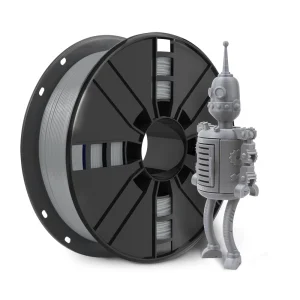
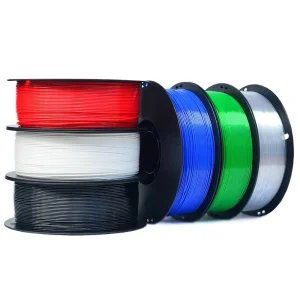
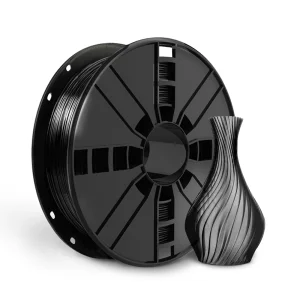
Explore our full line of PLA, PETG, TPU, ABS, and specialized 3D printing filaments manufactured in our ISO-certified facilities.
In-depth engineering answers for procurement managers, material engineers, and private-label distributors.