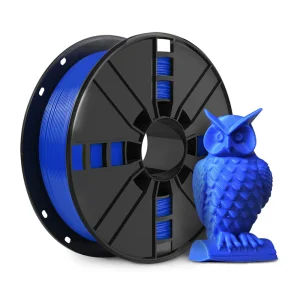
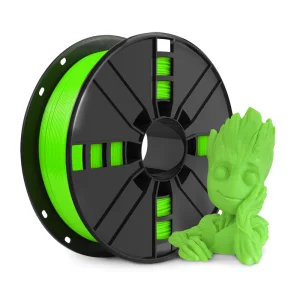
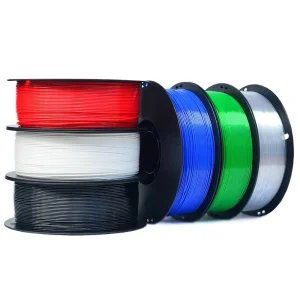
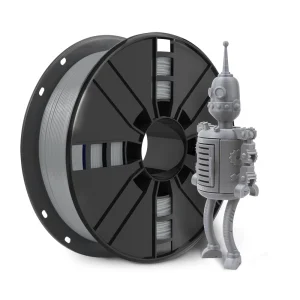
Explore our flagship extrusions produced under strict ±0.02 mm diameter tolerances with automated optical feedback.
A comprehensive analysis of polymer chemistry, structural integrity, and photolytic resistance in fused deposition modeling (FDM/FFF).
In modern industrial additive manufacturing, polymer selection dictates component lifespan, dimensional stability, and environmental resistance. While Standard ABS (Acrylonitrile Butadiene Styrene) has historically dominated functional prototyping, its vulnerability to ultraviolet (UV) radiation limits its long-term deployment outdoors. Acrylonitrile Styrene Acrylate (ASA) overcomes this limitation by replacing polybutadiene rubber with a synthetic acrylic ester elastomer matrix.
When searching for a trustworthy China ASA 3D printing manufacturer & supplier, global engineering teams and procurement directors require more than standard spools; they demand precise polymer formulations, low-warping thermal modifiers, and verifiable batch-to-batch consistency. China's advanced polymer extrusion ecosystem provides a powerful combination of raw resin compounding expertise, scale efficiencies, and strict quality control.
Standard ABS contains unsaturated double bonds within its butadiene component ($-\mathrm{CH=CH}-$). Under prolonged exposure to solar UV radiation (specifically UV-A and UV-B spectra between 290 nm and 400 nm), these double bonds undergo photo-oxidation. This reaction creates free radicals, leading to polymer chain scission, micro-cracking, severe yellowing, and impact strength loss within weeks of outdoor exposure.
In contrast, ASA utilizes a fully saturated acrylic ester rubber phase uniformly grafted within a Styrene-Acrylonitrile (SAN) matrix. Lacking vulnerable unsaturated double bonds, ASA resists photolytic breakdown. Accelerated weathering chamber tests (ISO 4892-2 Xenon-arc exposure) show that high-tier ASA filaments retain over 92% of their original tensile strength and exhibit a color variation ($\Delta E$) under 1.5 after 3,000 hours of continuous irradiation.
| Mechanical & Thermal Property | ASA Filament (Industrial Grade) | Standard ABS | PETG | Polycarbonate (PC) |
|---|---|---|---|---|
| Tensile Strength at Yield (MPa) | 45 – 52 MPa | 40 – 45 MPa | 48 – 50 MPa | 60 – 72 MPa |
| Flexural Modulus (GPa) | 2.1 – 2.4 GPa | 2.0 – 2.2 GPa | 1.9 – 2.1 GPa | 2.3 – 2.5 GPa |
| Notched Izod Impact Strength ($\text{kJ/m}^2$) | 18 – 25 $\text{kJ/m}^2$ | 12 – 18 $\text{kJ/m}^2$ | 7 – 9 $\text{kJ/m}^2$ | 35 – 50 $\text{kJ/m}^2$ |
| Heat Deflection Temp (HDT @ 0.45 MPa) | 96°C – 102°C | 92°C – 98°C | 70°C – 74°C | 135°C – 142°C |
| UV Resistance & Weatherability | Exceptional (Grade 5/5) | Poor (Yellows/Brittle) | Moderate (Degrades) | Moderate (Requires UV stabilizer) |
| Warping Propensity during FDM Print | Moderate (Mitigated via SAN tuning) | High | Very Low | Extreme |
How direct integration of petrochemical refining, precision machinery, and process engineering powers global OEM competitiveness.
Leading Chinese ASA manufacturers source virgin polymer resins directly from global chemical giants (such as INEOS Styrolution and SABIC) or proprietary Sinopec compounders, guaranteeing uncompromised purity and zero regrind contaminants.
Extrusion lines incorporate high-frequency dual-axis laser micrometers with real-time closed-loop PLC feedback. If strand diameter drifts by even 0.015 mm, puller speed dynamically adjusts, eliminating print nozzle clogs and extrusion fluctuations.
Automated servo-driven traverse spoolers ensure uniform, layer-by-layer filament arrangement. This prevents overlap tangles during long-duration prints, making it perfect for multi-material AMS units and industrial print farm arrays.
Experienced chemical engineers tune ASA melt flow rates (MFR) specifically for high-speed coreXY printers (up to 400 mm/s), introducing nucleating agents that reduce volumetric thermal expansion and control bed warping.
Enterprise procurement teams rely on verifiable performance data, scalable production capacity, and strict quality assurance protocols.
Procuring raw materials for industrial print farms or branded retail packaging requires stringent quality management across five core operational vectors:
Seamless international shipping, customs handling, and verified environmental safety documentation.
All ASA formulations fully comply with EU REACH SVHC restrictions and RoHS 2.0 heavy metal guidelines, ensuring safety for indoor production environments and international retail sales.
Comprehensive ISO-standard technical documentation accompanies every product line, providing structural engineers with accurate flexural, tensile, thermal deflection, and flammability metrics.
Leading suppliers provide end-to-end Delivered Duty Paid (DDP) logistics via sea, air, and rail express, alongside regional warehouse buffer stocking to prevent supply chain disruptions.
Where high mechanical performance meets severe environmental exposure.
Used for side-mirror housings, roof rack brackets, radiator grilles, and custom off-road vehicle fixtures requiring heat deflection up to 100°C and resistance to road salts and UV rays.
Ideal for 5G antenna radomes, solar-powered weather stations, and smart-grid outdoor junction boxes due to its RF transparency, impact resistance, and hydrophobic nature.
Resists saltwater corrosion, harsh marine environments, and UV degradation. Applied in boat dashboard instrument panels, deck cleats, and navigation light housing assemblies.
Enables low-volume production of custom exterior lighting diffusers, urban drainage caps, HVAC vent hoods, and facade mounting components with long design lifespans.
Next-generation composite materials driving high-speed additive manufacturing forward.
Blending 15%-20% high-modulus chopped carbon fiber into ASA increases flexural rigidity while virtually eliminating thermal warping. ASA-CF produces a sleek matte black surface that masks print layer lines.
Modern fast-printing FDM systems demand increased melt flow behavior. Modified ASA resins utilize narrow molecular weight distribution polymer bases to support extrusion speeds up to 500 mm/s without layer delamination.
Emerging applications in public transit, electrical enclosures, and aviation demand self-extinguishing properties. Specialized halogen-free additive blends achieve UL94 V-0 ratings at 1.5mm wall thickness.
In-depth answers to key technical, quality control, and sourcing inquiries from global engineering buyers.
From aesthetic silks to ultra-tough ABS and specialty carbon composites, explore factory-direct offerings.