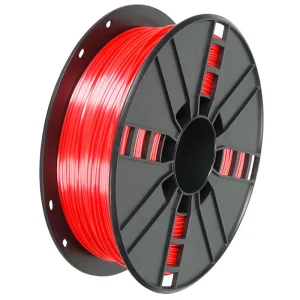
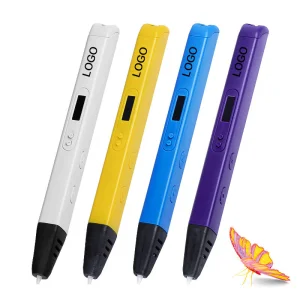
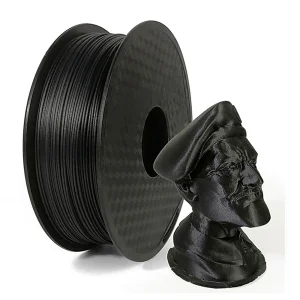
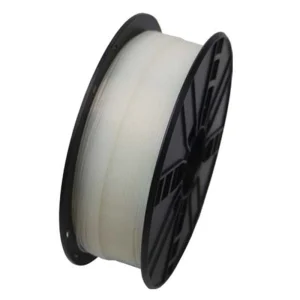
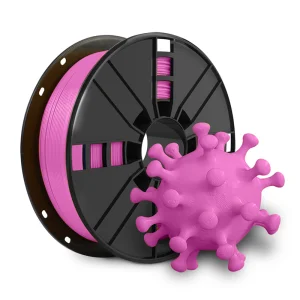
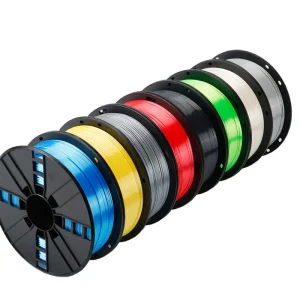
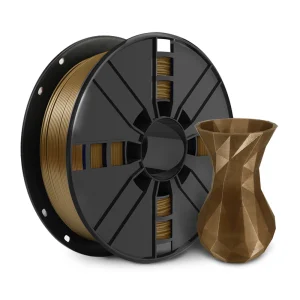
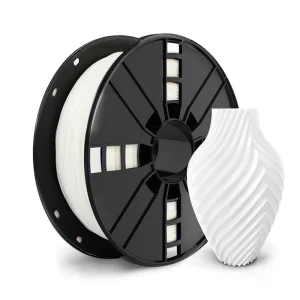
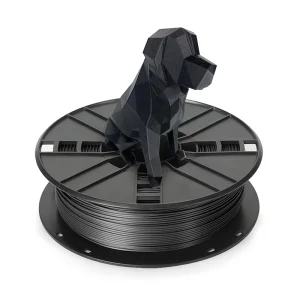
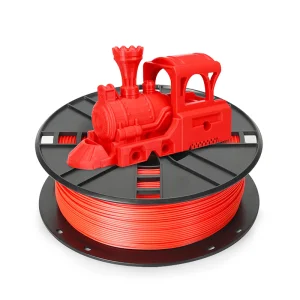
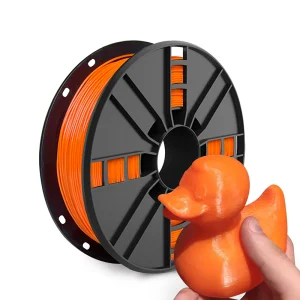
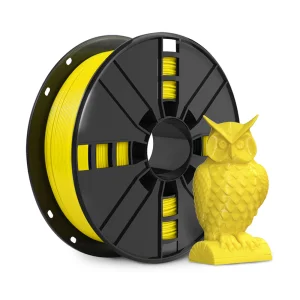
Explore our flagship standard and specialty filament grades. Every spool undergoes inline laser micrometer verification with ±0.02 mm tolerance guaranteed.
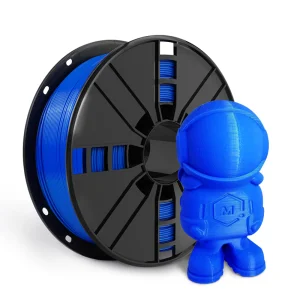
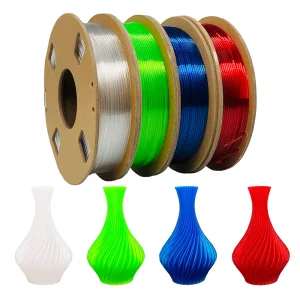
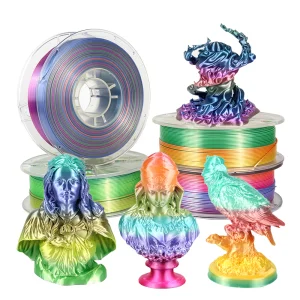
From visual novelty items to critical safety markers and tactical components: How Chinese manufacturing leadership is redefining high-performance photoluminescent thermoplastics.
The global demand for photoluminescent 3D printing filaments has experienced a structural pivot. Historically confined to desktop hobbyist models, engineering-grade ABS Glow In Dark filament is now widely adopted in aerospace dark-vision maintenance tools, low-light marine emergency indicators, tactical defense gear, and automotive accent prototyping. The combination of ABS’s high Heat Deflection Temperature (HDT ~ 95°C) and persistent phosphorescence provides operational reliability where standard PLA-based luminescent polymers fail under thermal stress.
China commands over 85% of the world’s refined rare-earth aluminate production—the essential precursor for long-persistence photoluminescence. Leading manufacturers leverage vertical integration: combining raw virgin Acrylonitrile Butadiene Styrene resin synthesis, micro-encapsulated Strontium Aluminate ($SrAl_2O_4:Eu,Dy$) pigment doping, and precision twin-screw compounding. This cluster density ensures unmatched cost-efficiency, superior chemical homogeneity, and batch-to-batch spectral stability for global B2B procurement partners.
Integrating photoluminescent particles into a polymer matrix introduces severe processing friction. Incompetent formulation causes pigment settling, nozzle clogging, severe brittleness, and erratic thermal degradation. Tier-1 China factories utilize specialized surface-treated organic silane coupling agents that encapsulate phosphorescent micro-particles, maintaining polymer chain mobility while guaranteeing smooth extrusion through industrial FDM/FFF printing hardware.
Understanding the molecular dynamics, pigment morphology, thermal stability, and nozzle physics required for flawless enterprise manufacturing.
The core mechanism of photoluminescence in ABS filament relies on electron excitation trapped within crystal lattice defects. Legacy glow materials utilized Zinc Sulfide ($ZnS:Cu$), which yields weak luminance, short persistence ($< 45\text{ minutes}$), and degrades rapidly under UV light. Premium Chinese manufacturers utilize ultra-pure Europium-Dysprosium doped Strontium Aluminate ($SrAl_2O_4:Eu^{2+},Dy^{3+}$). When exposed to ambient light or UV radiation ($320\text{--}400\text{ nm}$), electrons absorb photon energy and jump to higher quantum energy states. The Dysprosium ($Dy^{3+}$) co-dopant creates deep energy traps, releasing photons slowly over a decay period exceeding 12 hours, achieving initial luminance levels upwards of $3500\text{ mcd/m}^2$.
Strontium Aluminate particles possess a Mohs hardness rating of 6.0–6.5 (similar to quartz). Extruding standard glow-in-the-dark ABS through standard brass nozzles will enlarge orifice diameter from $0.4\text{ mm}$ to over $0.7\text{ mm}$ within less than 250 grams of print throughput! To maintain print fidelity, enterprise end-users must deploy hardened steel, tungsten carbide, or ruby-tipped nozzles. Furthermore, bed adhesion and thermal warp control require strict adherence to temperature profiles:
| Thermal & Mechanical Property | Standard Industrial ABS | Torwell ABS Glow In Dark (Premium Grade) | Testing Standard |
|---|---|---|---|
| Extrusion / Nozzle Temp | 220°C – 240°C | 230°C – 250°C (Optimized flow) | In-house Rheometry |
| Heated Bed Temperature | 90°C – 110°C | 95°C – 105°C (Enclosed chamber recommended) | FDM Verification |
| Glass Transition Temp ($T_g$) | 105°C | 104°C – 108°C | DSC (ISO 11357) |
| Heat Deflection Temp (HDT @ 0.45MPa) | 92°C | 95°C | ASTM D648 / ISO 75 |
| Charpy Impact Strength | 22 kJ/m² | 18 – 20 kJ/m² (Retained core impact resistance) | ISO 179 |
| Tensile Strength at Yield | 43 MPa | 40 – 42 MPa | ASTM D638 / ISO 527 |
| Luminescent Decay Duration | N/A | > 12 Hours (Green / Blue spectral output) | DIN 67510 Standard |
| Filament Diameter Tolerance | ±0.05 mm | ±0.02 mm (Continuous Laser Gauged) | Inline Dual-Axis Optical Sensor |
Where high heat tolerance meets self-sustaining visual illumination: Engineering solutions for challenging industrial environments.
In municipal transit tunnels, offshore oil platforms, and high-occupancy industrial complexes, structural power failures pose extreme safety risks. 3D printed photoluminescent signs, directional floor rivets, escape route switch plates, and valve identification handles made with ABS Glow In Dark meet ISO 7010 and DIN 67510 emergency lighting mandates. Unlike fragile PLA, ABS maintains mechanical structural integrity under ambient elevated temperatures near steam vents or electrical enclosures.
Tactical operators, night-vision maintenance crews, and specialized search-and-rescue teams require zero-power passive marking tools. ABS Glow In Dark is routinely extruded into custom weapon accessory mounts, tactile toggle switch caps, field kit latches, and drone landing markers. The material’s high impact resistance guarantees survival under severe physical shock while preserving subtle long-wavelength illumination visible under localized night-optics.
Global Tier-1 automotive interior studios utilize ABS Glow In Dark for rapid prototyping of ambient cabin trim, illuminated cup holder rings, and emergency door-latch release prototypes. ABS allows post-processing techniques such as acetone vapor smoothing, yielding ultra-glossy, seamless luminescent automotive components that replicate production-grade injection-molded parts.
Operating a 2,500 m² state-of-the-art facility equipped with 6 automated extrusion lines, delivering 60,000 kg monthly output for global OEM brands.
ABS polymer is highly hygroscopic; moisture absorption leads to micro-foaming, brittle strands, and catastrophic layer delamination. Our automated facility utilizes dual-bed desiccant dehumidifying dryers, keeping raw ABS moisture content below 0.02% before twin-screw extrusion compounding.
Every millimeter of extruded filament passes through inline dual-axis optical laser calipers operating at 1,000 Hz sampling rates. Automatic feedback loops adjust puller speeds instantly, maintaining strict target tolerances of ±0.02 mm and flagging ovality anomalies automatically.
Precision servo-driven winding mechanics guarantee neat, layer-by-layer spool alignment compatible with modern multi-material automated feed systems (e.g., AMS). Every spool is instantly heat-sealed in heavy-duty aluminum-foil moisture barrier bags with silica desiccant.
Ensuring seamless international distribution with full documentation support, custom formulations, and white-label branding solutions.
To support frictionless importation into European, North American, and Asia-Pacific markets, all Torwell filaments strictly adhere to global environmental safety standards:
We empower regional distributors and Amazon top-sellers to establish market authority through end-to-end white-label production:
Pioneering future-proof material science to address the next decade of additive manufacturing challenges.
Developing sub-micron Strontium Aluminate particles ($< 1\text{ }\mu\text{m}$) via wet planetary ball milling. Reduces nozzle abrasion by up to 70%, enabling standard brass nozzle compatibility without sacrificing luminance output.
Integrating surface-functionalized Carbon Nanotubes (CNTs) with photoluminescent pigments to produce Electrostatic Discharge safe ($10^6 - 10^9\text{ }\Omega/\text{sq}$) phosphorescent components for cleanroom semiconductor tooling.
Formulating Acrylonitrile Styrene Acrylate (ASA) photoluminescent filaments designed for 10+ year outdoor UV exposure, replacing ABS in extreme weathering and solar-irradiated environments.
Addressing essential questions regarding sourcing, manufacturing tolerances, material performance, and OEM logistics.
While PLA is easier to print on non-enclosed desktop printers, it softens at just 55°C–60°C and possesses low impact resistance. Industrial ABS Glow In Dark withstands operating environments up to 95°C, offers far superior Charpy impact strength (18–20 kJ/m²), and supports chemical post-processing (such as acetone vapor smoothing) for watertight, high-strength functional end-use parts.
Due to the abrasive nature of Strontium Aluminate particles ($Mohs\text{ }6.0\text{--}6.5$), standard brass nozzles will erode rapidly. We strongly advise using hardened steel, hardened tool steel, tungsten carbide, or ruby nozzles with a minimum orifice diameter of $0.4\text{ mm}$ (preferably $0.6\text{ mm}$ for continuous long-run prints).
Our premium Europium-Dysprosium doped Strontium Aluminate formulation delivers visible phosphorescence for over 12 hours following a 15-minute exposure to UV light or bright daylight, conforming to DIN 67510 afterglow standards.
All 1.75 mm and 2.85 mm spools are monitored continuously by dual-axis laser calipers during extrusion. We guarantee a diameter tolerance of ±0.02 mm and an ovality variance below 1%, eliminating feeder jams and under-extrusion.
Yes. We provide complete OEM/ODM support including Pantone color matching, private label spool stickers, custom retail carton packaging, and customized master carton bundling for container shipments.
Immediately after online quality checks, every spool is vacuum-sealed inside high-density moisture-barrier bags with a fresh 10g silica desiccant pack, guaranteeing shelf-life integrity exceeding 24 months when stored unopened.
We recommend a nozzle temperature of 230°C–250°C, heated bed temperature of 95°C–105°C, layer fan disabled (or 10% max), and printing inside an enclosed build chamber to prevent ambient thermal contraction draft warping.
Our standard MOQ for custom branded packaging or custom color runs is 200 kg per SKU. For standard stock formulations, flexible trial orders starting at 50 kg are welcomed.
Yes, every commercial batch is delivered with complete REACH, RoHS 3, and GHS-compliant Safety Data Sheets (SDS) ready for customs clearance and workplace safety audits.
Qualified B2B distributors and enterprise buyers can contact our sales engineering team directly via email or our contact page to arrange sample evaluation spools delivered via express air courier.
Full manufacturing options across high-speed PLA, carbon fiber composites, modified PETG, flexible TPU, and specialized 3D printing accessories.