A Comprehensive Engineering Guide to Shore Hardness Science, Advanced Polymer Extrusion Technology, OEM Sourcing Frameworks, and Macro Industry Solutions for Global Enterprise Procurement
Explore our premium elastomeric and industrial thermoplastic filaments extruded with tight tolerances for global OEM brands, distributors, and high-speed print farms.
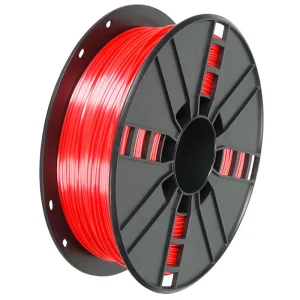
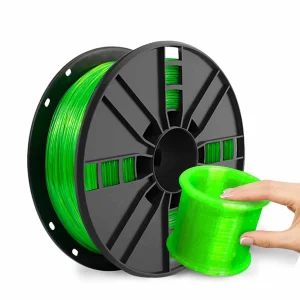
Understanding the viscoelastic properties, phase morphology, and molecular chemistry that establish TPU as the premier elastomeric polymer for Fused Deposition Modeling (FDM).
Thermoplastic Polyurethane (TPU) is a linear block copolymer consisting of alternating soft polymer segments (which provide elasticity, low-temperature flexibility, and high elongation at break up to 600%) and rigid hard segments (derived from diisocyanates and chain extenders that impart mechanical strength, abrasion resistance, and chemical durability).
By precisely controlling the stoichiometric ratio between hard and soft domains during reactor synthesis, Chinese TPU filament suppliers can engineer exact Shore hardness grades ranging from flexible 80A and 85A up to semi-rigid 95A and 98A variants.
Global procurement teams must differentiate between the two major chemical backbones of industrial TPU:
Unlike rigid plastics such as PLA or ABS, TPU exhibits pronounced shear-thinning (non-Newtonian) behavior during extrusion. Under high shear rates within a constrained 3D printer nozzle, melt viscosity drops dramatically, allowing rapid flow. However, upon exiting the nozzle, immediate elastic recovery occurs. Top-tier Chinese TPU filament manufacturers formulate custom additives that stabilize the melt flow index (MFI), eliminating feeding buckling while maintaining layer-to-layer molecular diffusion.
How China's integrated polymer supply chain, continuous automation, and strict laser-guided quality control deliver unmatched scale, consistency, and cost efficiency.
China is home to the world's largest chemical polymer synthesis clusters (partnering with global raw material giants like Wanhua Chemical, Covestro China, and BASF Asia). Direct pipeline supply of virgin medical-grade and industrial-grade TPU resins reduces raw material acquisition costs by 15-25% while ensuring batch-to-batch polymer purity.
Leading Chinese factories utilize automated extrusion lines equipped with high-speed dual-axis laser micrometers. Operating at frequencies exceeding 500 Hz, these systems continuously measure filament diameter and ovality, maintaining a strict target tolerance of ±0.02 mm over continuous 1,000-meter spools.
TPU is highly hygroscopic, absorbing atmospheric moisture rapidly and causing thermal degradation (foaming, popping, stringing) during printing. Advanced Chinese production facilities dry virgin resin in multi-stage desiccant towers down to <0.01% moisture before extrusion, immediately followed by inline vacuum sealing with active desiccant pouches.
From automotive energy absorbers to custom orthotic footwear and high-speed robotic end-effectors, discover how TPU filament powers modern manufacturing.
Scenario: Rapid prototyping and low-volume production of flexible vehicle gaskets, protective cable conduits, air intake boots, and anti-vibration bushings.
Macro Solution: By replacing injection molding tooling, automotive OEMs shorten engineering iteration cycles from 8 weeks to 48 hours while producing parts with oil resistance and Shore 95A impact damping.
Scenario: Customized orthotic shoe insoles, energy-returning lattice midsoles, and flexible smartwatch straps.
Macro Solution: Utilizing soft Shore 85A TPU filament, footwear brands produce variable-density lattice structures calculated directly from 3D foot pressure scans, delivering tuned biomechanical support.
Scenario: Compliant soft robotic grippers, pneumatic suction cups, protective arm bellows, and dynamic cable drag chain dampeners.
Macro Solution: High-durability polyether TPU filaments allow automation engineers to 3D print custom grippers that handle fragile glass containers or metallic parts without surface scratching.
Scenario: Shock-proof mobile tablet bumpers, waterproof sealing rings, acoustic isolation mounts, and drone landing gear pads.
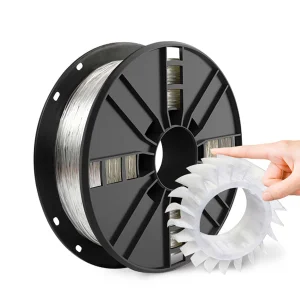
Macro Solution: High-clarity transparent TPU filaments allow visual inspection of underlying electronics while providing drop-test protection certified to military shock standards.
Standardized physical properties and baseline extrusion parameters for engineering procurement teams and print farm operators.
| Property / Parameter | Shore 85A TPU | Shore 90A TPU | Shore 95A TPU | Shore 98A / High-Speed TPU |
|---|---|---|---|---|
| Target Flexibility | Ultra-Flexible / Rubber-Like | High Flexibility | Medium Elasticity (Standard) | Semi-Rigid / High Stiffness |
| Extruder Nozzle Temp (°C) | 210 – 225 °C | 215 – 230 °C | 220 – 240 °C | 230 – 250 °C |
| Print Bed Temp (°C) | 30 – 50 °C | 40 – 60 °C | 50 – 70 °C | 50 – 70 °C |
| Recommended Extruder Type | Direct Drive (Short Path) | Direct Drive Preferred | Direct Drive / Tuned Bowden | Direct Drive & Standard Bowden |
| Printing Speed Range | 15 – 35 mm/s | 25 – 50 mm/s | 40 – 80 mm/s | 100 – 250 mm/s |
| Tensile Strength (MPa) | 28 MPa | 35 MPa | 42 MPa | 48 MPa |
| Elongation at Break (%) | > 600% | > 550% | > 480% | > 400% |
| Abrasion Loss (mm³) | 35 mm³ | 30 mm³ | 25 mm³ | 20 mm³ |
How technological advancements in high-speed extrusion, conductive compounds, micro-foaming, and sustainable bio-based polyols are redefining additive manufacturing.
With the rapid proliferation of high-speed CoreXY 3D printers (such as Bambu Lab, Voron, and Creality K1 platforms), traditional slow-printing TPU creates operational bottlenecks. Chinese material laboratories have engineered high-speed TPU formulations featuring optimized rheology and rapid melt-crystallization kinetics, allowing reliable flexible printing at speeds exceeding 250 mm/s without layer delamination.
Incorporating multi-walled carbon nanotubes (MWCNTs) or specialized conductive carbon black into TPU resin yields permanent anti-static properties (volume resistivity 104 to 107 Ω·cm). This breakthrough allows electronics manufacturers to print custom ESD-safe component trays, sensor housings, and wearable bio-electrodes.
By blending expandable thermoplastic microspheres into the extrusion formulation, foamed TPU achieves a 40-50% density reduction compared to solid TPU. Upon exiting the heated nozzle, controlled thermal volumetric expansion occurs, creating lightweight, highly resilient cushioning parts ideal for sports equipment and footwear.
Aligning with global ESG and decarbonization mandates, Chinese chemical factories are scaling TPU resins synthesized from bio-sourced castor oil polyols (up to 45% bio-content). Furthermore, pure TPU thermoplastic scrap can be 100% remelted and re-extruded into high-performance recycled filament spools.
A step-by-step strategic framework for overseas brands, wholesalers, and print farms sourcing custom TPU filaments from Chinese manufacturers.
Define physical performance targets including Shore hardness rating (85A to 98A), chemical exposure requirements (oil vs. moisture), and print speed parameters. Technical engineers evaluate sample parts to recommend optimal polyether or polyester resin bases.
Submit Pantone/RAL color codes or physical target samples. Laboratory spectrophotometers match masterbatch formulations under standard D65 illumination to guarantee zero color variance between manufacturing lots.
Select spool formats: standard 1kg plastic spools, eco-friendly high-density cardboard spools, or bulk 3kg/5kg industrial spools. Custom die-cut retail packaging boxes, customized vacuum bags, moisture-indicator cards, and private-label branding are finalized.
Each production run undergoes rigorous laboratory testing. Complete documentation packages—including RoHS, REACH SVHC, FDA CFR 21 (food contact grades), and Technical Data Sheets (TDS)—are issued prior to container dispatch.
Discover our extended selection of engineering-grade materials, aesthetic silk polymers, and specialty filaments shipped worldwide.
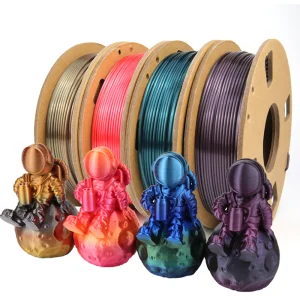
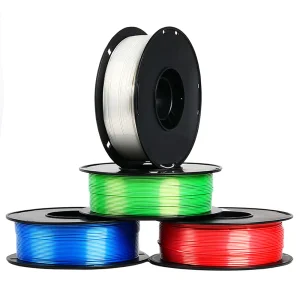
Expert insights answering critical engineering, procurement, quality control, and logistics questions for global buyers.
Sourcing TPU filament directly from specialized Chinese suppliers provides three major competitive advantages:
Shore hardness measures a polymer's resistance to indentation:
Quality control relies on closed-loop feedback systems. Continuous dual-axis laser gauges scan the filament immediately after leaving the multi-stage water cooling bath. If the strand deviates by more than ±0.015 mm from the 1.75 mm or 2.85 mm target, automated melt pumps dynamically adjust extrusion speed in real time. Defective sections are automatically flagged and purged prior to spooling.
TPU contains polar amide and ester groups that actively absorb water molecules from ambient air. Printing wet TPU causes steam expansion within the hotend, leading to popping noises, excessive stringing, low layer adhesion, and surface pitting. We recommend drying TPU at 65–70 °C for 4 to 6 hours in a dedicated filament dryer or convection oven before use, and printing directly from a sealed dry box with silica gel desiccant.
Yes, but success depends on Shore hardness and path constraint. Stiffer TPU grades like Shore 95A and 98A can be printed successfully on Bowden setups if the PTFE tube path is fully constrained with minimal tolerance gaps between the drive gear and tube entry. Soft TPU (Shore 80A–85A) requires a Direct Drive extruder with a fully enclosed filament path to prevent the soft strand from buckling or wrapping around the drive gear.
Leading Chinese exporters provide comprehensive compliance portfolios including ISO 9001 quality management certificates, RoHS directives, REACH SVHC chemical safety reports, halogen-free certifications, and FDA CFR 21 food contact compliance reports for food-grade TPU series.
Factories support comprehensive OEM branding services: custom die-cut color boxes, custom branded spool stickers, transparent or black plastic spools, eco-friendly cardboard spools, customized vacuum bag printing, custom desiccant pouch sizes, and master carton shipping marks tailored to your regional distribution channels.
Polyether TPU is significantly superior for long-term outdoor, marine, and medical applications because its ether linkage cannot be broken down by water (hydrolysis resistance) and resists microbial attack. Polyester TPU, while offering higher mechanical tensile strength, is susceptible to gradual hydrolytic degradation when continuously exposed to high humidity and warm water environments.