Examining the structural evolution of manufacturing hubs in Gauteng, Western Cape, and KwaZulu-Natal toward high-durability polymer extrusion.
The additive manufacturing (AM) landscape in South Africa is undergoing a profound transition. Historically centered on rapid visual prototyping, industrial enterprises across the Witwatersrand (Gauteng), the automotive manufacturing corridors of Gqeberha (Port Elizabeth) and Rosslyn (Pretoria), and the mining-tech complexes of Rustenburg are rapidly adopting fused deposition modeling (FDM) for direct digital manufacturing of functional end-use parts. Central to this transition is the surge in demand for engineering thermoplastics—specifically Polycarbonate (PC) filaments.
South Africa’s domestic manufacturing sector faces distinct operational challenges: extreme environmental conditions, severe mechanical stress in underground mining equipment, exposure to high ambient temperatures, and the imperative for rapid localization of replacement components amid global supply disruption. Standard commodity plastics such as conventional PLA or standard ABS frequently fail under the thermal and mechanical stresses required by local operations. Polycarbonate (PC), recognized for its extraordinary impact strength, high heat deflection temperature (HDT up to 140°C–145°C), optical clarity, and flame-retardant characteristics, has emerged as the polymer of choice for engineers across the African continent.
Information Gain Insight: Unlike standard commodity filaments, industrial Polycarbonate exhibits an Izod Notched Impact Resistance exceeding 600 J/m and a Glass Transition Temperature ($T_g$) of approximately 147°C. This makes factory-grade PC filament essential for housing solar telemetry systems in the Northern Cape desert, housing high-voltage electrical relays, and fabricating chemical-resistant mining ductwork.
OEM automobile assembly plants in the Eastern Cape and Gauteng demand high-heat assembly jigs, custom wire-harness routing brackets, and prototype interior components capable of surviving elevated paint-curing and thermal testing environments.
Extensive platinum, gold, and diamond mining networks require shatter-proof protective covers, spark-resistant electrical enclosures, and customized dust-filtration manifolds built to withstand constant high-frequency vibration.
Solar farm deployments in the high-ultraviolet, high-heat Karoo region utilize PC and modified PC-CF components for outdoor junction boxes, solar tracker sensor mounts, and weatherproof terminal housings.
Understanding molecular weight distribution, moisture kinetics, and thermal performance parameters for industrial extrusion.
Polycarbonate is an amorphous thermoplastic polymer containing carbonate groups in its chemical structure. The molecular chain structure, based on Bisphenol A (BPA) linked by carbonate groups, confers exceptional physical rigidity, high optical clarity, and remarkable ductility before fracture. However, extruding raw Polycarbonate resin into high-precision 3D printer filament ($\pm0.02\text{ mm}$ tolerance) demands rigorous thermal process control during the manufacturing process.
Unlike semi-crystalline polymers such as PEEK or PLA, Polycarbonate does not undergo sharp crystalline melting. Instead, it exhibits a gradual softening behavior above its glass transition temperature ($T_g \approx 147^\circ\text{C}$). For optimal layer adhesion and structural isotropy, processing temperatures during FDM printing must be tightly controlled between $260^\circ\text{C}$ and $300^\circ\text{C}$, backed by a heated build chamber maintained at $90^\circ\text{C}$ to $120^\circ\text{C}$.
| Physical / Mechanical Property | Standard Test Method | Torwell Industrial PC Filament | Standard ABS Filament | Standard PETG Filament |
|---|---|---|---|---|
| Tensile Strength at Yield (MPa) | ASTM D638 | 65 – 72 MPa | 40 – 45 MPa | 48 – 52 MPa |
| Flexural Modulus (GPa) | ASTM D790 | 2.3 – 2.5 GPa | 2.1 – 2.3 GPa | 2.0 – 2.2 GPa |
| Izod Notched Impact Strength (J/m) | ASTM D256 | 650 – 850 J/m | 200 – 250 J/m | 80 – 120 J/m |
| Heat Deflection Temp (HDT @ 0.45 MPa) | ASTM D648 | 138°C – 143°C | 92°C – 98°C | 70°C – 75°C |
| Glass Transition Temp ($T_g$) | DSC Curve | 147°C | 105°C | 80°C |
| Hygroscopic Rate (% moisture 24h) | Internal Gravimetric | 0.35% (High Moisture Sensitivity) | 0.20% | 0.15% |
A critical engineering parameter often overlooked by general distributors in South Africa is the hygroscopic nature of Polycarbonate. At processing temperatures exceeding $250^\circ\text{C}$, even trace moisture content ($>0.02\%$) absorbed within the raw filament undergoes immediate hydrolysis—a chemical process where water molecules break the ester bonds along the polymer backbone. This results in severe polymer chain scission, drastically dropping the molecular weight, causing structural brittleness, steam bubbling, and layer delamination in the final printed part.
To mitigate hydrolytic degradation during long-distance maritime freight from China to South African ports (Durban, Cape Town, Gqeberha), Torwell Technologies implements a multi-stage industrial drying protocol: virgin PC resin is dehumidified at $110^\circ\text{C}$ for 8 hours prior to extrusion, followed by immediate inline vacuum drying, automated winding, and triple-layer aluminum-foil vacuum sealing with active desiccant packs.
Practical proof points of Torwell Polycarbonate filaments operating within challenging local conditions.
Challenge: Underground gold extraction electronics in West Rand exposed to high impact, dust, and continuous ambient ambient heat up to $65^\circ\text{C}$.
Solution: Custom enclosures printed with Torwell Industrial PC Black filament. The parts provided shock insulation exceeding 700 J/m impact force, preventing sensor failure and eliminating metal machining lead times from 6 weeks to 8 hours.
Challenge: Automotive assembly lines required lightweight yet rigid grippers capable of holding sheet metal without flexing or fracturing under high acceleration.
Solution: Transitioned from aluminum EOAT components to 3D printed PC parts. Reduced total manipulator end-mass by 62%, accelerated cycle time by 14%, and passed 500,000 continuous stress cycles without thermal fatigue.
Challenge: Regional electrical utilities required custom flame-retardant junction covers resistant to salt spray, coastal humidity, and thermal arcing.
Solution: Flame-retardant PC blend formulations delivered dielectric strength exceeding 20 kV/mm, fulfilling localized municipal safety compliance and eliminating import delays for European component spares.
Empowering South African brands, distributors, and print farms with world-class production capacity, strict QC, and OEM flexibility.
Founded in 2011, Torwell Technologies Co., Ltd. stands as an industry leader among China's high-tech 3D printing material manufacturers. Operating a 2,500 m² state-of-the-art standardized workshop equipped with 6 automated extrusion lines, Torwell delivers a monthly production output of 50,000 to 60,000 kilograms of premium 3D printing filament to partners across more than 75 countries and regions.
For South African B2B buyers—ranging from specialized resellers in Sandton and Cape Town to large-scale print farms servicing industrial tenders—supply chain stability, batch-to-batch consistency, and compliance documentation are paramount.
Real-time inline laser measuring gauges continuously feed data back to the extrusion pullers, ensuring absolute roundness and strict $\pm0.02\text{ mm}$ diameter consistency to prevent nozzle jams in high-speed printers.
Full support for customized spool weights (250g, 1kg, 3kg, 5kg), private label master cartons, branded stickers, eco-friendly cardboard spools, and custom Pantone color matching for South African distributors.
Comprehensive RoHS, REACH, ISO9001, and SDS/TDS documentation provided with every order to ensure seamless customs clearance at Durban, Cape Town, or OR Tambo International Airport.
Next-generation developments in carbon-composite PC, flame retardancy, and high-speed extrusion profiles.
As the Global Additive Manufacturing market scales toward high-speed kinematics (print speeds exceeding $500\text{ mm/s}$ with accelerations up to $20,000\text{ mm/s}^2$), standard material formulations face mechanical degradation due to shortened melt residence times inside hotends. Torwell Technologies is driving polymer innovation to support these advanced platforms across South Africa.
Traditional Polycarbonate requires high pressure to extrude through narrow nozzles at high linear speeds. Torwell’s research team has developed modified low-viscosity PC masterbatches that lower melt shear resistance by 35% without sacrificing tensile strength. This allows South African print farms to operate high-speed CoreXY equipment at maximum throughput while retaining complete mechanical bond strength between layers.
Integrating high-modulus chopped carbon fibers (15% by weight) into the polycarbonate matrix creates a lightweight structural composite. PC-CF exhibits zero warping, increased tensile modulus ($>5.5\text{ GPa}$), and electrostatic dissipation (ESD) properties—making it the ideal solution for drone frames, defense robotics, and heavy mining telemetry gear manufactured in South Africa.
In response to stringent safety regulations in South African public transport, rail networks (PRASA), and commercial building installations, Torwell is scaling halogen-free, flame-retardant PC filaments. These formulations self-extinguish within 10 seconds of flame removal, preventing toxic smoke emissions in enclosed industrial spaces.
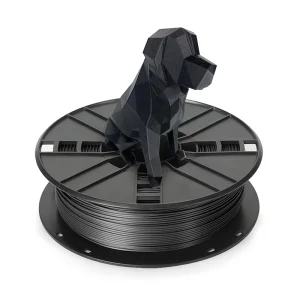
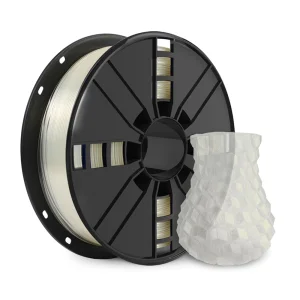
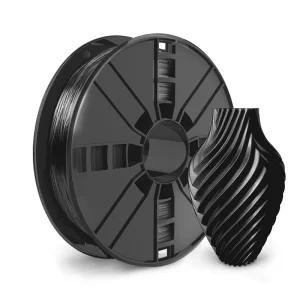
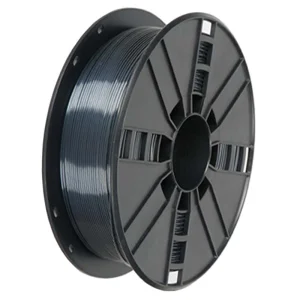
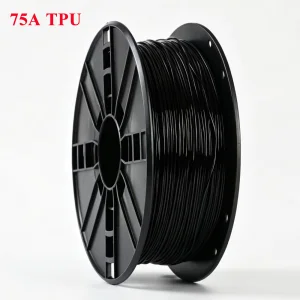
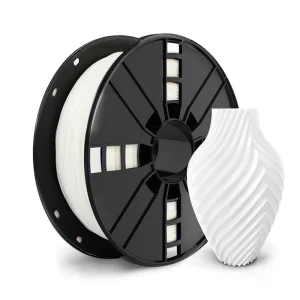
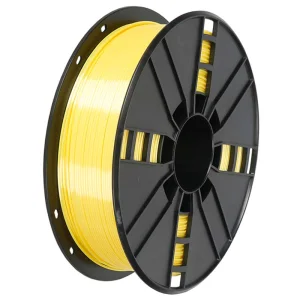
Explore our complete range of engineered 3D printing polymers available for OEM direct supply.
Addressing key engineering, logistical, and commercial inquiries for South African buyers.
Polycarbonate requires a hotend temperature between $270^\circ\text{C}$ and $300^\circ\text{C}$ and a heated bed maintained at $100^\circ\text{C}$ to $120^\circ\text{C}$. For large engineering parts, an enclosed build chamber kept at $80^\circ\text{C}$–$100^\circ\text{C}$ is strongly recommended to prevent thermal warping and layer splitting.
Every spool of Torwell PC filament undergoes continuous industrial drying prior to spooling. Spools are immediately vacuum sealed inside thick multi-layer barrier foil bags with active silica gel desiccant packs before being boxed, guaranteeing fresh printability upon arrival at Durban or Cape Town ports.
Yes. Torwell supports OEM/ODM projects including custom color matching according to Pantone codes or physical samples, private label spools, custom-printed retail boxes, and market-ready Technical Data Sheets (TDS) tailored to your brand.
Production lead time for standard container orders is typically 10–15 business days. Sea freight transit from Shenzhen/Guangzhou to Port of Durban takes approximately 20–25 days, while air freight to Johannesburg (JNB) delivers within 5–7 days.
Neat Polycarbonate can be printed using standard brass nozzles. However, if using modified Carbon Fiber Polycarbonate (PC-CF) or Glow-in-the-Dark variants, a hardened steel or ruby-tipped nozzle ($0.4\text{ mm}$ or $0.6\text{ mm}$) is required to prevent rapid abrasive wear of the orifice.
Torwell provides complete export documentation including Commercial Invoice, Packing List, Bill of Lading, Certificate of Origin, RoHS & REACH Compliance Reports, and Material Safety Data Sheets (MSDS/SDS).
Get direct factory pricing, request free sample spools, or discuss custom OEM production for the South African market.