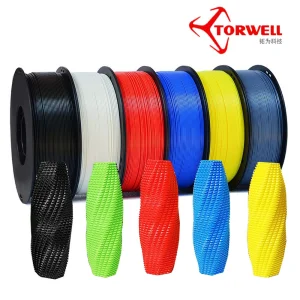
Direct factory extrusion engineered for high-speed additive manufacturing, tight roundness tolerance, and zero-clog reliability.
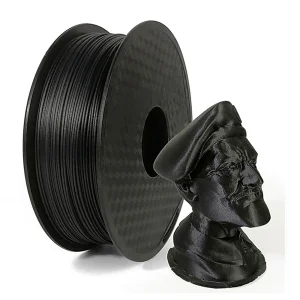
Operational metrics powering global OEM/ODM supply agreements across 75+ international markets.
Market growth drivers, material sustainability compliance, and global B2B procurement restructuring.
The global market for bio-based 3D printing filaments, specifically Wood Polymer Composites (WPC) formulated with Poly(lactic acid) (PLA), is undergoing a profound commercial expansion. Driven by consumer preferences for tactile organic aesthetics and strict corporate Environmental, Social, and Governance (ESG) mandates, enterprise procurement teams are increasingly turning toward wholesale Wood PLA suppliers and factories to secure steady raw material streams.
Unlike unfilled thermoplastic monofilaments (such as neat PLA, ABS, or PETG), Wood PLA filaments represent a complex matrix comprising virgin thermoplastic biopolymer filled with micronized natural wood flour (typically derived from pine, bamboo, cork, birch, or cedar residues). The result is a additive manufacturing medium that mimics the density, fragrance, sanding workability, and visual texture of natural timber while retaining Fused Deposition Modeling (FDM) processability.
Wood PLA utilizes bio-derived lactide monomers combined with upcycled industrial timber byproducts, significantly reducing net fossil carbon intensity per printed cubic centimeter.
Prints exhibit authentic wood grain aesthetics that can be stained, sanded, carved, and varnished using standard carpentry stains, opening premium consumer decor channels.
The global market for composite 3D printing materials is projected to expand at over 14.8% CAGR through 2030, with natural fiber-filled composites leading eco-consumer verticals.
Navigating the supply chain for Wood PLA requires evaluating raw material fiber distribution, moisture-induced hydrolysis risk during extrusion, and coupling agent compatibility. Low-tier suppliers often suffer from variable wood particle sizing, leading to thermal degradation, micro-nozzle clogging, and inconsistent batch color shades.
How Torwell Technologies solves wood fiber agglomeration, thermal degradation, and diameter instability.
Extruding high-grade Wood PLA monofilaments requires sophisticated thermal management and polymer chemistry. Natural wood fiber contains hemicellulose, cellulose, and lignin—components susceptible to thermal charring and gas evolution at temperatures exceeding 200°C. Torwell Technologies Co., Ltd. leverages a 2,500 m² standardized manufacturing plant with 6 automated extrusion lines to ensure stable particle dispersion and minimal degradation.
Comprehensive physical, thermal, and mechanical comparisons across Torwell's primary filament lines.
| Filament Material | Density (g/cm³) | Tensile Strength (MPa) | Heat Deflection (°C) | Recommended Nozzle (°C) | Bed Temp (°C) | Primary Commercial Value |
|---|---|---|---|---|---|---|
| Torwell Wood PLA | 1.15 - 1.18 | 38 - 45 | 53 - 56 | 190 - 210 | 40 - 60 | Authentic wood aroma, sandable finish, low warping, eco-branding |
| Standard PLA | 1.24 | 55 - 60 | 55 - 58 | 190 - 220 | 0 - 60 | High printing speed, dimensional accuracy, baseline prototyping |
| PLA+ High Impact | 1.25 | 62 - 68 | 58 - 62 | 200 - 230 | 50 - 60 | Enhanced layer adhesion, impact resistance, functional models |
| Silk PLA | 1.23 | 42 - 48 | 52 - 55 | 200 - 230 | 50 - 60 | High luster sheen, dual-color coextrusion, aesthetic decor |
| Industrial PETG | 1.27 | 48 - 52 | 68 - 72 | 230 - 250 | 70 - 80 | Chemical resistance, toughness, water-tight containers |
| Engineering ABS | 1.04 | 40 - 45 | 85 - 92 | 230 - 260 | 90 - 110 | Thermal stability, acetone vapor smoothing, automotive components |
| Weatherproof ASA | 1.07 | 42 - 47 | 88 - 95 | 240 - 260 | 90 - 110 | UV stability, outdoor weather resistance, exterior fixtures |
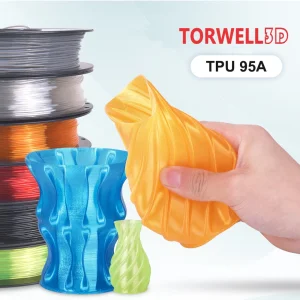
| Flexible TPU 95A | 1.21 | 35 (Elongation >400%) | 60 | 210 - 230 | 30 - 60 | High elasticity, abrasion resistance, gaskets, dampeners |
| Polycarbonate (PC) | 1.20 | 65 - 72 | 110 - 125 | 260 - 300 | 100 - 120 | High heat resistance, optical transparency, structural strength |
| Carbon Fiber Composite | 1.29 | 75 - 85 | 75 - 85 | 230 - 260 | 70 - 80 | Ultra-high rigidity, low weight ratio, matte industrial finish |
How global industries integrate Wood PLA to replace traditional timber turning and injection molding.
Architectural firms utilize Wood PLA to render organic terrain maps, heritage building restorations, and structural models that require natural wooden aesthetics without manual carving labor.
The natural wood fiber loading alters acoustic damping characteristics. High-end audio prototyping labs print custom speaker horns and baffle structures that minimize standing waves.
Cosmetic and spirits brands prototype eco-conscious luxury caps, wooden containers, and limited-edition packaging hardware with Wood PLA, aligning with carbon-neutral branding strategies.
Custom interior design studios fabricate bespoke drawer pulls, lamp bases, and decorative acoustic wall panels that undergo post-print wood staining to match room decor.
Entertainment prop studios fabricate lightweight, authentic-looking medieval artifacts, movie props, and museum exhibits that accept antiquing glazes and sanding tools like real timber.
Next-generation polymer composite breakthroughs driving industrial FDM additive manufacturing forward.
Engineering customized melt flow index (MFI > 25 g/10min at 210°C) additives enabling Wood PLA printing speeds exceeding 300 mm/s on modern high-speed 3D printing platforms without nozzle clogging.
Developing specialized biomass filaments infused with micro-encapsulated essential oils to retain authentic Cedar, Pine, Walnut, and Ebony scents during and after the 3D printing process.
Eliminating petroleum-based compatibilizers in favor of 100% bio-based bio-derived coupling agents, ensuring printed Wood PLA components achieve ISO 14855 industrial compostability standards.
A streamlined, factory-direct procurement roadmap for global distributors, brands, and print farms.
Torwell Technologies acts as a strategic manufacturing partner for leading 3D printing material brands across North America, Europe, Asia, and Oceania. With an estimated monthly output of 50,000 to 60,000 kg of high-grade filament, our factory supports complete private labeling and OEM custom developments.
We formulate custom wood flour percentages (10% to 30% loading), custom wood tones (Light Pine, Dark Walnut, Mahogany, Rosewood), and specific target shore hardnesses or flexural moduli.
Select from eco-friendly recyclable cardboard spools, high-transparency polycarbonate spools, or master print farm spools (1kg, 3kg, 5kg). Full custom carton graphics and labeling.
Filaments are dynamically dried down to <200 ppm moisture, vacuum-sealed with high-capacity desiccant pouches and humidity indicator cards, and double-boxed for ocean container transit.
Explore our complete manufacturing capabilities available for global OEM bulk supply.
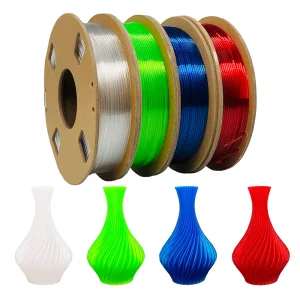
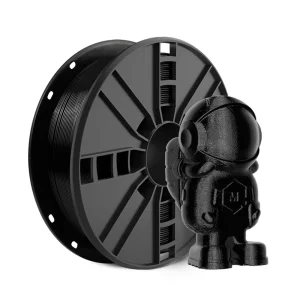
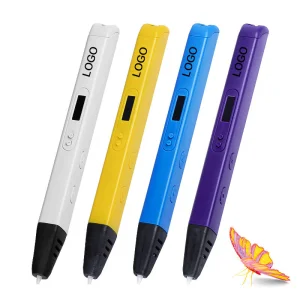
Expert answers regarding Wood PLA extruding parameters, OEM MOQ guidelines, and supply chain logistics.
While 0.4mm brass nozzles can be used if wood particle sizes are held below 75 microns, we strongly recommend 0.5mm or 0.6mm hardened steel/brass nozzles for high-volume production. The larger orifice eliminates heat-creep friction and micro-agglomeration of wood cellulose fibers.
Natural wood flour absorbs ambient moisture rapidly. Torwell co-dries virgin PLA resin and micronized wood powder in vacuum dehumidifying hopper dryers down to <200 ppm water content before compounding. Every spool is then vacuum sealed within 15 minutes of spooling.
For standard stock wood shades (Light Pine, Dark Walnut), MOQ starts as low as 100 spools per SKU. For fully customized wood species formulations, custom color matchings, or bespoke cardboard spool printing, typical OEM MOQs range from 500 to 1,000 kg.
Yes. Due to the high porous wood fiber loading on the printed surface, models can be sanded with 120-600 grit sandpaper, stained with oil-based or acrylic wood stains, carved, and sealed with clear wood varnish to achieve authentic timber finishes.
All extrusion lines are outfitted with inline dual-axis laser measuring systems. We guarantee a continuous ±0.02mm diameter accuracy and <1% ovality ratio across 1.75mm and 2.85mm filament spools.
Carbon Fiber PLA provides significantly higher structural tensile strength (~80 MPa) and rigidity for functional engineering brackets. Wood PLA (~42 MPa) is engineered primarily for visual aesthetics, tactile feel, acoustic damping, and eco-friendly consumer goods.