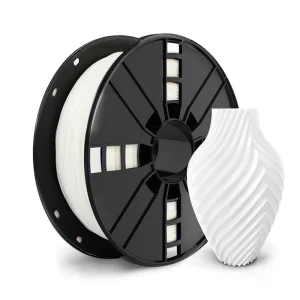
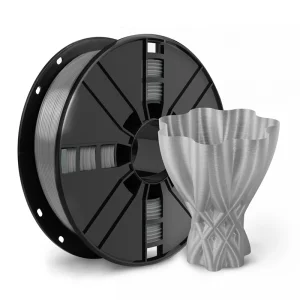
Explore our high-demand OEM/ODM stock formulations engineered for stable volumetric flow and low warpage across FDM/FFF 3D printing platforms.
A comprehensive technical analysis of wood particulate integration within biopolymer matrices for professional additive manufacturing.
Wood 3D printer filament is an advanced bio-composite material produced by compounding virgin Poly Lactic Acid (PLA) or thermoplastic polymers with finely milled organic wood flour (typically 20% to 30% by weight). Our proprietary compounding process utilizes pine, bamboo, ebony, and birch micro-particles sieved to sub-50-micron particle size to guarantee non-clogging performance while delivering authentic tactile feel, timber aroma, and matte wooden surface aesthetics.
Unlike standard un-filled polymers, wood filament exhibits unique thermochromic behavior during Fused Deposition Modeling (FDM). By adjusting extrusion temperatures between 190°C and 230°C, machine operators can dynamically alter the shade of the printed object—lower temperatures produce light natural timber hues, while higher temperatures burn the organic lignin slightly, producing dark ringed wood effects reminiscent of natural hardwood growth rings.
Standard wood filaments suffer from phase separation and nozzle blockage due to agglomerated cellulose fibers. Torwell's proprietary twin-screw compounding technology applies reactive coupling agents (maleic anhydride grafted PLA) that chemically bond the wood fibers to the polymer backbone. This yields a Melt Flow Index (MFI) of 8–12 g/10 min (210°C/2.16kg), ensuring consistent volumetric extrusion through 0.4mm and larger brass or hardened steel nozzles without stringing or thermal degradation.
| Property Parameter | Torwell Premium Wood Filament | Standard Pure PLA | PETG Composite | Subtractive Real Timber (CNC) |
|---|---|---|---|---|
| Organic Wood Content | 20% - 30% Organic Micro-Dust | 0% | 0% | 100% Solid Wood |
| Density (g/cm³) | 1.18 - 1.22 g/cm³ | 1.24 g/cm³ | 1.27 g/cm³ | 0.60 - 0.85 g/cm³ |
| Tensile Strength (MPa) | 42 - 48 MPa | 55 - 65 MPa | 48 - 52 MPa | 40 - 90 MPa (Directional) |
| Post-Processing Sandability | Excellent (behaves like real wood) | Moderate (prone to melting) | Poor (gummy response) | Excellent |
| Stain & Varnish Acceptance | High (Absorbs oil/water stains) | Zero Absorption | Zero Absorption | High |
| Layer Line Masking | Superior (Matte grain finish) | Low (Visible reflective lines) | Moderate | N/A (Continuous grain) |
Leveraging Guangdong's world-class polymer processing ecosystem for high-volume, cost-optimized, and quality-controlled additive material manufacturing.
Situated in the heart of China’s advanced polymer manufacturing hub, our facility maintains direct strategic sourcing contracts for high-purity lactide resin and refined agricultural wood processing byproducts. This localized supply chain integration eliminates raw material lead times and minimizes freight inflation, allowing us to offer highly competitive tier pricing for wholesale distributors globally.
Our 6 high-speed automated extrusion lines are fitted with inline dual and quad-axis laser diameter monitoring systems. Operating with high-frequency feedback loops, the system measures filament diameter across 360 degrees, holding tight dimensional tolerances of ±0.02 mm. Out-of-spec segments are automatically flagged, cut, and discarded prior to spooling.
With standardized 2,500 m² cleanroom extrusion bays operating 24/7, our production infrastructure yields over 60,000 kg of specialty and standard filaments per month. Whether fulfilling full-container load (FCL) OEM contracts or multi-SKU LCL distribution orders, our factory ensures guaranteed lead times without compromising batch-to-batch color stability.
End-to-end contract manufacturing, private-label packaging, and customized formulation services tailored for international brands and high-volume procurement teams.
We empower regional brands and Amazon FBA sellers with turnkey OEM private label options. Choose from eco-friendly recycled cardboard spools, clear polycarbonate high-temp spools, customized artwork boxes, die-cut protective foam inserts, branded stickers, and moisture-proof aluminum foil vacuum bags with embedded humidity indicator cards.
Beyond our standard Pine and Dark Walnut formulations, our R&D engineering lab offers custom composite formulation matching. Enterprise customers can request specific organic particle loadings, custom pigment tinting matching Pantone PMS codes, or specialty wood fiber bases including Cherry, Mahogany, and Ebony for exclusive product line offerings.
Ensuring frictionless international trade with comprehensive regulatory documentation and flexible freight options for EU, North American, and Asia-Pacific markets.
All raw PLA polymers, natural wood dust fillers, and binding additives are independently tested and certified compliant with EU Directive 2011/65/EU (RoHS 2.0) and REACH (EC 1907/2006) SVHC candidate lists. Full lab test reports are made available to import compliance officers upon contract signing.
Complete Safety Data Sheets (SDS) authored according to GHS standards accompany every shipment. Additionally, our pure PLA biopolymer resin matrix meets US FDA 21 CFR standards for indirect food contact, ensuring peace of mind for educational institutions and consumer product manufacturers.
We support diverse international trading terms including EXW, FOB Shenzhen/Ningbo, CIF, and DDP (Delivered Duty Paid) to your regional fulfillment centers. Working alongside tier-1 freight forwarders, we streamline customs clearance, tax payments, and palletized ocean/air transport to North America, Europe, and Australia.
Staying ahead of market demands with high-speed print compatibility, bio-circular sustainability, and advanced surface finishes.
Modern FDM 3D printing is dominated by high-speed CoreXY platforms (such as Bambu Lab, Creality K1, Voron, and Flsun) operating at velocities of 250mm/s to 600mm/s. Torwell's late-generation Wood Filament formulas incorporate high-flow polymer modifiers and optimized particle lubricants, enabling seamless printing at speeds up to 300 mm/s without heat creep, extruder clicking, or layer separation.
Global consumer demand is rapidly tilting toward zero-petroleum, sustainable products. Our wood filament line relies exclusively on upcycled timber waste collected from certified sustainable lumber mills combined with annual renewable crop-derived PLA. The resulting material is 100% commercially compostable, aligning perfectly with ESG corporate procurement initiatives.
Because wood composite prints feature high internal porosity micro-voids, they exhibit natural sound dampening properties superior to rigid plastic polymers. This technical attribute makes wood filament increasingly popular in consumer audio enclosures, acoustic wall tiles, and tactile interior design objects where metallic plastic resonance is undesirable.
Bridging the gap between digital rapid prototyping and authentic hand-crafted wooden aesthetics across diverse commercial sectors.
Architects utilize our wood filament to print scale building models, timber framing concepts, and urban topography maps. The natural matte texture hides layer lines effortlessly without requiring heavy primer paint or manual sanding.
High-end cosmetic brands and spirit distillers employ custom wood filament 3D printing to create prototype caps, outer closures, artisanal bottle holders, and limited-edition sustainable packaging containers.
Museums and restoration labs utilize 3D scanning paired with wood filament printing to replicate missing fragments of ancient wooden artifacts, carved furniture, and historical architectural moldings with high color-staining fidelity.
From Bluetooth speaker enclosures to designer lamp shades, wall clocks, and tactile desk organizers, wood filament provides warm visual appeal and acoustic dampening qualities modern consumers favor.
Technical, procurement, and logistics details to assist procurement managers during supplier evaluation.
Due to the presence of real organic wood micro-particles, we recommend using a brass or hardened steel nozzle with a diameter of 0.4 mm or larger (0.6 mm is optimal for ultra-high reliability during multi-day print jobs). Recommended print settings: Extrusion Temperature: 190°C – 220°C; Heated Bed Temperature: 45°C – 60°C; Print Speed: 40 – 150 mm/s (up to 300 mm/s on high-flow setups); Retraction Speed: 35–45 mm/s.
Yes, absolutely. One of the greatest advantages of Torwell’s wood composite filament is its post-processing versatility. Once printed, parts can be sanded using standard sandpaper (120 to 400 grit), carved with wood chisels, and treated with oil-based or water-based wood stains, varnishes, or clear coats. The wood fibers inside absorb stains naturally, producing authentic timber grain highlights.
For standard stock colors (such as Natural Pine and Dark Walnut), our wholesale MOQ starts at 100 spools (mix-and-match across standard colors). For custom private-label OEM packaging, branded boxes, or custom-tinted wood formulations, the standard MOQ is 500 to 1,000 spools per SKU depending on customization complexity.
We solve the traditional brittleness of wood filament through double-stage twin-screw extrusion compounding. We add specialized elastomeric impact modifiers and plasticizers into the biopolymer matrix. Furthermore, all wood dust undergoes ultrasonic sieving to ensure particle size remains below 50 microns, eliminating large wood splinters that cause nozzle clogging.
Organic wood fibers are hygroscopic by nature. Therefore, immediately after extrusion and quality inspection, each spool is vacuum sealed in a high-density, puncture-resistant moisture barrier bag along with a 10g active silica gel desiccant pack. Vacuum bags are then packed into individual protective corrugated retail boxes and stacked on shrink-wrapped export pallets.
We provide full documentation packages for every batch order, including ISO 9001:2015 Quality Management System certification, RoHS 2.0 and REACH SVHC test reports from third-party labs (SGS/TÜV), technical data sheets (TDS), and complete safety data sheets (SDS) compliant with GHS standards.
For standard wholesale orders, products are dispatched within 7 to 10 business days. For full container load (FCL) OEM orders with custom packaging and spool printing, production lead time is typically 15 to 20 business days following final artwork approval.
Yes, we provide sample spools to verified commercial buyers, distributors, and print farms for testing on their production machines. Contact our sales engineering team to request a sample pack alongside our wholesale price matrix.
Explore our additional thermoplastic materials formulated for high strength, flexibility, and specialty visual effects.