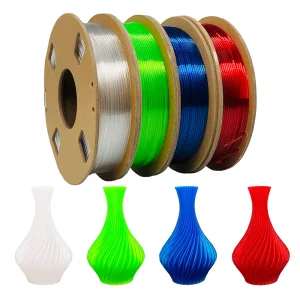
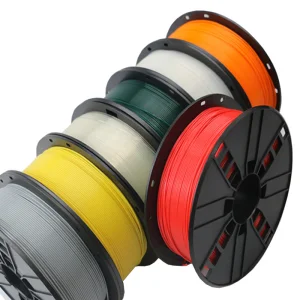
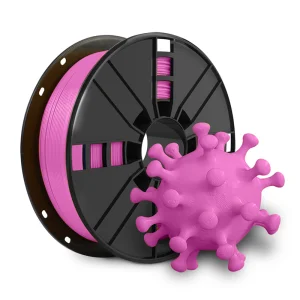
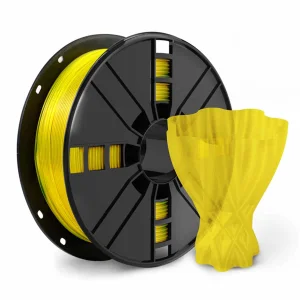
Explore our premium selection of factory-direct 3D printer filaments engineered for exceptional tensile performance, accurate dimensional consistency, and flawless aesthetic finish.
In the rapidly expanding Fused Deposition Modeling (FDM) additive manufacturing sector, Silk PLA (Polylactic Acid) 1.75mm has evolved from a niche cosmetic material into a dominant thermoplastic category for commercial display, high-end prototyping, giftware, and consumer product design. Achieving the characteristic satin-like metallic luster without sacrificing inter-layer adhesion or structural tensile strength requires precise polymer compounding and micro-structural formulation.
Standard PLA is a rigid aliphatic polyester derived from renewable plant starches (such as corn or sugarcane). While inherently brittle with low impact resistance, its high clarity and ease of printing make it an ideal base polymer. To engineer Wholesale Silk PLA 1.75mm filament, factory compounding teams blend pure Poly-L-lactic acid (PLLA) with specialized elastomeric modifiers—primarily Thermoplastic Elastomers (TPE/TPU) and high-sheen micro-polyester additives. This phase-separated blend alters how light refracts off the extruded layer lines.
The silky sheen is generated by microscopic domain dispersion of thermoplastic modifiers within the matrix. As molten filament exits the nozzle under pressure, these elastomeric particles align parallel to the extrusion pathway, forming a ultra-smooth microscopic boundary layer that reflects light speculatively rather than diffusely.
Blending additives lowers the glass transition temperature ($T_g$) slightly to around 55°C–60°C while modulating the Melt Flow Index (MFI). This ensures consistent flow across a standard 190°C–220°C print window, minimizing heat creep while preventing stringing, ooze, and nozzle clogging during high-speed printing.
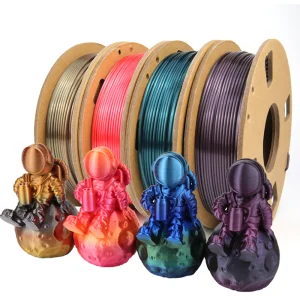
For Dual-Color and Tri-Color Silk PLA, advanced factories utilize co-extrusion die heads where two or three distinct color melt streams are merged into a single 1.75mm strand without mixing. The precise alignment preserves a sharp 50/50 or 33/33/33 longitudinal cross-section, creating chromatic dichroic visual effects upon model rotation.
When procuring wholesale quantities for brand distribution or print farm operation, technical buyers must analyze physical and mechanical property shifts resulting from silkening additives:
| Material Property | Standard Pure PLA | Torwell Premium Silk PLA | Test Standard / Method |
|---|---|---|---|
| Diameter Tolerance | ±0.03 mm to ±0.05 mm | ±0.02 mm (Dual-Axis Laser Control) | ISO 23529 / Inline Gauge |
| Glass Transition Temp ($T_g$) | 60°C – 65°C | 55°C – 60°C | DSC (Differential Scanning Calorimetry) |
| Melting Point ($T_m$) | 165°C – 180°C | 155°C – 170°C | DSC Analysis |
| Tensile Strength (X-Y Axis) | 55 – 65 MPa | 48 – 58 MPa | ASTM D638 / ISO 527 |
| Elongation at Break | 3% – 5% (Brittle) | 8% – 12% (Increased Toughness) | ASTM D638 |
| Recommended Print Nozzle Temp | 190°C – 210°C | 200°C – 220°C (Higher Temp = Greater Shine) | FDM Print Calibration Test |
| Recommended Print Bed Temp | 45°C – 60°C | 50°C – 60°C (PEI / Glass Plate) | Thermal Plate Test |
| Recommended Print Speed | 40 – 100 mm/s | 50 – 300 mm/s (High Speed Compatible) | CoreXY Print Farm Rig |
Note: Printing Silk PLA at higher nozzle temperatures (e.g., 215°C–225°C) enhances polymer chain mobility at the shell surface, significantly amplifying the glossy pearlescent reflection while increasing inter-layer adhesion strength.
As the global hub of 3D printing material manufacturing, China's ecosystem offers unmatched economies of scale, chemical compounding expertise, and equipment automation. Sourcing directly from established OEM factories like Torwell Technologies provides global brands and distributors with distinct structural competitive edges:
Operating over 2,500 m² of standardized workshop space, our facility features 6 state-of-the-art continuous extrusion lines equipped with automatic vacuum gravimetric feeders, closed-loop melt pumps, and dual-stage cooling baths. Monthly production ranges from 50,000 kg to 60,000 kg, facilitating rapid turnaround for multi-container order volumes.
To eliminate diameter variation—the primary culprit behind extrusion jams and uneven wall thickness—every millimeter of filament passes through dual-axis high-frequency laser micrometers. Deviations exceeding ±0.02mm automatically trigger puller speed adjustments, ensuring unyielding batch-to-batch consistency.
Loose or overlapping spools cause tension spikes and tangles that stop high-speed printers and multi-material systems (such as Bambu Lab AMS). Our factory utilizes high-precision CNC tension-controlled auto-winders that lay down perfectly parallel spools from hub to rim.
For enterprise buyers, regional distributors, and e-commerce brand owners (Amazon/Shopify sellers), establishing a localized brand identity with stable product performance is key to long-term profitability. As a turnkey China Silk Filament 1.75 PLA Supplier, we provide complete private label customization:
Beyond our 60+ standard stock colors (including Gold, Silver, Bronze, Copper, Rose Gold, Silk Rainbow, and Dual-Color co-extrusions), our color laboratory precisely matches physical masterbatch samples or Pantone color codes within 5 business days.
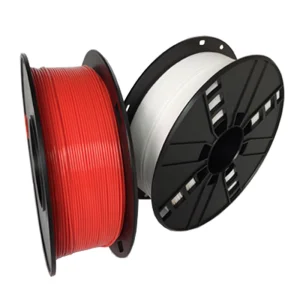
Choose between ultra-light ABS/PC transparent plastic spools or eco-friendly 100% recyclable cardboard spools designed to fit standard AMS multi-material hubs. Spool weights are customizable: 250g sample mini-spools, 1kg standard retail spools, up to 3kg/5kg bulk industrial spools.
To prevent hydrolysis and moisture degradation during long ocean transport (typically 30–45 days), each spool is baked, immediately vacuum-sealed with high-capacity desiccant in thick anti-puncture foil bags, and packaged into drop-test verified high-burst-strength cartons.
Entering stringent markets across North America, the European Union, Australia, and Japan demands full compliance with environmental and chemical safety regulations. Torwell filaments undergo rigorous third-party laboratory verification (SGS/TÜV) to streamline customs clearance and protect brand liability:
Free from heavy metals (Lead, Cadmium, Mercury, Hexavalent Chromium) and restricted Substances of Very High Concern (SVHC) listed under EU REACH regulations. Safe for indoor home, office, and educational use.
Compounded using food-grade base PLA resins and non-toxic colorants. Thermal extrusion testing confirms minimal Volatile Organic Compound (VOC) emissions during printing compared to ABS or Styrene-based materials.
Every shipment includes updated Material Safety Data Sheets (MSDS), Technical Data Sheets (TDS), and Certificate of Analysis (CoA) records, providing regional distributors with complete legal backing.
Understanding where Silk PLA 1.75mm is deployed enables resellers to target high-margin vertical markets. The unique aesthetic properties eliminate post-processing steps like sanding, priming, or painting:
Vases, lampshades, interior design sculptures, and scale architectural concept models print with invisible layer transitions and natural silk sheen under ambient lighting.
Popular for armor pieces, ceremonial swords, crowns, and movie replica props where high metallic brilliance (Gold, Silver, Bronze) is required directly off the build plate.
Custom jewelry boxes, cosmetics container prototypes, trophies, and premium holiday ornaments benefit from the pearlescent surface finish, elevating perceived brand value.
Odors-free, non-toxic, and visually stimulating color palettes make Silk PLA an attractive consumable for university design labs, school STEM programs, and maker spaces.
As FDM 3D printing accelerates toward high-speed kinematics (print speeds exceeding 500 mm/s and accelerations beyond 20,000 mm/s²), traditional filament formulations face thermal transfer limitations. Factory R&D is pioneering next-generation material innovations:
Standard silk additives can lose luster or experience inter-layer weakening under rapid cooling fans at 300+ mm/s. Novel low-viscosity silk polymers maintain rapid thermal conductivity, ensuring full micro-luster development even at short layer times.
Demand is shifting from monochromatic silk toward rapid rainbow color-change cycles (transitioning color every 3–5 meters) and multi-axis co-extrusion (Dual, Tri, and Quad silk strands), creating dynamic iridescent prints without nozzle swaps.
Transitioning fully toward zero-waste packaging. Factory production lines are standardizing high-stiffness glued cardboard spools, bio-degradable desiccant pouches, and FSC-certified unbleached packaging boxes.
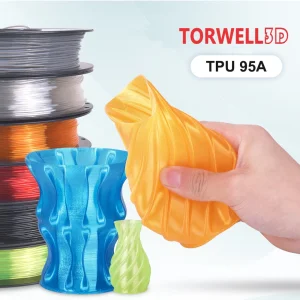
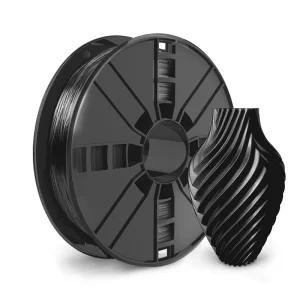
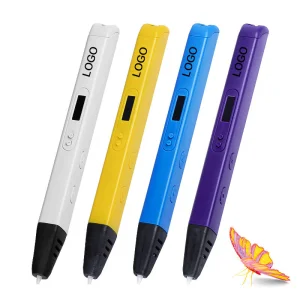
Discover our expanded catalog of specialized materials including high-flexibility TPUs, durable ABS formulations, and comprehensive print pen accessory kits.
Answers to common technical, manufacturing, and supply chain questions raised by global distributors and enterprise buyers: