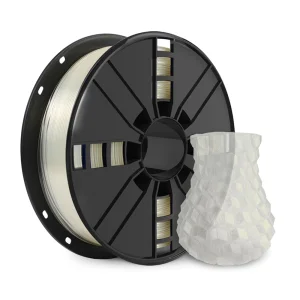
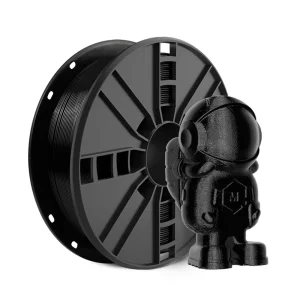
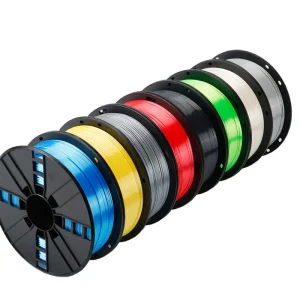
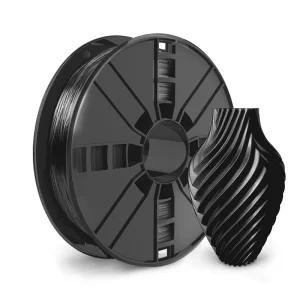
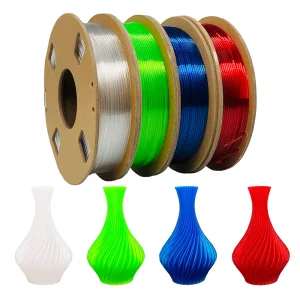
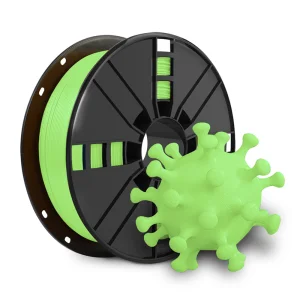
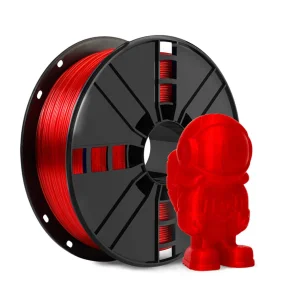
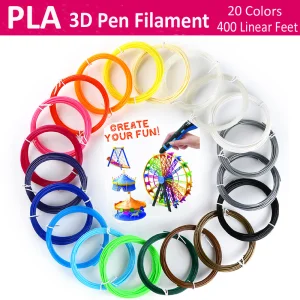
Direct factory-grade 3D printer filaments featuring tight ±0.02 mm tolerance and advanced multi-color aesthetics.
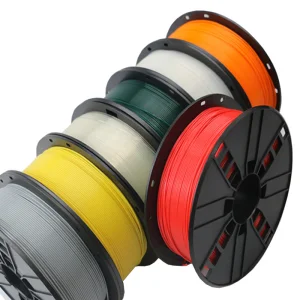
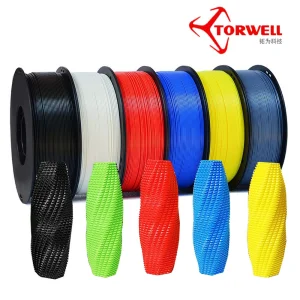
Analyzing market growth, shift toward multi-color aesthetic additive manufacturing, and institutional B2B procurement dynamics.
The global fused deposition modeling (FDM) 3D printing consumables market is experiencing a massive shift. Multi-color gradient filaments, specifically high-speed Silk Rainbow PLA and flexible TPU Rainbow, represent one of the fastest-growing categories in wholesale procurement. Driven by consumer demand for visually striking models without post-processing or multi-extruder hardware, rainbow filaments have transitioned from niche aesthetic novelties to core inventory items for major distributors, Amazon private labels, and commercial print farms.
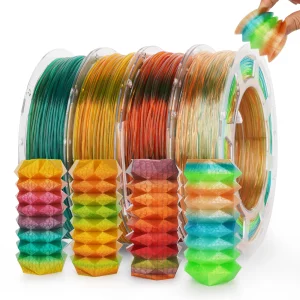
Wholesale buyers evaluate rainbow filament manufacturers on three essential criteria: transition length consistency, layer adhesion performance, and dimensional stability. Unlike single-color filaments where minor pigment variations pass unnoticed, rainbow filaments require precise continuous extrusion control. B2B clients demand standardized color transition cycles (e.g., fast gradient every 3–5 meters or subtle long gradient every 15–20 meters) to ensure reliable end-user print aesthetics across production batches.
As automated multi-material print systems (such as AMS and KSU multi-spool feed units) dominate the desktop and prosumer 3D printing ecosystem, factory-level quality assurance has become non-negotiable. Leading wholesale suppliers must guarantee tangle-free spooling, zero moisture inclusion, and uniform melting behavior. Suppliers capable of offering fully automated OEM packaging, custom spool weights, and verifiable ISO/REACH/RoHS compliance maintain a definitive competitive advantage.
Technical breakdown of polymer blends, pigment dispersion dynamics, and laser-monitored extrusion physics.
Manufacturing commercial-grade rainbow filament requires precise adjustment of the base polymer’s melt flow index (MFI).
• Silk PLA Rainbow: Formulated using high-purity Poly(lactic acid) blended with organic impact modifiers and micro-crystalline luster agents (such as bio-compatible mica or synthetic fluorophlogopite). This combination yields high reflectivity while maintaining layer bond strength.
• TPU 95A Rainbow: Utilizes thermoplastic polyurethane with optimized elastic recovery and shore hardness balance. TPU rainbow extrusion requires low-shear twin-screw compounding to prevent thermal degradation while ensuring vibrant multi-tone color transitions.
• PETG Rainbow: Combines Polyethylene Terephthalate Glycol-modified resin with heat-stable dye matrices, maintaining chemical resistance and mechanical toughness alongside fast color gradient shifting.
The engineering hallmark of top-tier rainbow filament lies in controlling the Color Transition Pitch (the filament length required to cycle through the full spectral palette). Advanced production facilities utilize multi-channel dynamic color dosing units connected directly to the extruder throat.
By dynamically altering the volumetric feeding ratio of masterbatch concentrates (Red, Yellow, Green, Blue, Purple, Gold) without disturbing the total polymer throughput, the factory produces uniform color gradients.
Fast-Gradient Filaments: Engineered with a short transition pitch of 3 to 5 meters, allowing even small 50g-100g prints to display 3 to 4 distinct color shifts.
Standard Long-Gradient Filaments: Feature a 15 to 20-meter pitch designed for large-format architectural and sculptural models.
| Filament Grade | Density (g/cm³) | Melt Index (MFI) | Extrusion Temp Range | Bed Temp Range | Tensile Strength | Color Transition Pitch |
|---|---|---|---|---|---|---|
| Silk Rainbow PLA | 1.24 - 1.26 | 7-9 g/10min (190°C/2.16kg) | 190°C - 225°C | 45°C - 60°C | ≥ 58 MPa | 3m - 5m (Fast) / 15m (Long) |
| Flexible TPU 95A Rainbow | 1.20 - 1.22 | 12-15 g/10min (210°C/2.16kg) | 210°C - 235°C | 30°C - 50°C | ≥ 35 MPa | 5m - 8m (Standard) |
| High-Toughness PETG Rainbow | 1.27 - 1.29 | 10-14 g/10min (230°C/2.16kg) | 230°C - 250°C | 70°C - 85°C | ≥ 48 MPa | 8m - 12m (Standard) |
| Sparkling / Glitter PLA | 1.25 - 1.27 | 6-8 g/10min (190°C/2.16kg) | 200°C - 230°C | 50°C - 65°C | ≥ 52 MPa | Single / Multi-Blend Options |
Eliminating print jams, ovality defects, and color banding through state-of-the-art dual-axis laser inspection systems.
During continuous melt extrusion, diameter fluctuations directly translate into flow rate inconsistencies, causing under-extrusion or nozzle clogging. Advanced production lines employ dual-axis high-frequency laser micrometers positioned after water cooling troughs. These sensors measure filament outer diameter at 1,000 Hz frequencies across X and Y axes simultaneously, enforcing a strict target tolerance of ±0.02 mm.
Laser measurement units interface directly with the haul-off puller motor PLC via a real-time closed-loop control system. If the filament diameter trends toward 1.77 mm, the puller instantly speeds up by micro-fractions of a millimeter per second to stretch the melt line back to 1.75 mm. Conversely, if diameter drifts down to 1.73 mm, puller speed reduces instantly. This guarantees zero diameter spikes throughout full 1,000-meter continuous runs.
Tangled filament causes severe operational loss in automated multi-spool printing hubs. Automated CNC spooling machinery utilizes optical sensor arrays and mechanical traverse arms to lay filament down layer-by-layer under constant servo tension. This precise traverse control prevents overlapping coils, cross-under loops, or loose winding, ensuring smooth unspooling even during high-speed printing retracts.
How regional markets and specialized industries leverage wholesale rainbow filament products for maximum economic yield.
In North America, private label brands selling via e-commerce platforms focus heavily on Silk Rainbow PLA and Fast-Gradient Multi-Color PLA. Consumers prefer eye-catching desk art, dragon figurines, pop-culture prop replicas, and toy accessories that require zero manual painting. Distributors prioritize custom co-branded packaging, transparent spools, and standardized 1kg net weight spools designed for immediate fulfillment.
European B2B buyers emphasize material compliance, eco-friendly spools, and reduced carbon footprints. Demand centers on virgin bio-based PLA formulations packed on recycled cardboard spools. Common application scenarios include architectural lighting diffusion shades, ergonomic consumer accessories, luxury retail displays, and bio-compatible educational prototyping materials certified under EU REACH regulations.
In APAC manufacturing hubs, massive commercial 3D print farms running hundreds of high-speed FDM machines consume bulk quantities of TPU Rainbow 95A and High-Speed PLA Rainbow. Key application verticals include mass-producing colorful footwear prototypes, flexible phone protection bumpers, custom sensory toys, and rapid commercial prop manufacturing where consistent flow rates at high print speeds (300-500 mm/s) are critical.
Turnkey manufacturing services for global distributors, resellers, and private label brand owners.
Enterprises can specify exact color hex codes, Pantone references, or order dedicated color order cycles (e.g., Pastel Rainbow, Metallic Tri-Color, Neon Dark Gradient) tailored to target seasonal market trends.
Select from environmentally friendly cardboard spools, high-durability clear polycarbonate spools, or high-speed auto-feed compatible spools. Packaged in vacuum-sealed moisture-barrier bags with fresh desiccant packs.
Every production batch includes comprehensive documentation: Technical Data Sheets (TDS), Safety Data Sheets (SDS), RoHS compliance certificates, and REACH SVHC declarations required for international customs clearing.
Direct OEM factory fulfillment with optimized carton dimensions for ocean container utilization (20GP, 40HQ). Palletized with moisture shrink wrapping to protect cargo during sea transportation.
Next-generation material innovations driving the future of high-speed FDM additive manufacturing.
As modern FDM printers reach acceleration speeds of 20,000 mm/s² and print speeds exceeding 500 mm/s, legacy rainbow filaments suffer from optical dulling and flow starvation. Next-generation formulas incorporate low-viscosity polymer modifiers that increase melt flow rate without reducing interlayer shear strength, keeping color lustres vibrant even at extreme printing speeds.
Future material research focuses on integrating smart response additives directly into multi-color extrusions. Development pipelines include UV-reactive chromatic rainbow filaments that change color spectrum under direct sunlight, thermochromic gradient lines that visually map thermal distributions on functional printed parts, and conductive multi-tone composites for aesthetic structural electronics.
Addressing environmental sustainability, continuous-extrusion factories are pioneering 100% chemically recycled PLA (rPLA) and PETG (rPETG) rainbow filaments. Utilizing purified post-industrial polymer waste combined with non-toxic bio-pigments allows factory lines to achieve identical mechanical strength and surface quality to virgin resins while drastically cutting carbon footprints.
Direct engineering and procurement answers for wholesale buyers, print farm operators, and OEM partners.
For standard catalog products (such as stock Silk Rainbow PLA or TPU 95A Rainbow), our minimum order quantity starts at 100 kg. For custom OEM branding—including custom Pantone color sequence transitions, private label spool stickers, and branded outer cartons—the standard MOQ is 500 kg per SKU. We also support mixed-SKU palletized orders for established regional distributors.
Silk PLA filaments naturally contain elastomer modifiers and gloss agents that can weaken layer-to-layer adhesion if incorrectly formulated. Our factory solves this by utilizing a specialized melt-grafting process during twin-screw extrusion, enhancing polymer chain entanglement. Furthermore, we maintain strict control over moisture content (under 0.05% before vacuum sealing), ensuring optimal inter-layer bonding during printing.
Yes. All our latest rainbow filament iterations feature an upgraded high melt flow index (MFI) base resin formulation. This enables rapid thermal absorption in high-flow hotends (such as ceramic heater blocks), ensuring complete melting and smooth extrusion at print speeds up to 500 mm/s without causing click-grinding in direct-drive extruders or color degradation.
We employ dual-axis high-speed laser gauge micrometer measurement systems directly on every automated extrusion line. Out-of-spec segments (exceeding ±0.02 mm) are automatically flagged and cut by an inline automated reject system. In addition, every finished production lot undergoes physical sample testing on multi-brand FDM test rigs before entering packaging.
We offer both precision-molded smooth-rim plastic spools and high-durability recycled cardboard spools featuring rounded press-fitted plastic rims. Both designs are engineered with standard outer diameters (200mm), inner hub diameters (54mm), and smooth edge geometry to prevent slippage or friction jams inside AMS and auto-feed systems.
When stored in its original unopened vacuum package with desiccant in a cool, dry environment, our filament has a verified shelf life of 24 months. For hygroscopic materials like TPU and PETG, we utilize thick aluminum-foil composite or heavy-duty vacuum seal bags to guarantee zero ambient moisture penetration during long ocean transit and warehouse storage.
Explore additional specialized technical filaments, transparent options, and engineering materials.