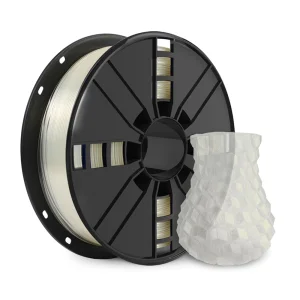
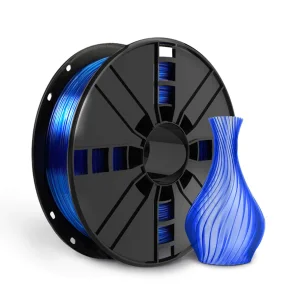
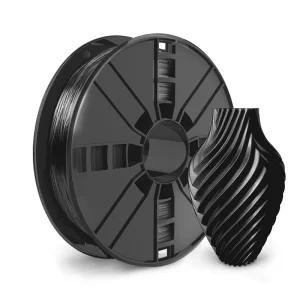
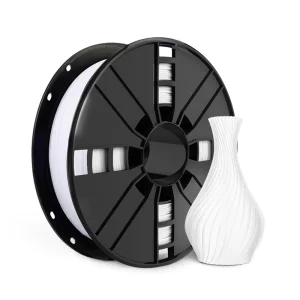
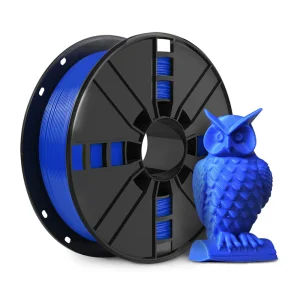
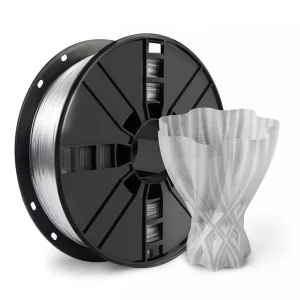
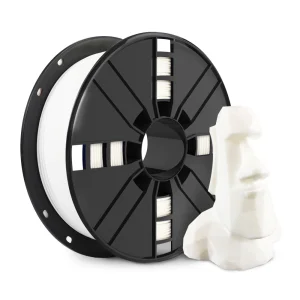
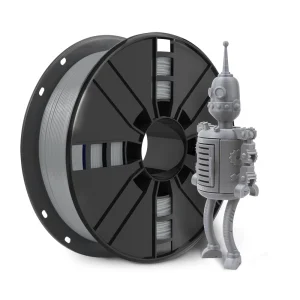
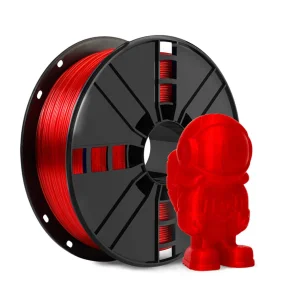
Direct factory supply of high-purity thermoplastic filaments manufactured under strict ISO 9001 quality controls with ±0.02 mm inline laser diameter monitoring.
Polyethylene Terephthalate Glycol-modified (PETG) has solidified its position as the premier bridge polymer in additive manufacturing, seamlessly connecting the ease-of-use associated with Polylactic Acid (PLA) and the high mechanical resilience of Acrylonitrile Butadiene Styrene (ABS). For international wholesale buyers, print farm operators, and private-label distributors, sourcing from specialized wholesale printing PETG suppliers and direct extrusion factories represents a mission-critical supply chain strategy.
The global market demand for high-grade 3D printing filaments is undergoing a dramatic structural transformation. Driven by the rapid proliferation of high-speed FDM/FFF desktop and industrial 3D printers (operating at velocity thresholds exceeding 300 mm/s to 600 mm/s), legacy polymer formulations are no longer adequate. PETG’s chemical structure—specifically its non-crystallizing amorphous nature modified with 1,4-cyclohexanedimethanol (CHDM)—prevents brittle cracking and unwanted micro-crystallization during ultra-fast extrusion cycles.
Information Gain Insight: Unlike standard PET, the addition of CHDM glycol groups disrupts polymer chain regularity, resulting in an amorphous resin that resists stress whitening and maintains high optical clarity even under severe mechanical flexure.
As the global 3D printing industry matures from low-volume rapid prototyping into full-scale direct digital manufacturing, the technical parameters demanded by corporate procurement managers have evolved. B2B purchasers sourcing from printing PETG factories must navigate four primary technological waves currently reshaping the market:
Modern high-speed printers generate high volumetric flow rates ($>30\text{ mm}^3/\text{s}$). Specialized PETG formulations integrate internal lubricants and melt flow index (MFI) modifiers, ensuring rapid thermal melting in hotends without sacrificing inter-layer adhesion strength.
Global ESG directives are driving demand for high-strength recycled PETG (rPETG) compounds paired with zero-waste cardboard or fully biodegradable spools. Leading factories now offer closed-loop scrap recycling systems to reduce carbon footprints.
To satisfy industrial automotive and aerospace tooling demands, wholesale suppliers are compounding virgin PETG with short carbon fiber (PETG-CF), glass fiber (PETG-GF), or flame-retardant additives compliant with UL-94 V-0 safety standards.
Understanding the exact physical, mechanical, and thermal performance indicators of PETG allows procurement engineers to match application requirements precisely. The following comparative data matrix reflects factory laboratory testing under ISO/ASTM standard conditions:
| Mechanical Property | PETG (Standard) | PLA (High-Speed) | ABS (Industrial) | ASA (Weather-Resistant) |
|---|---|---|---|---|
| Tensile Strength (Yield, MPa) | 50 ± 3 | 62 ± 4 | 43 ± 3 | 45 ± 4 |
| Flexural Modulus (GPa) | 2.1 ± 0.1 | 3.15 ± 0.2 | 2.25 ± 0.15 | 2.10 ± 0.1 |
| Izod Impact Strength (kJ/m²) | 8.5 ± 0.5 | 3.2 ± 0.3 | 12.5 ± 0.8 | 10.0 ± 0.6 |
| Glass Transition Temp ($T_g$) | 80 °C | 60 °C | 105 °C | 100 °C |
| Chemical Resistance | High (Acids, Alkalis, Oils) | Moderate | Low (Soluble in Acetone) | High (UV & Weather Proof) |
| Moisture Absorption Rate | ~0.20% (Hygroscopic) | ~0.30% | ~0.40% | ~0.35% |
| Layer Adhesion Energy | Exceptional (Near Isotropic) | Moderate | Low (Thermal Shrink Risk) | Moderate-High |
Due to its exceptionally low thermal contraction coefficient ($<0.5\%$), PETG eliminates the severe warping and corner lifting phenomena common to ABS and ASA when printed without heated chambers. This makes PETG the default polymer for large-format additive manufacturing ($>500\text{ mm}^3$ build volumes).
From North American automotive manufacturing hubs to European medical device facilities and East Asian retail display manufacturing centers, wholesale PETG printing materials serve diverse localized industrial demands:
Region: Europe & North America
Custom medical trays, prosthetics test sockets, and surgical guide prototypes. Pure clear PETG conforms to ISO 10993 cytotoxicity standards and allows Gamma ray or ethylene oxide sterilization.
Region: Germany, Japan, USA
Assembly line arm end-effectors, inspection gauges, and ergonomic handheld tools. High impact resistance combined with oil and grease tolerance makes PETG superior to unmodified PLA in workshop environments.
Region: Global Commerce & Retail
FDA 21 CFR compliant food-contact containers, cosmetic bottle prototyping, and translucent display housings. High light transmission ($>90\%$) enables glass-like visual aesthetics.
Region: Southeast Asia & India
Outdoor sensor boxes, drone frames, and IoT gateway housings requiring weather durability, moisture resistance, and reliable structural rigidity under variable temperatures.
Supplying consistent, tangle-free, bubble-free PETG filament at scale demands rigorous control over material chemistry, thermodynamic cooling, and mechanical spooling. Professional wholesale suppliers operate under standardized multi-stage manufacturing protocols:
Virgin PETG resin is hydroscopic and must be dried in desiccant rotor dryers at 70°C–80°C for 6 to 8 hours until internal moisture drops below 150 ppm (0.015%), eliminating steam bubbles and nozzle popping during printing.
Extrusion lines incorporate 1000 Hz dual-axis laser diameter gauges. Filaments are continuously scanned for diameter variance ($\pm 0.02\text{ mm}$) and ovality ($<0.01\text{ mm}$). Out-of-spec segments are automatically cut and purged.
Automated CNC winding gear regulates spooling torque, placing clean layer-by-layer parallel loops to guarantee zero tangles—an essential requirement for automated multi-material print systems (AMS).
When selecting a factory partner for wholesale PETG filament, procurement officers must look beyond initial unit cost per spool. Long-term profitability and brand reputation depend on several critical operational parameters:
Leading factories possess in-house spectrophotometer color-matching laboratories capable of duplicating custom corporate RAL/Pantone color targets within $\Delta E < 1.0$ consistency across multi-ton production batches.
Full private-label turnkey solutions include customized vacuum barrier bags, high-grade desiccant packets, customized cardboard spools, outer retail boxes, and master shipping cartons optimized for Amazon FBA or sea-freight container loading.
Ensure your factory supplier provides comprehensive Safety Data Sheets (SDS), RoHS compliance certification, REACH authorization, and FDA food-contact declaration letters to ensure smooth customs clearance worldwide.
Material R&D centers are currently focused on pushing the boundary performance of glycol-modified polyester filaments to capture market share from traditional engineering plastics. Key innovation tracks slated for 2025–2028 include:
Incorporating exfoliate montmorillonite nanoclays to drastically reduce vapor transmission rates, creating ultra-impermeable containers for pharmaceutical storage and liquid chemical containment.
Addressing the inherent weak link of 3D printing—interlayer Z-height tensile drop. Advanced chain-extender additives enable transesterification reactions across printed layer boundaries during deposition.
Eliminating the traditional ultra-glossy finish of PETG through microscopic phase-separated additives that diffuse light reflections, yielding a smooth satin texture preferred for architectural models.
PETG offers the ideal commercial middle ground. It delivers mechanical toughness, temperature resistance ($T_g = 80^\circ\text{C}$), and chemical durability superior to PLA, while completely avoiding the warping, toxic styrene fumes, and heated enclosure requirements of ABS. This makes it suitable for both hobbyist users and demanding industrial print farms, maximizing your target customer addressable market.
Standard factory MOQs for custom-branded packaging or custom Pantone color matching typically range from 500 kg to 1,000 kg depending on spool size specifications. Lead time for mass production is generally 10 to 15 business days following sample approval and packaging proof confirmation.
Every single spool undergoes automated inline drying down to $<150\text{ ppm}$ moisture content immediately prior to winding. Spools are then vacuum-packed in high-density aluminum-poly foil or thick PE vacuum bags with active silica gel desiccant packs, protecting the material against humidity changes for up to 24 months in storage.
Our production lines operate inline 2-axis high-speed laser micrometers measuring diameter variance at 1000 times per second. We guarantee a continuous diameter tolerance of $\pm 0.02\text{ mm}$ for both 1.75 mm and 2.85 mm specifications, preventing nozzle clogs and extrusion starvation.
Yes. Our high-flow PETG formulations feature optimized rheology designed for high volumetric speed printing up to $30-35\text{ mm}^3/\text{s}$. This permits print speeds ranging from 250 mm/s to 500 mm/s without layer delamination or extruder gear slipping, provided nozzle temperature is adjusted to 240°C–260°C.
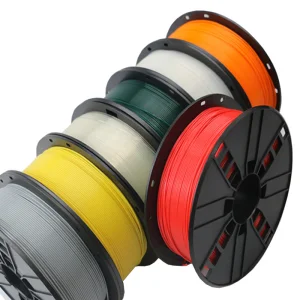
Select from our comprehensive inventory of engineering polymers, flexible materials, and aesthetic specialty filaments available for container volume export.