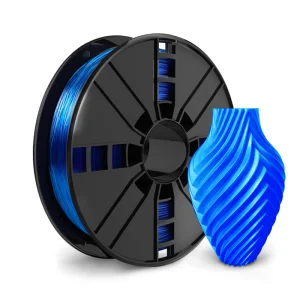
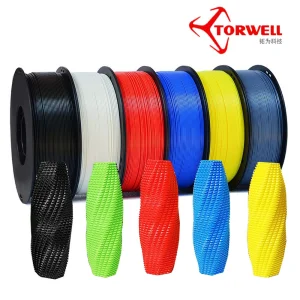
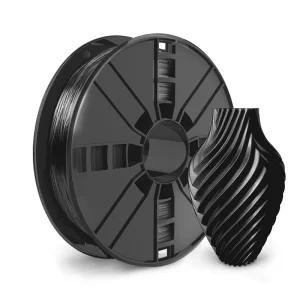
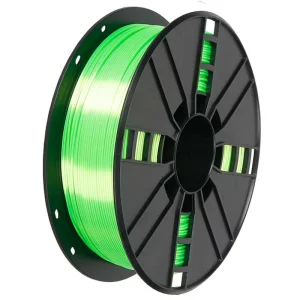
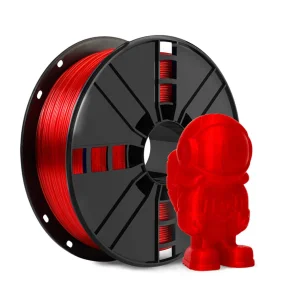
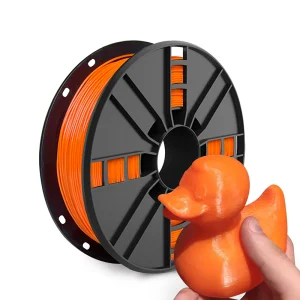
Direct factory access to our highest-demand 3D printing filaments, manufactured with strict laser tolerance controls and export-grade vacuum moisture seal protection.
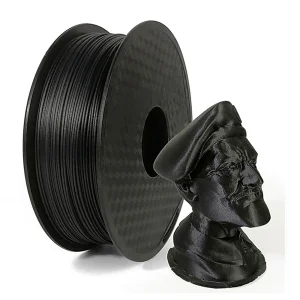
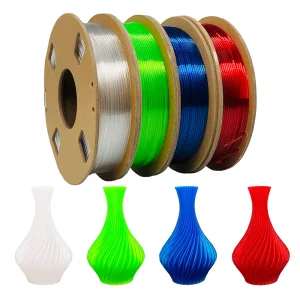
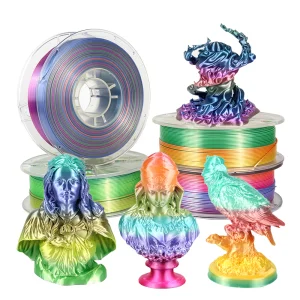
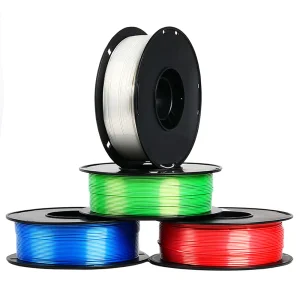
In the rapidly expanding fused deposition modeling (FDM) additive manufacturing sector, PLA Rainbow Filament 1.75mm has emerged from a niche decorative consumable into a cornerstone volume-driver for global distributors, e-commerce brand owners, and commercial print farms. As modern desktop and industrial 3D printers achieve print speeds exceeding 500 mm/s, the technical demands placed on multi-color co-extruded polymers have transformed dramatically. B2B buyers no longer seek merely "aesthetic filaments"; they require high-speed melt stability, pristine layer adhesion, precise color-change pitch lengths, and zero-spool-tangle reliability.
As a primary Wholesale PLA Rainbow Filament 1.75mm Manufacturer operating automated extrusion lines since 2011, Torwell Technologies addresses the core pain points of international supply chains. By combining raw NatureWorks Ingeo™ polylactic acid resin matrixes with specialized organic luster masterbatches and real-time dual-axis laser micrometer tracking, we engineer rainbow filaments that mitigate common field defects such as nozzle clogging, thermal degradation, micro-void bubbling, and pitch inconsistency.
Achieving vibrant, seamless gradient transitions across a continuous 1.75mm strand without compromising structural integrity requires advanced polymer rheology management. Standard monofilament extrusion involves single melt-zone homogenization; conversely, manufacturing premium rainbow PLA demands multi-meter color transition control.
A major point of differentiation for global buyers is color pitch length. Traditional rainbow PLA transitions every 10 to 15 meters, meaning small printed models (under 50 grams) display only one or two static colors. Torwell’s engineered Fast Color Gradient Change Rainbow PLA features a shortened transition cycle of 3 to 5 meters. This allows even compact printed figures, novelty items, and decorative prototypes to showcase a complete rainbow spectrum across the surface.
Modern high-speed extruders (such as Bambu Lab AMS and Creality K1 series) are exceptionally sensitive to diameter variance. Ovality fluctuations exceeding ±0.03mm can lead to feeder gear slipping, extrusion under-dosing, or heat-break clogging. Our continuous dual-axis laser feedback loops measure diameter at 500 Hz per second, automatically adjusting feed screw speeds to guarantee an unwavering target of 1.75mm (±0.02mm).
| Property / Parameter | Test Method / Standard | Technical Value (PLA Rainbow 1.75mm) | Impact on Printing Performance |
|---|---|---|---|
| Filament Diameter Tolerance | Dual-Axis Laser Micrometer | 1.75 mm ± 0.02 mm (Ovality ≤ 1.5%) | Prevents gear grinding & clogging in high-speed feeders. |
| Melt Flow Index (MFI) | ISO 1133 (210°C / 2.16kg) | 7 – 10 g / 10 min | Ensures smooth fluidity during rapid printing cycles. |
| Density | ISO 1183 | 1.24 g/cm³ | Consistent mass yield across 1kg and bulk spools. |
| Glass Transition Temperature (Tg) | DSC (10°C/min) | 58°C – 62°C | Determines bed heating requirement & thermal deflection. |
| Tensile Strength (Yield) | ISO 527 | 55 MPa – 65 MPa | Provides structural toughness for printed components. |
| Color Change Pitch Length | Optical Spectrometry | 3m – 5m (Fast) / 10m – 15m (Standard) | Determines color transition density across part heights. |
| Recommended Printing Nozzle Temp | Direct Hotend Sensor | 190°C – 225°C | Broad processing window for desktop & industrial units. |
| Recommended Heated Bed Temp | Integrated Bed Thermistor | 50°C – 65°C (PEI / Glass Surface) | Eliminates corner warping without secondary adhesives. |
Procuring 3D printing consumables at container scale requires far more than aesthetic appeal. Procurement directors for major retail brands, Amazon FBA sellers, and regional B2B distributors demand rigorous manufacturing consistency, flexible OEM packaging, and supply chain security.
The primary cause of retail returns for rainbow filaments is shade discrepancy between orders. Torwell utilizes automated masterbatch gravimetric dosing systems during raw compounding, guaranteeing that the spectrum order (e.g., Silk Red → Yellow → Green → Blue → Purple) remains identical from lot to lot.
PLA is hygroscopic; excess ambient humidity absorption leads to polymer hydrolysis during hotend melting, creating popping sounds, stringing, and weak layer bonds. Every spool produced in our factory is baked in dehumidifying ovens, then vacuum sealed with a high-capacity desiccant pouch within a 4-layer barrier film.
We provide full turnkey OEM/ODM services: customized spool geometry (clear PC, black ABS, or eco-friendly cardboard spools), branded sticker labels, custom die-cut retail outer boxes, Pantone-matched masterbatch formulations, and custom net weight configurations (250g, 500g, 1kg, 3kg, 5kg).
PLA Rainbow Filament 1.75mm is widely deployed across diverse commercial verticals due to its visual appeal and low post-processing costs:
The high-gloss silk pearlescent finish of rainbow PLA diffuses light effectively, masking layer lines inherent to FDM 3D printing. This makes it the preferred material for producing art vases, dragon models, cosplay props, and interior lighting shades without requiring labor-intensive manual sanding or painting.
For print farm operators managing hundreds of machines simultaneously, spool reliability translates directly to profitability. Our neat-winding spool technology utilizes precision tension sensors, eliminating cross-over tangles and reducing unmanned print failure rates by over 99.2%.
Derived from renewable corn starch and sugarcane feedstocks, our PLA formulations emit zero toxic VOCs or styrene fumes during printing. Schools and universities utilize rainbow filaments to engage students in CAD design and additive prototyping with visually dynamic results.
Product designers use multi-tone fast-gradient filaments to evaluate ergonomics and visual segmentation in toy prototypes during initial concept phases, bypassing the cost of early multi-material tooling.
Navigating customs regulations and environmental standards across North America, the European Union, and Asia-Pacific requires strict compliance documentation from your manufacturing partner.
All Torwell PLA products are certified under RoHS (Directive 2011/65/EU) and REACH (EC 1907/2006) standards, ensuring the complete absence of heavy metals, SVHC toxins, phthalates, and hazardous halogenated flame retardants.
Our raw resin additives comply with FDA 21 CFR specifications for indirect food contact, providing peace of mind to distributors supplying consumer accessory markets.
Master cartons are fabricated from 5-ply corrugated reinforced fiberboard, engineered to withstand compressive loads during multi-week ocean transit and drop tests without compromising internal vacuum integrity.
As the additive manufacturing industry transitions toward high-speed CoreXY platforms and automated multi-material systems, Torwell’s R&D team is actively driving next-generation material innovations:
We are optimizing raw polymer chain lengths to lower shear viscosity at elevated melt temperatures, allowing flawless extrusion at flow rates exceeding 30 mm³/s without layer strength reduction.
Transitioning 100% of our spool lineup to high-grade recycled post-consumer cardboard, complete with high-friction silicone-coated flanges designed specifically for automated AMS roller feeding.
Embedding customized RFID micro-tags into spool cores to allow automatic color profile, melt temperature, and remaining weight recognition across smart 3D printing ecosystems.
Detailed engineering and commercial answers to help procurement managers evaluate Torwell PLA Rainbow Filament.
Explore our full line of functional engineering, flexible, and specialty materials engineered for high-performance 3D printing applications.