Featured extrusion materials manufactured under strict ISO 9001:2015 quality standards with inline laser micrometer diameter tracking.
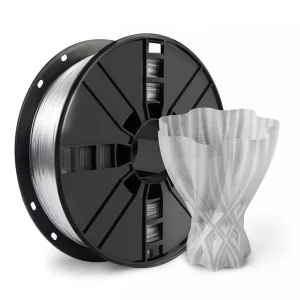
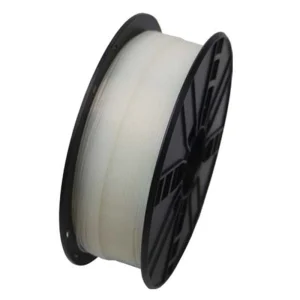
Understanding the molecular dynamics, pigment dispersion physics, and crystallographic behavior required to engineer industrial-grade white 3D printing monofilament.
White PLA requires opaque, pure pigmentation without degrading mechanical toughness. High-tier Chinese factories utilize sub-micron Rutile Titanium Dioxide ($\text{TiO}_2$) surface-treated with alumina-silica coatings. This prevents polymer degradation during melt compounding while delivering 99% light opacity under standard 0.2mm layer heights.
Standard white PLA filaments suffer from brittleness if pigment loading exceeds threshold values. Advanced suppliers balance the Melt Flow Index (MFI target: 7-10 g/10min at 210°C/2.16kg) by adding organic impact modifiers and bio-compatibilizers. This guarantees smooth shear thinning inside high-speed hotends without nozzle clogs.
Controlling the ratio of poly(L-lactide) (PLLA) to poly(D-lactide) (PDLA) allows premier factories to increase heat deflection temperatures (HDT) up to 65°C. Optimized cooling rates during monofilament cooling water baths stabilize cold crystallization, ensuring low warpage during long-duration prints.
In fused deposition modeling (FDM), achieving a crisp, non-translucent "pure signal white" finish demands elevated titanium dioxide loading (typically 2.5% to 4.5% by weight). However, raw $\text{TiO}_2$ particles act as stress concentrators within the semi-crystalline PLA matrix, potentially reducing elongation at break from 12% down to under 4%. Premium B2B suppliers resolve this trade-off through twin-screw co-rotating extrusion, incorporating elastomeric masterbatch carriers that encapsulate inorganic pigment particles, preserving inter-layer adhesion strength exceeding 45 MPa.
How top-tier Chinese manufacturing facilities achieve precise roundness, zero internal micro-voids, and seamless automatic AMS spooling.
Production lines operate real-time dual-axis laser inspection systems measuring filament diameter across 360 degrees at 500 Hz per second. Deviations beyond ±0.02 mm automatically trigger melt pump pressure adjustments, rejecting off-spec segments before spooling.
PLA resin is highly hygroscopic; moisture causes hydrolysis during melt processing resulting in micro-bubbles and stringing. Raw materials undergo desiccant drying to under 200 ppm (0.02%) moisture content prior to extrusion. Multi-stage temperature-controlled water baths prevent thermal shock and internal stress cracks.
Modern industrial print farms and multi-color desktop printers (such as Bambu Lab AMS, Voron multi-gear feeders, and Creality CFS) require uniform layer-by-layer spool winding. Overlapping or crossed strands cause feed-gear stalling and print failures. Leading Chinese OEM factories deploy high-precision servo-driven winding arms to ensure consistent pitch control, guaranteeing tangle-free unwinding from the outer layer to the core hub.
Why global distributors, Amazon top-sellers, and 3D printer brands partner directly with Chinese monofilament factories for bulk scaling.
China accounts for significant global bioplastic processing volume. Direct factory partnerships with raw lactide suppliers (NatureWorks Ingeo™, TotalEnergies Corbion) secure prime virgin resins at wholesale costs unreachable by small regional extruders.
White isn't just one shade. B2B buyers can specify exact color vectors: Pure Cold White (RAL 9003), Warm Cream White (RAL 9010), Signal White (RAL 9016), or custom OEM Pantone formulations matching existing product enclosures.
From eco-friendly recyclable cardboard spools to customized high-clarity polycarbonate spools, factories deliver full white-label packaging: custom box artwork, branded vacuum bags, batch QR barcodes, and compliant SDS inserts.
Navigating international import regulations, environmental certifications, and localized distribution networks for global enterprises.
Enterprise procurement requires strict adherence to environmental safety laws. Leading Chinese PLA filament factories provide full laboratory test reports for international clearance:
To eliminate long maritime lead-times, established manufacturers offer flexible international shipping protocols tailored to buyer risk profiles:
Why white PLA remains the preferred material across architecture, medical modeling, consumer electronics prototyping, and production print farms.
White PLA offers unmatched visual clarity for spatial scale models. Its clean matte/satin light-scattering properties highlight intricate geometric details, cantilever angles, and shadow depths without reflecting distracting hot-spots.
Radiologists and orthopedic surgeons utilize white PLA to 3D print bone fractures, spinal segments, and cranial implants directly from CT scan DICOM data. High dimensional stability ensures 1:1 anatomical fidelity for pre-operative practice.
Before committing millions to injection molding tooling, consumer hardware companies print functional white enclosures to validate snap-fits, screw boss durability, visual aesthetics, and ergonomic hands-on feel.
How additive manufacturing material science is adapting to high-speed CoreXY printing and sustainable circular economy goals.
Next-gen high-speed PLA White incorporates hyper-branched polymers that lower melt viscosity at high shear rates. This enables clean extrusion flow up to 600 mm/s on high-acceleration CoreXY printers without layer delamination.
Modifying PLA with core-shell acrylic impact modifiers yields "PLA Pro / PLA+" grades delivering Charpy notch impact resistance up to 5 times greater than standard PLA, rivaling traditional ABS toughness without enclosure warping.
With global plastic bans, 100% bio-based PLA filaments certified under EN 13432 and ISO 14855 standards allow brands to offer fully industrially compostable prototypes, aligning with corporate ESG metrics.
Explore our complete catalog of factory-direct polymers engineered for retail, engineering, and print farm applications.
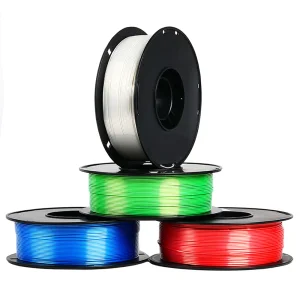
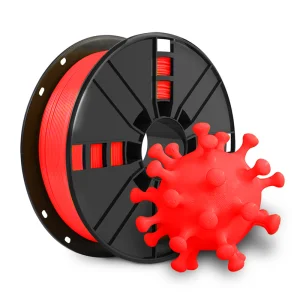
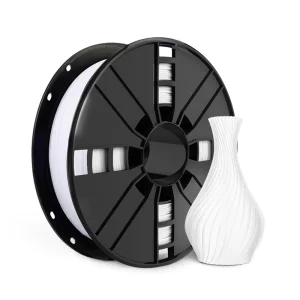
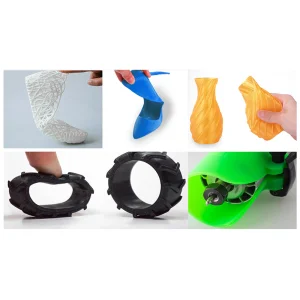
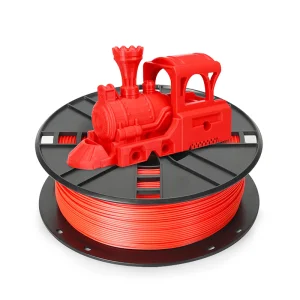
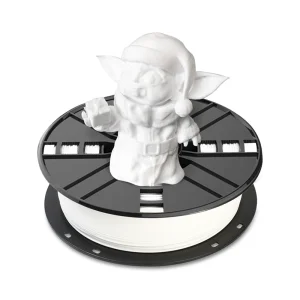
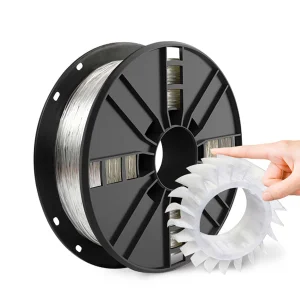
A side-by-side engineering evaluation for procurement officers, print farm managers, and OEM private label brands.
| Material Grade | Nozzle Temp (°C) | Bed Temp (°C) | Tensile Strength (MPa) | Impact Strength (kJ/m²) | Primary Industrial Best-Use |
|---|---|---|---|---|---|
| Standard White PLA | 190 – 210 | 40 – 60 | 55 – 60 | 16 – 18 | Architectural models, visual prototypes, educational kits |
| White High-Speed PLA | 210 – 240 | 50 – 60 | 52 – 58 | 15 – 17 | High-acceleration CoreXY print farms (300-600 mm/s) |
| White PLA+ / PLA Pro | 200 – 230 | 50 – 60 | 45 – 52 | 28 – 35 | Functional enclosures, snap-fit assemblies, mechanical jigs |
| White PETG | 230 – 250 | 70 – 80 | 48 – 54 | 20 – 25 | Chemical-resistant containers, outdoor housings, water tight parts |
| White ABS | 240 – 260 | 90 – 110 | 40 – 45 | 35 – 42 | Automotive interior prototypes, high heat deflection tools |
| White TPU 95A | 210 – 230 | 30 – 60 | 35 – 40 | Flexible / N/A | Vibration dampers, gaskets, wearable medical devices |
When issuing a Request for Proposal (RFP) for container-load monofilament orders, international buyers should verify the following four critical factory capabilities:
Authoritative answers to common technical, logistics, and private-label manufacturing questions for enterprise importers.
For standard stock white PLA (1.75mm in 1kg spools), factory MOQs typically start at 100 spools. For custom private-label branding—including customized box artwork, custom Pantone color matching, branded spool stickers, and special reel weights—the minimum order quantity is generally 500 to 1,000 spools per SKU, allowing for full container-load scale economies.
Low-grade white filaments use un-coated, coarse anatase $\text{TiO}_2$ particles, which are abrasive and cause premature wear on standard brass nozzles. Premier Chinese factories utilize sub-micron, surface-treated Rutile $\text{TiO}_2$ suspended homogeneously within the virgin PLA matrix. This formulation drastically reduces orifice abrasion, allowing thousands of printing hours without nozzle enlargement.
All premium monofilament extrusion lines utilize online dual-axis laser feedback micrometers. Standard 1.75 mm monofilament is guaranteed at a tolerance target of ±0.02 mm with an ovality error of less than 0.01 mm. Any section exceeding these parameters is automatically flagged, cut, and discarded prior to automated spool winding.
Prior to packaging, filament undergoes forced-air desiccant dehumidification down to under 0.02% moisture content. Each spool is immediately vacuum sealed in a heavy-duty, puncture-resistant aluminum-poly barrier bag containing a high-absorption silica gel desiccant pack. Master cartons are reinforced with moisture-resistant corrugation, protecting inventory during multi-week ocean transit.
Yes. Specialized High-Speed White PLA formulations incorporate chain-extended polymer bases with modified melt strength. This allows volumetric flow rates up to 24-30 mm³/s, maintaining excellent inter-layer adhesion at print speeds between 300 mm/s and 600 mm/s on high-acceleration CoreXY printers without under-extrusion.
Suppliers provide a complete regulatory compliance package including globally compliant Safety Data Sheets (SDS) in accordance with GHS standards, Technical Data Sheets (TDS) detailing mechanical parameters, REACH SVHC certificates, RoHS 3 chemical reports, and FDA 21 CFR raw material compliance documentation.
Initial private-label orders—which include custom box printing proofing and spool sticker approval—typically require 15 to 20 business days. Repeat container-load orders (20ft / 40ft HQ) are extruded, packaged, and loaded at port within 10 to 14 business days from deposit confirmation.