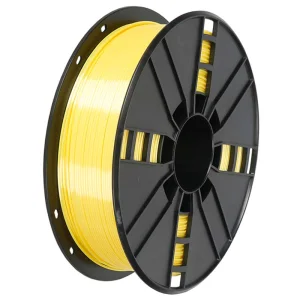
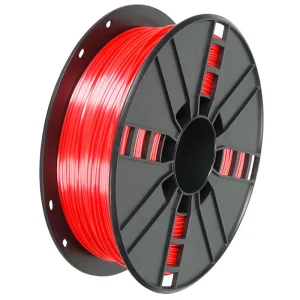
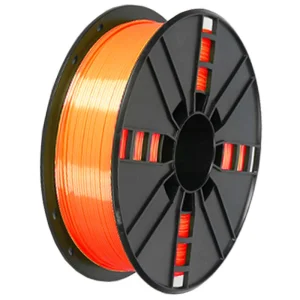
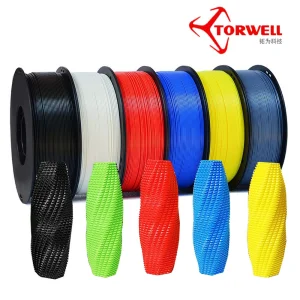
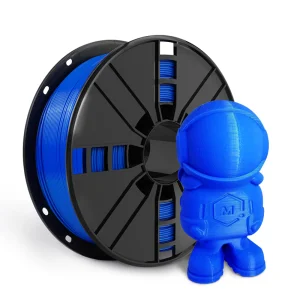
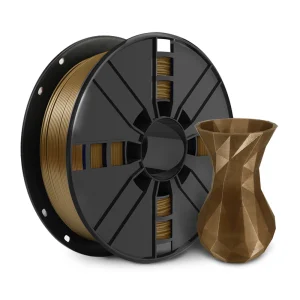
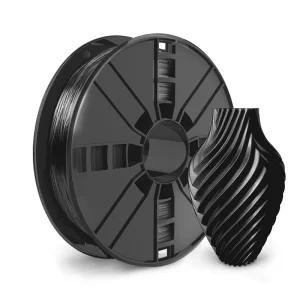
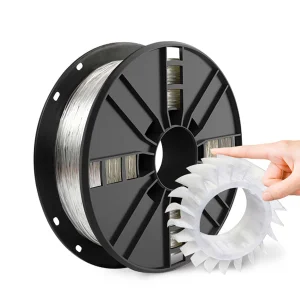
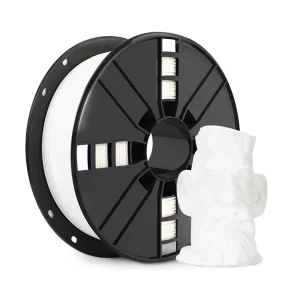
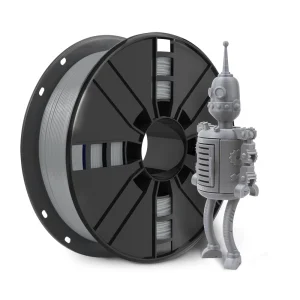
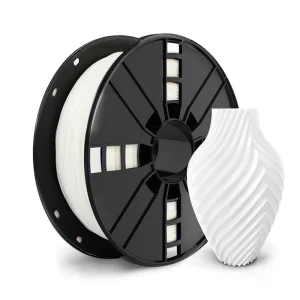
Explore our export-ready 3D printing filament lines engineered for high-speed automated extrusion systems and industrial print farms.
Understanding how Cyclohexanedimethanol (CHDM) glycol modification eliminates brittleness while preserving thermal and mechanical resilience.
Polyethylene Terephthalate Glycol (PETG) is created by incorporating CHDM into the PET polymer backbone. This modification prevents polymer crystallization during rapid cooling, creating a completely amorphous structure that resists glassiness and micro-fracturing under stress.
PETG exhibits exceptional molten weldability. When extruded at 230°C–250°C, polymer chains entangle across layer boundaries, delivering up to 92% isotropic tensile strength compared to the base material’s bulk axial strength—eliminating Z-axis delamination.
Unlike Nylon (PA) or polycarbonate (PC), fully cured PETG displays high resistance to dilute acids, alkalis, alcohols, and aqueous cleaning solutions. Its low water absorption coefficient maintains long-term structural integrity in humid operational environments.
| Physical / Mechanical Property | PETG 1.75mm (Torwell Standard) | Standard PLA | ABS (Acrylonitrile Butadiene) | Test Standard Method |
|---|---|---|---|---|
| Tensile Strength at Yield | 50 MPa | 62 MPa | 40 MPa | ISO 527 / ASTM D638 |
| Flexural Modulus | 2.1 GPa | 3.1 GPa | 2.3 GPa | ISO 178 / ASTM D790 |
| Izod Impact Strength (Notched, 23°C) | 8.5 kJ/m² | 2.7 kJ/m² | 15 kJ/m² | ISO 180 / ASTM D256 |
| Glass Transition Temp ($T_g$) | 80 °C | 58 °C | 105 °C | ISO 11357 (DSC) |
| Heat Deflection Temp (HDT @ 0.45MPa) | 74 °C | 55 °C | 88 °C | ISO 75 / ASTM D648 |
| Shrinkage Rate (%) | 0.2% – 0.4% | 0.3% – 0.5% | 0.7% – 1.0% | Internal Optical Metrology |
PETG bridges the gap between easy-to-print PLA and high-performance engineering ABS. By selecting 1.75mm PETG from a direct manufacturer with tightly controlled melt flow index (MFI), distributors can offer end users a material that provides industrial toughness without requiring an enclosed heated chamber.
How Torwell Technologies leverages automated multi-stage extrusion lines to ensure precise batch consistency and global delivery resilience.
Every extrusion line utilizes inline 2-axis optical laser interferometers running at 500 Hz. The system feeds real-time feedback to the melt pump speed controllers, holding diameter variance within ±0.02 mm and flagging ovality before spooling.
PETG is highly hygroscopic. Our raw resin undergoes desiccated air drying at 70°C for 6 consecutive hours to reduce internal moisture content below 200 ppm prior to melt extrusion, eliminating micro-void bubble formation during 3D printing.
With the rise of multi-material systems (like Bambu Lab AMS and Creality CFS), our automated winding lines ensure uniform tension control, zero layer crossing, and precision dynamic spool balancing to avoid feed jams.
How global buyers deploy 1.75mm PETG filament across high-demand industrial, commercial, and healthcare ecosystems.
Manufacturing plants replace heavy CNC-machined aluminum assembly jigs with dense PETG printed components. PETG's high yield strength and impact damping absorb continuous mechanical vibration on production lines, lowering shop-floor tooling replacement costs by over 60%.
Due to PETG’s bio-compatibility potential and chemical resistance to chemical disinfectants (such as isopropyl alcohol and quaternary ammonium solutions), medical device manufacturers utilize clear PETG 1.75mm to print custom fluidic manifolds, sensor housings, and ergonomic surgical tools.
Unprotected PLA degrades under moisture and heat, while ABS yellow-discolors under UV rays. PETG provides weatherability, retaining structural elasticity and clarity under direct sunlight exposure and ambient temperature swings up to 75°C.
Print farms operating hundreds of machines require continuous, unattended printing. Torwell PETG 1.75mm provides a low-stringing formulation optimized for rapid retraction cycles, lowering cleaning labor and minimizing scrap rates across multi-day print runs.
Anticipating next-generation additive manufacturing needs with high-flow resins, composite reinforcing, and sustainable circular polymers.
With high-speed FDM platforms printing at 500–600 mm/s, legacy PETG suffers from under-extrusion and volumetric speed bottlenecks. Our R&D team is tuning polymer chain length to increase Melt Flow Index (MFI) by 45% without sacrificing layer-bond toughness.
Integrating 15% weight-ratio chopped micro-carbon fibers into the modified PETG matrix elevates tensile modulus to 4.8 GPa while reducing volumetric shrinkage to under 0.1%. This composite delivers a matte surface finish for functional end-use parts.
Supporting corporate ESG initiatives, Torwell is establishing a certified 100% recycled PETG line derived from industrial bottle-flake streams. Processed through multi-stage melt filtration, it achieves matching dimensional tolerances to virgin grade.
A complete operational framework for brand owners, importers, and regional distributors requiring OEM private labeling and regulatory documentation.
We provide precise color matching based on Pantone codes or physical color samples. Custom spools, eco-friendly cardboard packaging, custom core stickers, and vacuum bag branding are available with low Minimum Order Quantity (MOQ) thresholds.
Exporting to the European Union, North America, and Asia-Pacific requires strict chemical safety documentation. Torwell PETG 1.75mm is fully documented and independently verified across key international compliance frameworks:
Every spool is vacuum-sealed with high-capacity silica gel desiccants immediately following precision winding. Vacuum bags feature a high-density PE/PA barrier film layer to prevent air ingress during multi-week ocean freight transport.
Discover our complementary 1.75mm 3D printing filaments engineered for diverse mechanical and aesthetic applications.
Selecting the right filament stock based on printability, mechanical resistance, and end-user application demands.
| Material Grade | Print Temp Range | Bed Temp Range | UV & Weathering | Impact Strength | Ease of Printing | Primary Commercial Market |
|---|---|---|---|---|---|---|
| PETG 1.75mm | 230°C – 250°C | 70°C – 80°C | Good | High | High (No Enclosure) | Functional Prototypes, Print Farms, Jigs |
| PLA / PLA+ | 190°C – 220°C | 0°C – 60°C | Poor | Moderate | Very High | Consumer Electronics, Toys, Architectural |
| ABS | 230°C – 260°C | 90°C – 110°C | Poor | Very High | Medium (Requires Chamber) | Automotive Parts, Tool Housings |
| ASA | 240°C – 260°C | 90°C – 110°C | Exceptional | Very High | Medium (Requires Chamber) | Outdoor Fixtures, Exterior Automotive |
| TPU 95A | 210°C – 230°C | 30°C – 60°C | Excellent | Extremely High | Moderate (Direct Drive) | Gaskets, Wearable Devices, Seals |
| Carbon Fiber PLA/PETG | 220°C – 260°C | 60°C – 80°C | Good | High Stiffness | High (Hardened Nozzle) | Drone Frames, RC Parts, Aerospace Prototypes |
Direct answers from our senior extrusion engineers regarding technical specifications, MOQs, and OEM customization.