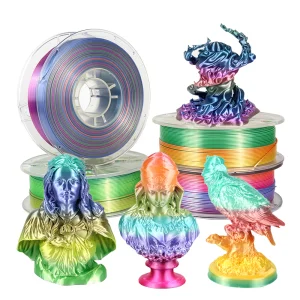
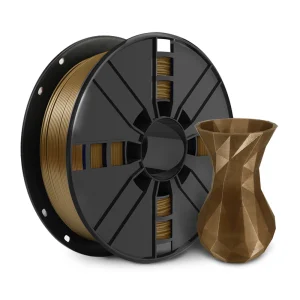
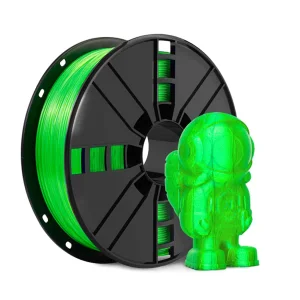
Direct factory procurement solutions for high-speed additive manufacturing, commercial OEM brands, and global distributors.
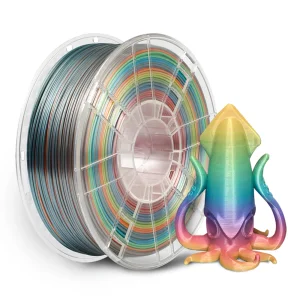
Understanding the molecular advantage of Glycol-Modified Polyethylene Terephthalate for industrial supply chains and high-throughput FDM/FFF print farms.
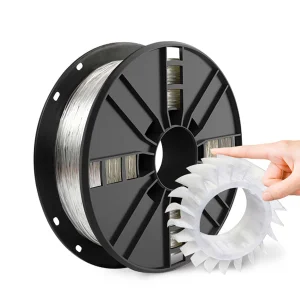
By replacing a portion of the ethylene glycol content with 1,4-cyclohexanedimethanol (CHDM), PETG prevents crystallization inherent to standard PET. This results in an amorphous, highly transparent thermoplastic with superior impact resistance, low brittleness, and zero hazing during rapid hot-end cooling.
Modern 1.75mm PETG formulations optimized for high flow rates enable print speeds up to 300 mm/s to 500 mm/s. Controlled melt flow index (MFI) ensures consistent volumetric extrusion without nozzle clogging or inter-layer shear failure under aggressive acceleration.
Factory-direct wholesale PETG 1.75mm produced under ISO 9001:2015 standards complies with EU REACH, RoHS 3, and FDA 21 CFR 177.1315 regulations, guaranteeing safety for food-contact items, medical enclosures, and consumer electronics housings.
Market dynamics driving the adoption of modified PETG polymers across international additive manufacturing sectors.
Historically, industrial prototypers relied heavily on Acrylonitrile Butadiene Styrene (ABS) for heat deflection and mechanical toughness. However, high warping rates, pungent styrene fume emissions, and the requirement for heated build chambers have pushed enterprise procurement teams toward 1.75mm PETG filaments.
PETG offers mechanical toughness approaching ABS (tensile strength around 50 MPa) while maintaining the printing simplicity of PLA. It requires no closed chamber, exhibits zero toxic odor, and delivers superior chemical resistance against acids, alkalis, and alcohol-based sterilizers.
The global demand for functional end-use parts has catalyzed the development of reinforced PETG composites:
Comprehensive physical, thermal, and mechanical performance evaluation for commercial buyers and engineering procurement specs.
| Polymer Parameter | PETG 1.75mm (Standard) | PLA+ Industrial | ABS Engineering Grade | PC (Polycarbonate) |
|---|---|---|---|---|
| Tensile Strength (ISO 527) | 50 – 53 MPa | 60 – 65 MPa | 40 – 45 MPa | 70 – 75 MPa |
| Flexural Modulus (ISO 178) | 2,100 – 2,300 MPa | 3,100 – 3,500 MPa | 2,000 – 2,200 MPa | 2,400 – 2,600 MPa |
| Izod Impact Strength (ISO 180) | 8.5 – 10.5 kJ/m² | 5.5 – 6.5 kJ/m² | 12.0 – 15.0 kJ/m² | 35.0 – 45.0 kJ/m² |
| Heat Deflection Temp (HDT @ 0.45MPa) | 75°C – 78°C | 55°C – 58°C | 88°C – 96°C | 135°C – 140°C |
| Water Absorption (24h @ 23°C) | 0.15% (Moderate) | 0.30% (High) | 0.20% (Moderate) | 0.35% (Very High) |
| Chemical Resistance | Excellent (Acids, Bases, Oils) | Poor (Hydrolyzes easily) | Moderate (Soluble in Acetone) | Moderate (Soluble in Hydrocarbons) |
| Bed Temperature Requirement | 70°C – 80°C | 45°C – 60°C | 90°C – 110°C | 110°C – 130°C |
Inside modern automated extrusion plants: How advanced quality control ensures zero-defect 1.75mm PETG filament coils for international OEM partners.
Extrusion lines incorporate quad-axis high-speed laser measurement units sampling filament diameter at 10,000 Hz. Automated feedback loops adjust puller speeds in real-time, locking tolerances strictly within ±0.02mm and preventing ovality errors that cause extruder slippage.
PETG raw resin is extremely hygroscopic. Advanced factories utilize multi-stage desiccant dryer towers maintaining a dew point of -40°C. Polymer moisture is reduced to under 0.02% prior to melt extrusion, eliminating micro-voids, steam bubbles, and hydrolytic degradation.
Manual winding causes line overlapping, cross-winding, and mid-print spool tangles. Automated servo-driven winding units maintain precise tension and pitch across cardboard or plastic spools, guaranteeing smooth unspooling for 24/7 automated print farm operations.
How wholesale PETG 1.75 supply chains cater to diverse commercial, geographical, and industrial requirements.
High demand for large-format 2.5kg to 10kg spools used in industrial prototyping, automated farm networks, and custom automotive accessory manufacturing. Priority: Rapid FCL sea-freight and custom retail packaging.
Strict focus on eco-sustainability, requiring 100% recyclable cardboard spools, rPETG (recycled resin blends), REACH SVHC compliance, and plasticizer-free safety documentation for educational and consumer sales.
Rapid growth in electronics assembly, robotics fixtures, and drone frame components. Key demand driver: High heat resistance and electrical insulation properties paired with low OEM MOQ options.
Expanding usage in architectural modeling, water-proof fluid tanks, and outdoor signage fixtures requiring strong UV stability and weather resistance without degradation over extended thermal cycles.
Real-world engineering implementations leveraging PETG's chemical, optical, and mechanical attributes.
Transparent PETG is widely chosen for face protection shields, test tube racks, surgical tool prototypes, and custom orthotic braces. Its capability to withstand ethylene oxide (EtO) and gamma sterilization makes it superior to PLA.
Unlike PLA which softens under intense sunlight (Tg ~55°C), PETG retains structural integrity up to 75°C. Combined with intrinsic UV stability, it is ideal for outdoor sensor junction boxes, light diffusers, and weather-proof housings.
Due to exceptional layer adhesion strength, 1.75mm PETG prints naturally form leak-tight seals without post-processing resin coatings. Widely used for custom coolant reservoirs, hydraulic manifolds, and chemical container prototypes.
Addressing core technical questions from procurement officers, OEM brand managers, and industrial print farm operators.
1.75mm filament requires significantly lower heating energy to reach uniform melt temperature inside the hot-end heat block compared to 2.85mm filament. This reduced thermal mass allows modern CoreXY high-speed printers (Bambu Lab, Creality K1, Voron) to melt and extrude polymer much faster without causing unmelted core zones or extruder gear slippage.
Export-grade packaging involves a multi-layer barrier strategy: First, filament is inline dried to <0.02% water content. Immediately post-winding, spools are vacuum-sealed inside heavy-duty 8-mil aluminum/poly composite bags containing active silica desiccant pouches. Spools are then boxed in corrugated cartons and unitized on shrink-wrapped export pallets with desiccants inside the shipping container.
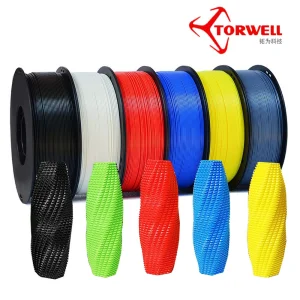
Comprehensive OEM services include Pantone/RAL exact color matching, custom spool flange branding, custom box printing, branded vacuum foil bags, barcode sticker application, customized technical data sheets (TDS/MSDS), and non-standard spool sizing ranging from 250g mini-spools up to 10kg industrial master spools.
PETG has extremely strong natural adhesion to PEI, smooth glass, and polyimide beds. In fact, printing directly onto bare glass or smooth PEI can cause bed chunk tear-outs. We recommend textured PEI sheets or applying a thin glue stick layer as a release agent. Heated bed temperatures should be configured between 70°C and 80°C.
Optimal nozzle temperatures range from 230°C to 250°C depending on speed. For standard print speeds (50–100 mm/s), 235°C yields maximum transparency and layer adhesion. For high-speed printing (>250 mm/s), elevating nozzle temp to 250°C reduces melt viscosity and prevents under-extrusion.
Explore complete polymer solutions for wholesale procurement, including PETG, PLA, Silk, TPU, and ABS formulations.