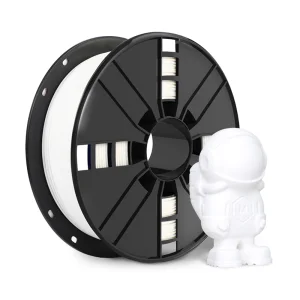
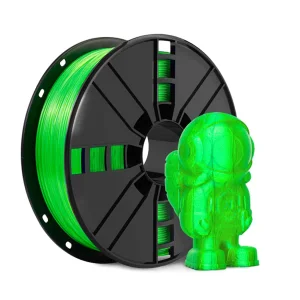
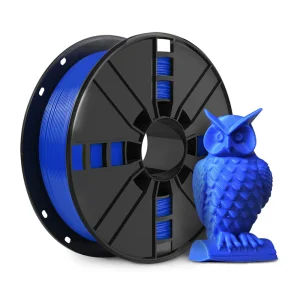
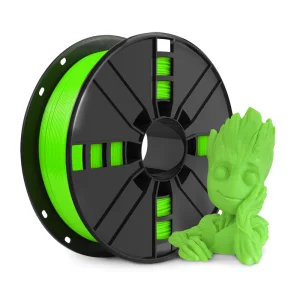
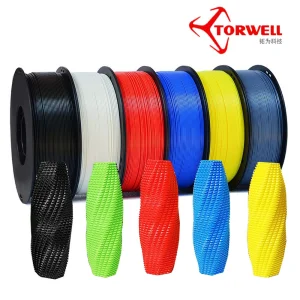
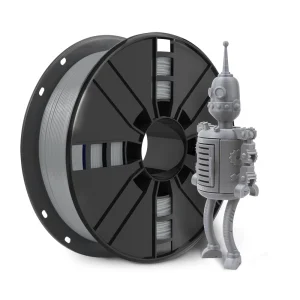
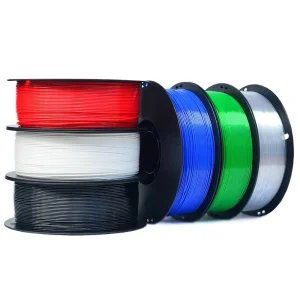
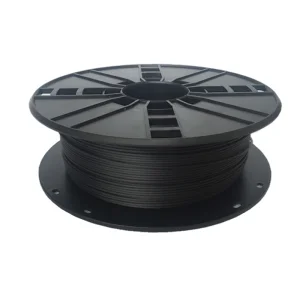
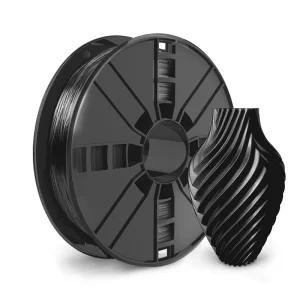
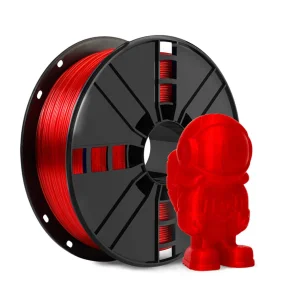
High-precision extrusions engineered for standard FDM/FFF printers and multi-material AMS systems.
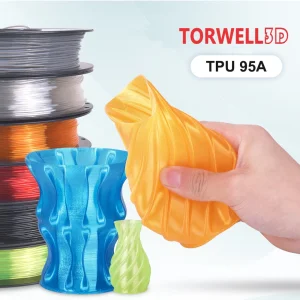
A comprehensive technical evaluation of elastomeric Fused Deposition Modeling (FDM) materials, extrusion physics, and quality benchmarks for industrial procurement.
Thermoplastic Polyurethanes (TPU) and Thermoplastic Elastomers (TPE) derive their unique physical properties from a block-copolymer morphology consisting of alternating alternating hard segments (providing thermal resistance, structural rigidity, and crystalline cross-linking points) and soft segments (providing long-chain mobility, low-temperature elasticity, and damping).
During fused filament fabrication, controlling the glass transition temperature ($T_g$) and melt flow behavior is paramount. Precise chemical formulation ensures that under shear rates experienced inside the nozzle orifice, the elastomer exhibits controlled pseudoplastic thinning without phase separation or mechanical degrade.
Unlike rigid polymers like PLA or ABS, flexible materials are highly susceptible to Euler column buckling under compressive extrusion force. The critical buckling force ($P_{cr}$) is mathematically governed by the filament’s flexural modulus ($E$), moment of inertia ($I$), and unguided drive length ($L$):
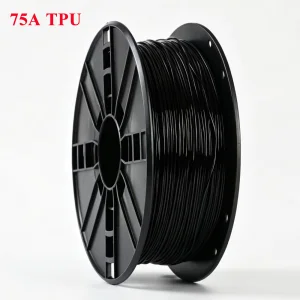
To eliminate gear tangling and feeding failure, Torwell’s manufacturing process tightly maintains a tight diameter tolerance of ±0.02 mm and controls shore hardness distribution, ensuring optimal column stiffness across 75A, 85A, and 95A durometers.
How technical advancements, high-speed 3D printers, and sustainability initiatives are redefining enterprise procurement demands worldwide.
Legacy flexible printing was limited to slow speeds of 15–30 mm/s to prevent filament wrapping. Modern core-XY systems push extrusion speeds past 150–250 mm/s. Sourcing demands are shifting toward high-flow TPU formulations with rapid melt kinetic recovery and slick surface lubricity coatings to drastically reduce friction inside direct-drive heat breaks.
Environmental regulations and corporate ESG directives are forcing global buyers away from pure petroleum-derived polyurethanes. The industry is rapidly adopting bio-TPU grades synthesized from castor oil polyols, retaining 30%–50% renewable carbon content without compromising tensile strength or abrasion resistance.
Additive manufacturing is expanding from passive elastic parts to active smart components. Incorporating multi-walled carbon nanotubes (MWCNTs) and conductive carbon black into TPU matrices enables ESD-safe electronics housings, flexible piezoresistive strain sensors, and soft robotic tactile pads printed in a single build.
Compare mechanical properties, Shore hardness scales, and thermal limits to align product lines with end-user requirements.
| Material Polymer Grade | Shore Hardness | Tensile Strength (MPa) | Elongation at Break (%) | Melt Temp (°C) | Recommended Bed (°C) | Primary Industrial Use Case |
|---|---|---|---|---|---|---|
| TPU 95A Industrial | 95 Shore A | 45 ± 3 | 550% | 210 – 235 | 30 – 60 | Protective cases, wheels, footwear, universal gaskets |
| TPU 85A Soft Grade | 85 Shore A | 38 ± 2 | 650% | 205 – 225 | 25 – 50 | Medical grips, vibration dampers, flexible couplings |
| TPU 75A Ultra-Soft | 75 Shore A | 28 ± 2 | 780% | 195 – 215 | 0 – 40 | Orthotic insoles, soft robotics, sealings, prosthetics |
| TPE 80A Olefin-Based | 80 Shore A | 22 ± 2 | 700% | 210 – 230 | 40 – 60 | Low-density buoyancy parts, chemical-resistant tubes |
| TPA Polyamide Elastomer | 63 Shore D | 58 ± 4 | 380% | 230 – 250 | 70 – 90 | High-resilience sports gear, extreme impact components |
| Carbon Fiber TPU Composite | 98 Shore A | 62 ± 3 | 120% | 230 – 250 | 50 – 70 | ESD-safe electronics, structural lightweight anti-shock mounts |
As a direct-factory manufacturer, Torwell provides comprehensive OEM/ODM solutions: masterbatch color matching to exact Pantone/RAL codes, custom spool weights from 250g sample spools to 10kg industrial payout drums, eco-friendly recyclable cardboard reels, and customized moisture-barrier vacuum packaging engineered for international sea/air freight stability.
Replacing traditional injection-molded rubber with on-demand additive manufacturing across critical industrial verticals.
Flexible TPU filaments enable rapid iteration of weather-sealed door grommets, air-intake boots, anti-vibration engine mounts, and protective sleeve wraps. Resistant to automotive oils, greases, and hydrolytic degradation.
3D printed footwear midsoles utilize variable-density lattice structures to deliver tuned energy return. In medical prosthetics, biocompatible TPU grades create custom socket liners and supportive braces tailored directly to patient 3D scans.
Pneumatic soft grippers, suction cups, accordian protective bellows, and end-of-arm tooling parts require high fatigue resistance. Torwell flexible filaments endure millions of flexural cycles without micro-cracking.
Ensuring your shipments clear global customs frictionlessly with complete safety certifications and batch traceability.
Every spool extruded at our 2,500 m² production facility undergoes continuous multi-axis laser gauge scanning. Filaments exceeding ±0.02mm deviation are automatically rejected by optical sensors. Finished reels undergo automated tension-controlled spooling to eliminate cross-winding and layer entanglement.
We provide global distributors with exhaustive documentation required by market authorities, including RoHS 2.0 (2011/65/EU), REACH SVHC (EC 1907/2006), and FDA food-grade material declarations.
Our R&D commitment to pushing polymer boundaries over the next five years.
Development of semi-rigid flexible filaments with slick surface friction modifiers designed for seamless automatic filament changing systems (AMS) without jamming or retuning PTFE tube tolerances.
Integration of advanced nano-fillers into TPU matrices to deliver self-dissipating ESD materials and thermal dissipation pads for direct 3D printing onto high-power PCB assemblies.
Pioneering 4D printing materials that alter their elastic modulus or programmed geometry when exposed to specific thermal or electrical thresholds for adaptive aerospace structures.
Essential guidance for procurement managers, distributors, and additive manufacturing engineers.
Explore our engineering-grade ABS, PETG, Silk PLA, Carbon Fiber, and Soft TPU product ranges.