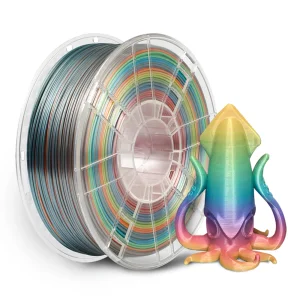
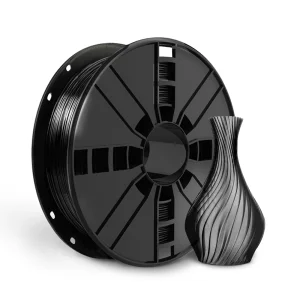
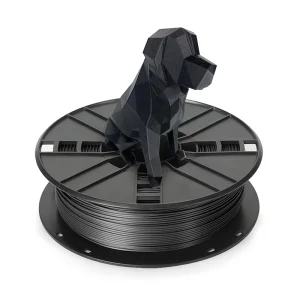
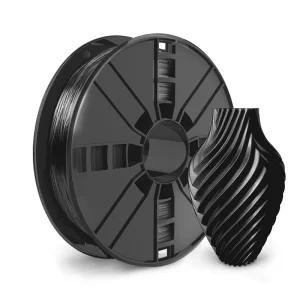
Factory-direct wholesale polymer spools manufactured under automated laser diameter feedback with ISO 9001 compliance for international brands and enterprise print farms.
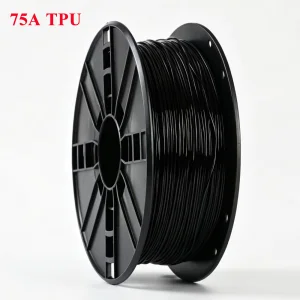
An in-depth material science examination into high-modulus short carbon fiber dispersion within glycol-modified polyethylene terephthalate matrices for Fused Deposition Modeling (FDM).
Amorphous Polyethylene Terephthalate Glycol (PETG) incorporates 1,4-cyclohexanedimethanol (CHDM) co-monomers into the polymer backbone. This suppresses crystallization, providing exceptional clarity, melt ductility, and a low processing enthalpy without the thermal brittleness common in un-modified PET polymers.
Compounded with premium 15%–20% weight ratio of short chopped carbon fibers (average diameter 7–9 μm, length 150–300 μm). These micro-reinforcements act as internal mechanical trusses, dramatically elevating structural stiffness and damping vibrational resonance during dynamic print movements.
Unreinforced polymers suffer from differential thermal contraction during layer deposition. The high aspect ratio of aligned carbon fibers constrains volumetric thermal expansion, dropping linear shrinkage rates to under 0.1% and practically eliminating edge warping on large industrial print beds.
| Mechanical & Thermal Property | Neat PETG Filament | PETG Carbon Fiber (20% CF) | PLA+ Structural Grade | PA6 Carbon Composite |
|---|---|---|---|---|
| Tensile Strength (ISO 527) | 49 MPa | 85 – 92 MPa | 62 MPa | 110 MPa |
| Flexural Modulus (ISO 178) | 2.1 GPa | 6.8 – 7.4 GPa | 3.1 GPa | 8.5 GPa |
| Heat Deflection Temp (HDT @ 0.45 MPa) | 68 °C | 82 – 86 °C | 55 °C | 165 °C |
| Moisture Absorption Rate (24h Saturation) | 0.20% | < 0.08% | 0.35% | 1.85% |
| Interlayer Adhesion Integrity | High | Very High (Optimum Shear) | Moderate | Requires Heated Chamber |
How our smart manufacturing plant standardizes polymer melt processing, precise multi-axis laser measuring, and dynamic automated winding for seamless global volume supply.
High-shear twin-screw extruders feature segmented screw elements tailored for carbon fiber dispersion without excessive fiber attrition. Gravimetric loss-in-weight feeders strictly maintain carbon loading within ±0.2% precision across 24/7 continuous production cycles.
To eliminate micro-voids, volatile degradation, and moisture pockets within the molten resin strand, our melt lines integrate multi-vent vacuum degassing chambers pulling -0.098 MPa prior to final gear-pump metering into the multi-cavity extrusion die.
Real-time dual-axis laser micrometers scan the filament strand at 1,000 Hz. Closed-loop PID feedback automatically adjusts puller speed to keep physical filament diameter within an ultra-strict target of 1.75 mm ±0.02 mm, maintaining flawless ovality.
Virgin PETG pellets undergo double-tower dehumidifying drying to reach < 0.02% moisture content before melt entering.
Temperature-profiled heating zones melt polymer smoothly while protecting carbon sizing agents from thermal burn.
Gradient thermal water tanks gradually solidify the composite core, avoiding residual internal mechanical stress.
Servo-driven traverse winders lay down smooth, non-crossing filament layers, preventing AMS & feeder jams.
Instant thermo-sealing in high-barrier aluminum bags with raw silica gel desiccant packs and humidity indicator cards.
Replacing heavy machined aluminum components with ultra-stiff, light-weight 3D printed PETG Carbon Fiber structures across demanding technical sectors.
Automated assembly lines utilize PETG Carbon fiber grippers to cut mass at the robot arm tip. Reduced inertia accelerates cycle times, cuts servo motor strain, and allows higher operational payload capacity during high-speed pick-and-place routines.
Resistant to automotive fluids including glycol engine coolants, brake fluids, and synthetic oils. PETG Carbon is heavily deployed for under-the-hood fluid reservoirs, intake manifold prototypes, and custom racing air ducting systems.
Drones require high stiffness-to-weight ratios to stabilize flight control algorithms. PETG Carbon printed airframes, camera gimbals, and motor mounts absorb high-frequency motor vibrations while preserving rigidity under aerodynamic loads.
Replaces costly CNC-milled aluminum tooling in factory workholding. Custom positioning jigs printed in PETG Carbon resist surface wear, eliminate dimensional shift under ambient factory temperature fluctuations, and protect sensitive parts.
Specially formulated PETG Carbon fiber grades provide volume resistivity tailored for ESD safety ($10^6 - 10^9 \ \Omega/\text{sq}$), preventing catastrophic electrostatic discharge during handling of sensitive PCB assemblies in microelectronics assembly plants.
Combines intrinsic chemical stability and moisture resistance with structural impact strength. Perfect for weatherproof sensor enclosures, marine instrument mounts, and outdoor telecommunication terminal covers.
Recommended industrial printer settings, thermal profile thresholds, and hardware requirements for maximum interlaminar shear strength.
| Parameter Parameter | Recommended Value | Optimal Range | Technical Engineering Notes |
|---|---|---|---|
| Nozzle Extrusion Temperature | 250 °C | 240 °C – 265 °C | Higher temperatures maximize polymer chain entanglements across Z-axis print layers. |
| Heated Bed Temperature | 75 °C | 70 °C – 85 °C | PEI sheets or textured powder-coated plates work best; glue stick acts as a release agent. |
| Nozzle Orifice & Material | 0.4 mm Hardened Steel | 0.4 mm – 0.8 mm (Hardened/Ruby) | Standard brass nozzles will suffer rapid abrasive erosion within 200g of printing. |
| Layer Cooling Fan Speed | 20% - 40% | 0% – 50% max | Excessive fan cooling compromises layer adhesion; minimal airflow optimizes tensile strength. |
| Volumetric Extrusion Speed | 12 mm³/s | 8 mm³/s – 18 mm³/s | Adjust print speed dynamically based on hotend melt zone heating capacity. |
| Pre-Print Drying Profile | 65 °C for 5 Hours | 60 °C – 70 °C (Desiccant Dryer) | Target internal moisture content under 0.04% to eliminate micro-foaming during deposition. |
Chopped carbon fiber particles are extremely abrasive. Industrial users MUST use hardened steel, tungsten carbide, or diamond-tipped nozzles. Standard brass orifices enlarge rapidly, leading to loss of dimensional control and inconsistent wall extrusions.
PETG Carbon exhibits strong shear-thinning behavior at higher shear rates inside the hotend thermal core. This allows smooth melt flow through 0.4 mm nozzles while maintaining high melt viscosity upon exiting the nozzle for crisp bridge spans.
While PETG Carbon has extremely low warp, its high chemical affinity for clean PEI surfaces can cause bed tear-out. Applying a thin coat of PVA-based glue stick or liquid adhesive acts as a necessary separation barrier during part cooling.
Full-spectrum OEM supply services for global distributors, Amazon top-sellers, and enterprise additive manufacturing service bureaus.
We provide full private label customization including custom-printed cardboard or high-impact ABS spools, customized Pantone box artwork, private brand labeling, and specialized spool weights ranging from 250g mini-spools to 10kg master industrial reels.
Beyond natural matte dark carbon gray, our chemical formulation lab offers custom-pigmented matrix options (Dark Carbon Red, Industrial Olive Drab, Navy Carbon Blue) aligned to exact target Pantone color codes without sacrificing tensile strength.
Every commercial production batch comes backed by full material trace documentation: Technical Data Sheets (TDS), Safety Data Sheets (MSDS), RoHS 3 compliance certificates, REACH registration verification, and UL94 flammability ratings.
End-to-end international trade pathways designed for effortless freight clearance, duty minimization, and rapid inventory replenishment.
We support all global shipment structures. Our logistics department handles full ocean container shipping (20GP / 40HQ), air freight consolidation, and door-to-door DDP (Delivered Duty Paid) shipping to Amazon FBA warehouses or regional fulfillment hubs in North America and Europe.
To shield global distributors against maritime delays, we maintain dedicated inventory buffer programs. Strategic stocking agreements ensure continuous production continuity for high-volume enterprise print farm clients.
Our factory transitions distributors toward fully recyclable cardboard spools engineered with high edge stiffness to withstand multi-material automated feeding systems without generating micro-dust inside print chambers.
Direct technical and commercial answers for material engineers, OEM buyers, and supply chain managers.
Adding high-modulus chopped carbon fibers to the PETG matrix dramatically elevates flexural modulus (from ~2.1 GPa to >7.0 GPa) and tensile strength. Furthermore, the fibers reduce isotropic volumetric shrinkage to under 0.1%, eliminating warping on large FDM prints and raising heat deflection temperatures under load.
Due to the abrasive nature of micro carbon fibers, standard brass nozzles will enlarge rapidly. We mandate using hardened steel, tungsten carbide, or ruby-tipped nozzles with an orifice size of at least 0.4 mm. A 0.6 mm nozzle further reduces micro-fiber clogging risk during high-throughput printing.
Yes. Our automated servo winding lines ensure clean, non-overlapping spooling with precise lateral alignment. Spools are engineered on standardized 200mm diameter reels with balanced rim geometries designed to rotate smoothly inside automatic material feeding systems without slippage.
Standard stock color spools are available with low MOQs starting at 100 kg. For full OEM private label customization (branded boxes, custom labels, dynamic spool colors), our typical starting MOQ is 500 kg per batch, allowing cost-effective setup for twin-screw compounding lines.
Immediately post-extrusion and drying, every spool is vacuum-sealed in a heavy-gauge multi-layer moisture barrier bag alongside active raw desiccant pouches. Individual spools are packed in reinforced corrugated inner boxes and stacked on shrink-wrapped export pallets for total oceanic moisture protection.
Yes. We compound specialized ESD-grade PETG Carbon variants that incorporate conductive carbon black additives alongside short carbon fibers, providing consistent surface resistivity ($10^6 - 10^9 \ \Omega/\text{sq}$) across printed components for electronics assembly cleanrooms.
While PA-CF yields slightly higher ultimate heat resistance and impact strength, PA-CF is severely hygroscopic and requires heated print chambers (80°C+) and continuous active drying. PETG Carbon prints easily on standard open-frame FDM printers with lower bed temperatures, zero moisture-induced bubbling during prints, and significantly lower raw material costs.
We provide full laboratory documentation with container shipments, including Technical Data Sheets (TDS), Safety Data Sheets (MSDS), RoHS 3 (EU Directive 2015/863) laboratory test reports, REACH SVHC declaration compliance certificates, and ISO 9001 quality audit reports.
Complete your supply line with our full portfolio of high-performance technical polymers, flexible elastomers, and aesthetic silk composite filaments.