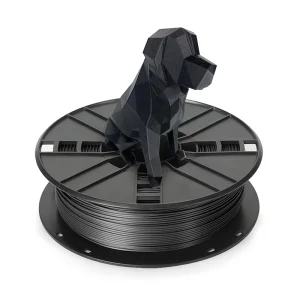
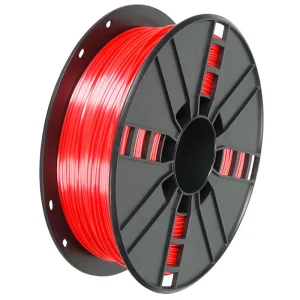
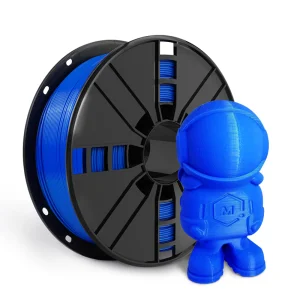
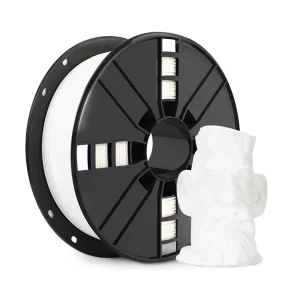
Precision-extruded spools manufactured under strict ISO 9001:2015 quality standards with inline dual-axis laser diameter monitoring.
Comprehensive insight into chemical polymer synthesis, carbon-black dispersion techniques, and mechanical behavior under dynamic load conditions.
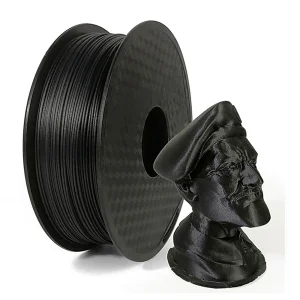
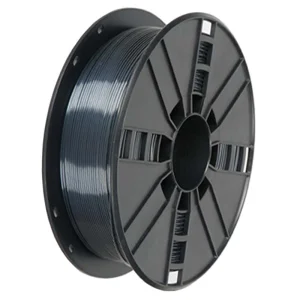
Our direct-factory black TPU (Thermoplastic Polyurethane) formulations utilize high-grade polyether and polyester polyol building blocks reacted with MDI (Methylene Diphenyl Diisocyanate). Polyether-based variants provide maximum hydrolytic stability and biological resistance, ensuring components subjected to humidity or moisture exposure maintain elongation without chain scission.
Achieving rich jet-black opacity without altering elastomeric elasticity requires sub-micron carbon black masterbatch compounding. Controlled twin-screw extrusion shear rates ensure homogenous dispersion, preventing agglomeration that causes nozzle clogging, mechanical stress points, or premature thermal degradation.
Engineered across Shore 85A, 95A, and 70D hardness scales. Shore 95A represents the optimal compromise for direct-drive and Bowden extrusion architectures, facilitating reliable feeding speeds up to 150 mm/s while preserving superior impact attenuation and high coefficient of friction.
| Physical & Mechanical Metric | Test Standard (ASTM/ISO) | Black TPU 85A Grade | Black TPU 95A Grade | Black TPU 70D Industrial |
|---|---|---|---|---|
| Specific Density (g/cm³) | ISO 1183 / ASTM D792 | 1.18 g/cm³ | 1.21 g/cm³ | 1.25 g/cm³ |
| Tensile Strength at Yield (MPa) | ISO 527 / ASTM D638 | 32 MPa | 45 MPa | 58 MPa |
| Ultimate Elongation at Break (%) | ISO 527 / ASTM D638 | 580% | 460% | 320% |
| Tear Strength (N/mm) | ISO 34-1 / ASTM D624 | 110 N/mm | 145 N/mm | 180 N/mm |
| Abrasion Loss (mm³) | ISO 4649 / DIN 53516 | 35 mm³ | 28 mm³ | 20 mm³ |
| Glass Transition Temp (Tg) | DSC (10°C/min) | -42 °C | -35 °C | -20 °C |
| Melt Flow Index (g/10min) | 190°C / 8.7kg | 8.5 g/10min | 12.0 g/10min | 15.5 g/10min |
Engineered to fulfill demanding operational requirements across tier-1 manufacturing, automotive assemblies, wearable tech, and automation equipment.
Black TPU filament exhibits unmatched resistance to hydrocarbons, engine oils, synthetic lubricants, and ozone exposure. Essential for manufacturing custom grommets, protective bellows, dust covers, and anti-vibration dampening mounts directly within automotive assembly lines.
High energy-return characteristics allow footwear manufacturers to rapidly print lattice mid-soles, dynamic shoe outsoles, and orthotic inserts. Black TPU provides permanent color fidelity, resisting UV discoloration while maintaining elastic recovery over millions of compression cycles.
Robotic arm grippers require non-marring, high-grip elastomeric surfaces to handle delicate components. Custom 3D printed TPU suction cups, soft robotic finger pads, and pneumatic seals prevent work-piece scratching while guaranteeing long fatigue life.
Used extensively by tier-1 brands for overmolded impact-resistant bumpers, IP-rated waterproof gaskets, strain-relief boots, and ruggedized protective cases for handheld field equipment operating in harsh environments.
Combining continuous extrusion automation, closed-loop telemetry control, and streamlined global export logistics.
Our automated production lines utilize dual-axis laser micrometers that measure diameter 300 times per second. Real-time feedback loops adjust haul-off capstan speeds dynamically, ensuring target dimensional tolerances of ±0.02 mm over 100% of the spool length to prevent feeding jams in high-speed 3D printers.
TPU resin is notoriously hygroscopic. Our raw materials undergo multi-stage continuous desiccant drying to lower moisture content below 0.02% (200 ppm) before melt extrusion. Inline vacuum-sealing directly at the spooling head guarantees zero ambient moisture absorption prior to shipment packaging.
Flexible TPU filaments present winding challenges due to stretch elasticity. Our factory employs precision servo-driven traverse spoolers maintaining constant low-tension winding. This eliminates spool overlap, cross-tangles, and diameter distortion under tension, facilitating seamless automated printing.
Next-generation elastomeric polymer developments pioneering high-speed printability, eco-friendly chemistry, and advanced functional conductivity.
Developing modified rheology TPU formulations designed for high-throughput CoreXY printers. By narrowing molecular weight distribution, shear-thinning behavior is maximized inside hotends, enabling print speeds up to 250-400 mm/s without sacrificing inter-layer adhesion strength.
Transitioning raw feedstocks to bio-monomers derived from non-food castor beans. Achieving up to 45% bio-based carbon content without compromising physical flexibility, helping enterprise clients reach scope 3 carbon reduction mandates.
Integrating multi-walled carbon nanotubes (MWCNTs) to engineer tailored electrostatic discharge (10^6 to 10^9 ohms/sq) and UL94 V-0 flame retardancy for sensitive electronics manufacturing cleanrooms and aerospace cabin interiors.
Full regulatory traceability, customized OEM white-label packaging, and structured volume distribution contracts.
Every batch of wholesale black TPU filament complies fully with international environmental safety protocols including EU RoHS 2.0 (Directive 2011/65/EU), REACH (EC 1907/2006 SVHC candidate list), and Halogen-Free guidelines. Complete Safety Data Sheets (SDS) and Technical Data Sheets (TDS) are supplied per order.
We deliver full turn-key ODM/OEM manufacturing services for global distributors. Customizations include branded spool sticker labels, high-barrier custom-printed foil vacuum bags, custom carton box design, and eco-friendly recycled cardboard spool choices compatible with Bambu Lab AMS systems.
Equipped to fulfill orders ranging from single pallet LCL shipments to multi-container FCL consignments. Lead times for custom OEM production range from 10 to 14 business days, supported by EXW, FOB, CIF, and DDP terms directly into Amazon FBA or regional distribution hubs worldwide.
Detailed technical insights addressing procurement, printing optimization, bed adhesion, and storage protocols.
For standard Black TPU 95A, the optimal hotend printing temperature ranges between 225°C and 245°C depending on print speed and nozzle geometry. Heated bed temperatures should be set between 40°C and 60°C. For textured PEI plates or glass beds, applying a light coat of PVA-based glue stick acts as a necessary release agent to prevent permanent bed bonding and surface tearing.
High-grade carbon black pigment utilized in our factory acts as a mild thermal stabilizer during extrusion. It provides slightly higher thermal conductivity within the hotend melt zone compared to unpigmented natural TPU. This allows for cleaner melt throughput and improved UV degradation resistance when parts are installed in outdoor environments.
Yes, our Shore 95A and Shore 70D black TPU grades are engineered with optimized column stiffness to support printing on constrained Bowden feed systems. However, print speeds should be kept around 25-40 mm/s with retraction distance minimized (0.5 to 1.5 mm) or disabled to prevent filament buckling inside the PTFE tube. Direct-drive extruders remain recommended for Shore 85A variants.
TPU should ideally be maintained below 0.03% moisture content. If spools absorb atmospheric moisture (exhibited by popping sounds at the nozzle, excessive stringing, or rough surface finish), dry the spool in a forced-air blast oven or dedicated filament dryer at 65°C to 70°C for 4 to 6 hours prior to printing.
Our standard factory MOQ for wholesale unbranded or stock-packaged TPU filament is 100 spools. For custom private-label OEM orders (including branded boxes, custom spool labels, and specific Pantone masterbatch matching), the standard MOQ is 500 kg per color/spec, with production lead times completed within 10 to 14 working days.
Explore our extended factory production lineup including specialized PLA formulations, high-impact ABS, and engineering composite grades.