Factory-direct 1.75mm & 2.85mm thermoplastic filaments engineered for ultra-tight tolerances, high print speeds, and consistent spool-to-spool performance across commercial applications.
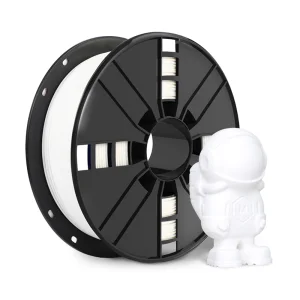
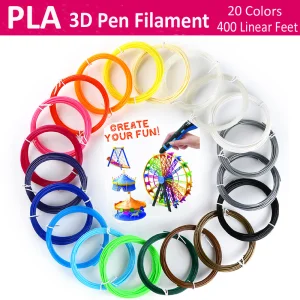
As additive manufacturing transitions from rapid prototyping into full-scale industrial batch production, the global requirement for high-consistency thermoplastic filaments has reached unprecedented technical rigor. Modern desktop and industrial Fused Deposition Modeling (FDM) / Fused Filament Fabrication (FFF) printers demand material extrusions that exhibit zero thermal drift, exceptional layer-to-layer cohesion, and sub-hundredth millimeter dimensional accuracy.
Procuring raw thermoplastic polymers and converting them into high-performance 3D printing filaments requires a deep masterwork of polymer physics, rheology control, and closed-loop process engineering. Filament manufacturers face constant material challenges: thermal degradation during melt processing, moisture-induced hydrolytic degradation in hygroscopic polymers like PETG, TPU, and PC, uneven pigment dispersion resulting in color shifts, and spool winding tension variations that induce mechanical jams in high-speed automatic material systems (AMS).
This technical intelligence report outlines how leading OEM filament factories in China utilize Industry 4.0 extrusion infrastructure, dual-axis laser diameter monitoring, inline melt filtration, and automated tension spooling to eliminate common failure modes. For enterprise brand owners, international distributors, and large-scale print farm operations, establishing a direct manufacturer partnership provides the foundation for stable, predictable polymer performance at scale.
Direct factory integration provides unmatched scalability, continuous material innovation, and strict cost efficiency for high-volume OEM brands and global resellers.
Extrusion lines integrate 500Hz optical dual-axis laser micrometers that measure filament diameter across 360 degrees every 2mm. Any deviation beyond ±0.02mm automatically triggers real-time screw speed and haul-off capstan adjustments.
We source prime virgin resins from international chemical giants (such as NatureWorks Ingeo PLA, Sabic ABS, Covestro PC, and BASF TPU). Raw materials undergo vacuum dehumidification drying to maintain optimal Melt Flow Index (MFI) and prevent micro-void creation.
To eliminate cross-winding and physical binding during high-speed printing, custom servo-driven traverse spoolers pack filament in pristine parallel layers. Compatible with all multi-material units (AMS) without drag or feeding resistance.
Compare physical, mechanical, and thermal properties across our comprehensive product portfolio. Engineered for consistent printing performance across standard and high-speed FDM/FFF equipment.
| Material Grade | Extrusion Temp (°C) | Bed Temp (°C) | Tensile Strength (MPa) | Heat Deflection (HDT @ 0.45MPa) | Recommended Speed | Primary Industrial Advantage |
|---|---|---|---|---|---|---|
| PLA / PLA Pro | 190 – 220 °C | 0 – 60 °C | 55 – 65 MPa | 55 °C | 50 – 500 mm/s | Low bio-footprint, zero warp, excellent visual surface finish |
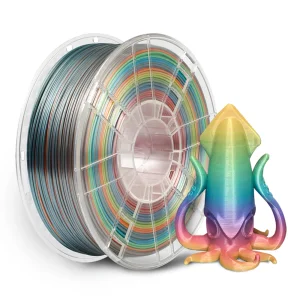
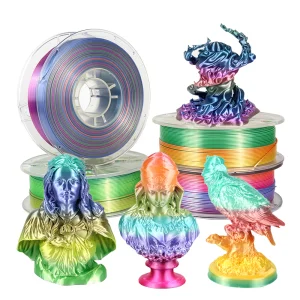
| Silk PLA / Rainbow | 200 – 230 °C | 50 – 60 °C | 45 – 52 MPa | 52 °C | 40 – 300 mm/s | High gloss pearlescent finish, fast dual/tri-color transitions |
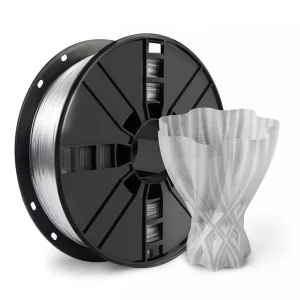
| PETG / Clear PETG | 230 – 250 °C | 70 – 80 °C | 48 – 55 MPa | 70 °C | 40 – 400 mm/s | High impact strength, moisture/chemical resistance, low shrink |
| ABS / Industrial ABS | 230 – 260 °C | 90 – 110 °C | 40 – 48 MPa | 85 °C | 40 – 300 mm/s | High heat deflection, impact resistance, acetone vapor smoothable |
| ASA (Weather Resistant) | 240 – 260 °C | 90 – 110 °C | 42 – 50 MPa | 92 °C | 40 – 250 mm/s | UV-stable, outdoor weatherability, long-term environmental resistance |
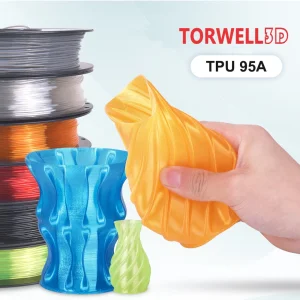
| TPU 95A / Soft Flexible | 210 – 230 °C | 30 – 60 °C | 35 – 42 MPa | 60 °C | 20 – 150 mm/s | Elastomeric elongation (>450%), high fatigue resistance, tear proof |
| PC (Polycarbonate) | 260 – 300 °C | 100 – 120 °C | 65 – 75 MPa | 115 °C | 30 – 200 mm/s | Exceptional optical clarity, flame retardancy, extreme toughness |
| Carbon Fiber Composite | 240 – 280 °C | 70 – 100 °C | 75 – 95 MPa | 110 °C | 40 – 350 mm/s | High stiffness-to-weight ratio, matte finish, minimal dimensional creep |
Material science in additive manufacturing is progressing rapidly. Our R&D laboratory focuses on four core technological pillars designed to meet the demands of next-generation hardware and enterprise circularity.
Modern CoreXY 3D printers operate at speeds exceeding 600 mm/s with accelerations over 20,000 mm/s². Our high-speed PLA and PETG variants incorporate rheology modifiers that lower melt viscosity without sacrificing inter-layer bonding tensile strength.
To support corporate ESG mandates, we are expanding closed-loop recycled PLA (rPLA) and recycled PETG (rPETG) formulations, along with bio-degradable PHA matrix blends that reduce environmental footprint while maintaining structural integrity.
Integrating micro-carbon fibers, glass spheres, and aramid fibers into engineering matrices like PA6, PA12, and PC creates structural materials capable of replacing CNC-machined aluminum in lightweight aerospace and automotive tooling applications.
Tailored masterbatch formulation allows the integration of functional additives: UL94-V0 flame retardants, static dissipative (ESD-safe) compounds, antibacterial agents, and hydrophobic surface coatings for specialized industrial deployment.
Our engineering-grade filaments provide certified material solutions across key global industries, replacing traditional sub-assembly lines with fast, lightweight, on-demand additive production.
High-impact ABS, ASA, and Carbon Fiber PC filaments serve tier-1 automotive suppliers in producing custom assembly jigs, ergonomic hand tools, interior prototype trims, and durable under-the-hood fluid ducting component prototypes.
Medical-grade PLA and transparent PETG are utilized by medical research institutions and device manufacturers to print anatomical study models, pre-surgical planning guides, and custom orthotic device housings under ISO 13485 cleanroom protocols.
End-of-arm robotic tooling (EOAT), pneumatic suction grips, and modular conveyor guides printed in Carbon Fiber composites deliver ultra-high stiffness with up to 60% mass reduction compared to solid aluminum tooling.
Custom TPU 95A elastomeric gaskets, protective bumper cases, and flame-retardant electrical enclosure housings enable consumer hardware brands to prototype, validate, and execute low-volume bridge manufacturing efficiently.
Temperature-resistant PC and specialized composite formulations allow aerospace engineering teams to perform aerodynamic wind tunnel testing, cabin environment mock-ups, and lightweight non-structural drone frame fabrications.
Non-toxic, low-odor PLA and Silk Rainbow filaments serve thousands of universities, technical institutes, and K-12 STEM labs worldwide, providing safe, vibrant materials for engineering education and design competitions.
We empower international filament brands, Amazon top-sellers, and regional industrial distributors with full turnkey white-label manufacturing, custom resin compounding, and custom retail packaging.
Our in-house spectrophotometer lab formulates custom color masterbatches matched precisely to your physical sample or Pantone C/U code. We guarantee tight batch-to-batch color consistency with Delta E variance under 1.0.
Choose from reusable transparent polycarbonate spools, high-speed AMS-compatible spools, or eco-friendly recycled cardboard spools. We provide custom spool sticker labeling, branded inner cartons, and heavy-duty outer shipping boxes.
Extruded filament is immediately transferred to humidity-controlled packaging zones. Every spool is vacuum-sealed with high-absorption silica desiccant pouches and humidity indicator cards to guarantee a shelf life of 24+ months.
From raw polymer crystallization to final palletization, our strict 5-stage quality management system guarantees that every spool leaving our factory meets international standards.
Resins undergo high-temperature desiccant drying to lower moisture content below 200 ppm, preventing hydrolysis during melting.
Multi-zone heating barrels melt polymer evenly under precise screw RPMs to preserve chemical chains and prevent degradation.
Continuous 360-degree laser sensors read filament diameter every 2ms, providing real-time feedback to maintain a ±0.02mm tolerance.
Neat layer-by-layer winding systems eliminate tangles, overlaps, and high-tension spooling that could deform filament geometry.
Every lot undergoes melt flow testing, print test verification, and immediate moisture-proof vacuum sealing with silica gel.
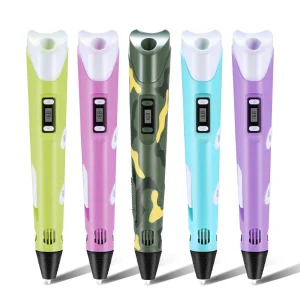
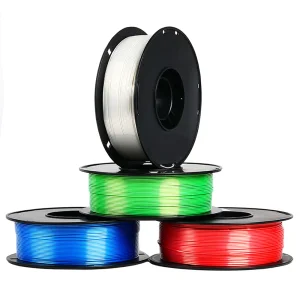
Explore our full range of high-performance polymer series, including specialized PETG, high-flex TPU, high-temp ABS, and creative 3D drawing pens.
Importing 3D printing filaments requires compliance with international chemical, safety, and environmental standards. We provide full regulatory documentation for seamless clearance in North America, Europe, and Asia-Pacific markets.
All polymer formulations, masterbatches, and additives comply strictly with EU REACH regulation (EC 1907/2006) and RoHS Directive 2011/65/EU. Filaments are certified free of heavy metals, phthalates, and hazardous volatile organic compounds (VOCs).
Our manufacturing facility operates under certified ISO 9001:2015 Quality Management and ISO 14001:2015 Environmental Management systems. Continuous audit trails ensure complete lot traceability from raw resin to shipped pallet.
Every material grade is accompanied by comprehensive Safety Data Sheets (SDS), Technical Data Sheets (TDS), and FDA food-contact compliance declarations (for qualifying virgin PLA and PETG series) to streamline your retail compliance.
Find detailed technical and commercial answers regarding factory Minimum Order Quantities (MOQ), OEM branding capabilities, shipping protocols, and multi-material system compatibility.