Direct factory supply of precision 3D printing filaments engineered for professional prototyping, OEM brands, and additive manufacturing farms.
An authoritative analysis of chemical compounding, microstructural phase separation, and carbon black loading mechanics in flexible additive manufacturing.
Thermoplastic Polyurethane (TPU) represents a unique class of block copolymers consisting of alternating hard segments (isocyanates and chain extenders) and soft segments (long-chain polyols). When evaluating a high-tier China TPU Filament Black Manufacturer & Manufacturers ecosystem, understanding the molecular dynamics of these segments is critical for industrial B2B procurement teams. The hard segments provide mechanical strength, thermal stability, and chemical resistance through hydrogen-bonded crystalline domains, while the soft segments dictate elastomeric flexibility, low-temperature impact performance, and energy dissipation.
In high-grade Black TPU 3D printing filaments, carbon black pigment is not merely a colorant; it functions as a functional micro-reinforcement matrix. Incorporating nano-dispersed carbon black particles enhances UV radiation degradation resistance, prevents photo-oxidative chain scission under outdoor exposure, and stabilizes thermal transfer within the extruder hotend. China's advanced compounding facilities utilize specialized twin-screw co-rotating extruders to ensure homogeneous carbon black dispersion, eliminating agglomerates that cause nozzle clogging, layer delamination, or local yield stress dropouts.
The performance of Black TPU filament during Fused Deposition Modeling (FDM) hinges on phase separation behavior during rapid solidification. As the molten filament is extruded at temperatures between 200°C and 230°C onto the build plate, the hard urethane segments crystallize rapidly, building an immediate structural backbone that prevents print sagging or geometry distortion. Simultaneously, the amorphous soft segment matrix retains glass transition temperatures ($T_g$) as low as -40°C, ensuring that functional printed components retain elastomeric memory without embrittlement.
Our manufacturing lines implement real-time melt flow index (MFI) control to regulate viscosity shear-thinning. Under high shear rates inside the nozzle, the polymer chain entanglement thins dynamically to ensure low extrusion torque, while immediately regaining high zero-shear viscosity upon deposition to preserve fine feature resolution, crisp overhangs, and clean bridging performance.
How leading Chinese manufacturers integrate dual-axis laser feedback, automated closed-loop drying, and precise spooling tension control.
Every meter of Black TPU filament passes through high-frequency dual-axis laser gauges sampling diameter profiles at 500 Hz. Automated feedback loops dynamically adjust extruder screw RPM and haul-off capstan speed to lock tolerances within an absolute threshold of ±0.02 mm, preventing feed slippage or nozzle jam events.
TPU polymers are inherently hygroscopic, rapidly absorbing atmospheric moisture which causes hydrolytic degradation, steam popping, and surface void formation during printing. Our facility utilizes continuous desiccant wheel dehumidifiers, ensuring raw polymer moisture content remains strictly below 0.02% (200 ppm) prior to melt extrusion.
Flexible filaments present distinct winding challenges due to elastic elongation under spooling tension. Our automated servo-driven traversing winding systems maintain uniform low-tension layer alignment, guaranteeing zero overlapping loops, cross-winding, or spool binding during high-speed printing.
Comprehensive physical, mechanical, and thermal performance parameters evaluated under standardized ISO and ASTM testing protocols.
| Property Parameter | Testing Standard | Shore 85A Grade | Shore 95A Grade (Standard Black) | Shore 98A Grade (High Speed) |
|---|---|---|---|---|
| Specific Gravity / Density | ISO 1183 / ASTM D792 | 1.18 g/cm³ | 1.21 g/cm³ | 1.23 g/cm³ |
| Tensile Strength at Yield/Break | ISO 527 / ASTM D638 | 32 MPa | 45 MPa | 52 MPa |
| Elongation at Break | ISO 527 / ASTM D412 | 620% | 500% | 420% |
| Tear Strength (Trouser Tear) | ISO 34-1 / ASTM D624 | 90 kN/m | 125 kN/m | 145 kN/m |
| Abrasion Loss | ISO 4649 (DIN 53516) | 35 mm³ | 28 mm³ | 22 mm³ |
| Glass Transition Temp ($T_g$) | DSC (10°C/min) | -42°C | -35°C | -28°C |
| Recommended Printing Temp | Extrusion Test | 200°C – 215°C | 210°C – 230°C | 225°C – 245°C |
| Bed Temperature Range | Adhesion Test | 30°C – 50°C | 40°C – 60°C | 50°C – 70°C |
| Carbon Black Pigment Content | TGA Analysis | 1.8 wt% | 2.0 wt% High UV Grade | 2.2 wt% |
Tailored flexible polymer solutions deployed across automotive, industrial automation, defense enclosures, and wearable devices.
Black TPU Shore 95A is heavily deployed for printing custom grommets, wire harness seals, flexible air ducts, and shock-absorbing spring isolators. Its resistance to automotive fluids (motor oil, diesel, glycol solutions) ensures long-term operational durability under bonnet environments.
For factory automation, customized vacuum suction cups, soft robotic finger pads, and anti-vibration arm dampeners require non-marring, high-coefficient-of-friction elastomeric surfaces. Black TPU provides high tear resistance and rapid elastic recovery during million-cycle compression loops.
Military-grade handheld communications devices, drone landing gear pads, and ruggedized tablet bumpers leverage Black TPU's high impact energy absorption. The deep matte black finish reduces optical reflection and provides IP67-rated waterproof gasket sealing capabilities.
Pioneering advancements in high-speed extrusion physics, electrostatic discharge safety, and bio-derived elastomeric formulations.
Traditional TPU filaments are historically restricted to slow print speeds (20–40 mm/s) to prevent filament buckling within the extruder drive gears. As Next-Gen high-speed FDM hardware (such as direct-drive core-XY motion systems) becomes standard across industrial print farms, our R&D team has engineered modified high-flow TPU compounds. By widening the molecular weight distribution and incorporating internal lubricant slip additives, our High-Speed Black TPU achieves print speeds up to 300 mm/s at standard volumetric melt rates of 24 mm³/s without heat creep or nozzle back-pressure binding.
Electrostatic Discharge (ESD) safety is mandatory in electronics manufacturing cleanrooms, semiconductor handling jigs, and explosive atmosphere (ATEX) enclosures. Our technical roadmap incorporates specialized multi-walled carbon nanotube (MWCNT) conductive carbon black networks into the polyether TPU backbone. This yields a surface resistivity strictly controlled within the anti-static window of $10^6 \text{ to } 10^9 \ \Omega/\text{sq}$, while preserving full elastomeric flexibility and high tensile elongation.
Aligning with global decarbonization mandates and ESG compliance goals, our next-generation sustainable TPU line replaces fossil-fuel polyols with bio-based monomer polyols derived from castor oil and renewable biomass. These bio-TPU formulations retain identical Shore 95A mechanical characteristics while reducing the overall product carbon footprint (PCF) by over 40% from cradle-to-gate, supporting eco-conscious OEM product lifecycles.
Guaranteeing global market access through comprehensive chemical safety certifications, REACH SVHC declarations, and standardized testing.
Every batch of Black TPU filament manufactured in our China production base undergoes strict GC-MS chemical screening. We certify full compliance with European Union REACH Regulation (EC) No 1907/2006 (covering 235+ Substances of Very High Concern) and RoHS Directive 2011/65/EU (Restriction of Hazardous Substances), restricting heavy metals, phthalates, and brominated flame retardants.
For applications involving repeated skin contact or incidental food handling (such as wearers' wristbands, prosthetics, or culinary gaskets), specific polyether-based TPU formulations are certified to conform with FDA 21 CFR 177.2600 (Rubber articles intended for repeated use) and ISO 10993 cytotoxicity standards.
Optional flame-retardant Black TPU grades are compounded with halogen-free intumescent additives. These formulations achieve UL 94 V-2 and V-0 ratings at 1.5mm thickness, self-extinguishing within 10 seconds of flame removal without dripping flaming particles, making them suitable for consumer electronics and aerospace interiors.
Full spectrum custom manufacturing, private labeling, bulk spool options, and container load optimization for global distributors.
While Shore 95A represents the ideal balance for universal FDM extruders, we compound custom hardness levels ranging from ultra-soft Shore 80A (for maximum flexibility) up to rigid Shore 75D (for tough impact-resistant structural components).
We provide turnkey OEM private label manufacturing. From custom branded cardboard spools, UV-coated retail boxes, individualized barcode labels, to nitrogen-flushed foil vacuum bags with high-capacity silica gel desiccant packs.
Industrial client requirements vary across prototyping and continuous print farms. We offer flexible spool packaging ranging from 250g mini-sample spools, standard 1.0kg retail reels, up to 3.0kg and 5.0kg master spools designed for heavy-duty industrial printers.
Detailed engineering insights answering procurement, extrudability, and material specification queries.
Top-tier Chinese manufacturers leverage integrated domestic polymer supply chains, accessing premium raw polyurethane resins and high-purity carbon black masterbatches. Advanced twin-screw extruders ensure sub-micron carbon dispersion, yielding superior tensile strength, rich matte surface finish, and exact ±0.02mm diameter consistency across multi-ton production lots.
Direct-drive extruders shorten the distance between the drive gears and melt zone to under 50mm, eliminating filament buckling and allowing precise retraction control (1.0–2.0mm at 30mm/s). Bowden setups can print Shore 95A TPU, but require slower speeds (15–25mm/s), zero retraction, and low-friction PTFE tubing to prevent binding.
If exposed to ambient humidity above 30% RH, TPU should be dried in a blast drying oven or dedicated filament dryer at 65°C to 70°C for 4 to 6 hours. Printing directly from a sealed dry box ensures void-free, highly transparent, and strong layer-bonded prints without stringing or popping sounds.
When compounded at optimal concentrations (1.5 to 2.5 wt%), fine carbon black particles act as structural fillers that slightly increase tensile modulus and UV resistance without compromising elastomeric elongation at break. Poor compounding, however, leads to particle agglomeration which creates stress concentrations and reduces tear strength.
For standard stock Black TPU 1.75mm spools, MOQ starts as low as 100 kg. Custom Shore hardness formulations, specialized conductive additives, or custom Pantone color matching typically carry an OEM order threshold of 500 kg to 1,000 kg per batch run.
TPU possesses a relatively wide thermal processing window and low thermal crystallization rate. As hot polymer chains are deposited onto previous layers, polymer chain diffusion occurs across the interface before crystallization locks the hard segments, creating near-isotropic structural strength where Z-axis layer bonding approaches 90%+ of X-Y tensile strength.
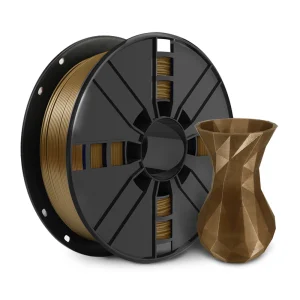
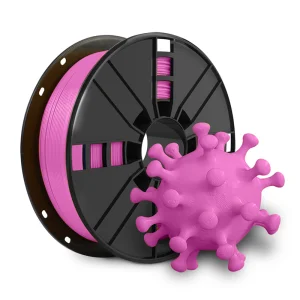
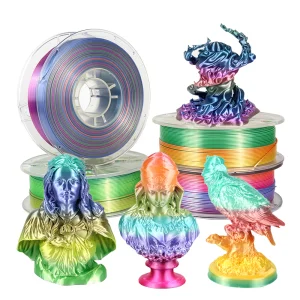
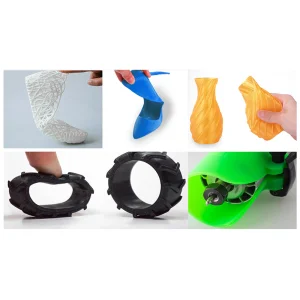
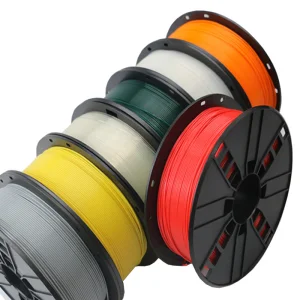
Explore our complete range of PLA, PETG, ABS, Silk, and specialized TPU printing materials direct from China manufacturing lines.
Streamline your procurement pipeline with industrial-grade polymer reliability, custom Shore hardness formulation, and certified OEM private label packaging.
Request Factory Technical Datasheet & Quote