Explore our industrial-grade and wholesale 3D printer filaments engineered with tight mechanical tolerances for global distributors and additive manufacturing hubs.
A comprehensive analysis of microstructural reinforcement, rheological behavior, and thermo-mechanical dynamics in high-speed Fused Deposition Modeling (FDM).
In the rapidly evolving landscape of industrial additive manufacturing, Carbon Fiber Reinforced Polyethylene Terephthalate Glycol (PETG-CF) represents a critical evolutionary leap. Standard unfilled PETG is renowned across consumer and commercial prototyping for its ease of printing, glycol-modified chemical resistance, and low thermal shrinkage. However, pure PETG lacks the high flexural modulus and dimensional stability required for end-use structural components subjected to continuous mechanical strain or elevated ambient temperatures.
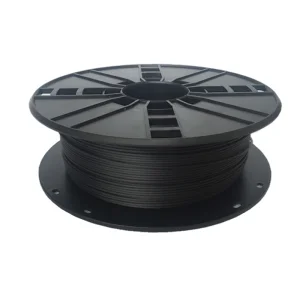
By compounding high-purity amorphous PETG resin with micro-scale chopped carbon fibers (typically 15% to 20% by weight loading ratio), accredited China Carbon Fiber PETG Suppliers and Factories alter the polymer's underlying physical properties. Chopped carbon fibers—possessing micro-diameters ranging from 7 to 10 μm—act as internal structural skeletons. During melt extrusion through precision dual-screw extruders, these fibers align along the flow direction, significantly boosting tensile strength, eliminating post-printing isotropic warpage, and imparting a distinctive matte black industrial surface finish that hides layer lines completely.
| Mechanical / Thermal Property | Standard Unfilled PETG | PETG-CF (15% Carbon Fiber) | PETG-CF (20% Carbon Fiber) | PA6-CF (Nylon Composite) |
|---|---|---|---|---|
| Tensile Strength (MPa) (ISO 527) | 48 - 52 MPa | 68 - 74 MPa | 78 - 85 MPa | 95 - 110 MPa |
| Flexural Modulus (GPa) (ISO 178) | 1.9 - 2.1 GPa | 4.5 - 5.2 GPa | 6.1 - 6.8 GPa | 7.2 - 8.5 GPa |
| Heat Deflection Temp (HDT @ 0.45MPa) | 68 - 72 °C | 80 - 84 °C | 84 - 88 °C | 160 - 185 °C |
| Moisture Absorption (24h immersion) | 0.20% | 0.12% | 0.09% | 1.25% (High Moisture Sensitivity) |
| Enclosure Requirement | Open Air / Optional | Not Required | Not Required | Required (Heated Chamber) |
| Dimensional Shrinkage Rate | 0.4% - 0.7% | < 0.15% | < 0.10% | 0.2% - 0.4% |
*Note: Data compiled from standardized injection-molded and FDM printed test bars under laboratory testing environments ($23^\circ\text{C}$, 50% Relative Humidity).
Emerging polymer compounding technologies driving the next generation of high-rigidity structural thermoplastics in Chinese smart manufacturing facilities.
Traditional carbon fiber filaments suffer from severe anisotropic mechanical properties—yielding immense X/Y-plane strength while sacrificing Z-axis layer bonding due to fiber bridging limits. Leading Chinese extrusion laboratories are pioneering dual-stage surface functionalization of carbon fibers using silane coupling agents. This enhances interfacial shear strength between the hydrophobic carbon fiber matrix and the PETG polymer chains, retaining up to 82% of Z-axis bond integrity relative to unreinforced PETG.
Future development roadmaps focus on expanding PETG-CF into Electrostatic Discharge (ESD) safe tooling for semiconductor and electronics manufacturing. By controlling carbon nanotube (CNT) and milled fiber aspect ratios, Chinese compounding plants achieve precise surface resistivity control within the ESD window of $10^6$ to $10^9\text{ ohms/sq}$. This eliminates static accumulation risks without sacrificing the structural stiffness of parts.
With the global transition toward automated material systems (AMS) and ultra-high-speed core-XY 3D printers ($>500\text{ mm/s}$), modern PETG-CF compounding mandates optimized melt flow index (MFI) engineering. Advanced chemical formulations increase MFI from $8\text{ g/10min}$ to over $22\text{ g/10min}$ (tested at $240^\circ\text{C}/2.16\text{kg}$), allowing rapid volumetric deposition without backpressure buildup, nozzle clogging, or filament grinding.
Environmental governance demands sustainable sourcing. Top-tier Chinese manufacturers are implementing closed-loop post-industrial PETG recycling coupled with reclaimed aerospace carbon fibers. Carbon footprint metrics indicate a 45% reduction in embodied carbon emissions for recycled PETG-CF spools while retaining over 92% of virgin material tensile stiffness.
How global industrial enterprises leverage China-manufactured Carbon Fiber PETG filaments to replace heavy aluminum parts and accelerate operational workflows.
Automotive assembly lines utilize PETG-CF for lightweight custom assembly jigs, positioning nests, and robotic end-of-arm tooling (EOAT). Unlike nylon composites that absorb moisture and swell—causing alignment errors—PETG-CF maintains zero dimensional drift in humid factory floor environments, ensuring sub-millimeter repeatable accuracy.
Unmanned Aerial Vehicle (UAV) frame arms, motor mounts, and battery enclosures require extreme rigidity-to-weight ratios to maximize flight duration and minimize vibration. PETG-CF provides high dampening characteristics, protecting sensitive onboard electronics while withstanding external impact and environmental UV exposure.
Custom cable chains, protective gear housings, sensor mounting brackets, and pneumatic actuator adapters printed with PETG-CF eliminate costly CNC metal machining lead times. Components can be printed overnight and deployed directly onto active production machinery.
Why sourcing Carbon Fiber PETG directly from qualified Chinese extruders yields unmatched quality control, cost efficiency, and operational agility.
The global market for additive manufacturing materials has transitioned from small-scale batch production to automated high-volume continuous manufacturing. China's leading polymer extrusion ecosystems operate state-of-the-art Industry 4.0 smart facilities engineered specifically for technical filament extrusion.
Standard retail filaments often suffer from diameter fluctuations ($\pm0.05\text{ mm}$), leading to inconsistent volumetric extrusion, underextrusion gaps, or hot-end jams. Top Chinese factories utilize inline dual-axis laser calipers operating at 1,000 measurements per second. Coupled with automated feedback control to the melt pump motor, diameter tolerances are strictly locked at $\pm0.02\text{ mm}$ across an entire 1,000-meter spool production run.
Directly blending carbon fibers with molten PETG resin without degrading fiber length requires specialized compounding machinery. Advanced Chinese facilities utilize co-rotating twin-screw extruders featuring custom L/D (Length-to-Diameter) ratios and segmented screw elements. This ensures uniform fiber dispersion while preventing fiber breakage, preserving mechanical integrity across all exported batches.
PETG polymer matrix chains hydrolyze when exposed to atmospheric humidity during high-temperature extrusion, resulting in brittle filament and severe surface bubbling. Chinese factories incorporate closed-loop desiccant drying towers that dry raw pellets to under 150 PPM moisture content before feeding. Immediate automated inline vacuum seal packaging with high-capacity silica desiccant guarantees shelf-life stability upon global delivery.
Tangled spools cause catastrophic print failures in unattended 3D print farms. Chinese automated winding stations utilize optical sensors and servo-driven traverse guides to place every filament layer cleanly side-by-side. Furthermore, spools are precision-molded to fit seamlessly within AMS multi-material units without rim drag or slippage.
Essential quality assurance criteria and compliance metrics for global brand owners, Amazon sellers, and industrial procurement officers.
Enterprise procurement mandates full compliance with environmental and safety standards. Enterprise-grade Chinese suppliers provide comprehensive chemical analysis reports, including RoHS 3.0 (EU 2015/863), REACH SVHC compliance, and SDS (Safety Data Sheets) to ensure friction-free international customs clearance and retail safety.
From custom Pantone-matched spool colors and eco-friendly recyclable cardboard spools to branded retail boxes, serialized QR-code tracking, and customized weight options (250g, 1kg, 2.5kg, 5kg industrial reels), China OEMs offer turnkey private-label solutions tailored to your market branding.
Industrial users require strict lot traceability. Qualified China factories archive raw resin blend masterbatches and log extrusion melt temperature histories for every single batch, providing technical data sheets (TDS) detailing verified tensile, flexural, and impact metrics with every shipment.
Seamless international logistics, dedicated application engineering support, and hazard-free export clearance for bulk procurement partners.
Navigating global supply chain friction requires flexible trade terms. Premier Chinese filament vendors support full FOB, CIF, and DDP (Delivered Duty Paid) logistics routes via sea freight, air express, and international rail transport. All shipments feature heavy-duty 5-ply corrugated outer master cartons wrapped in moisture-barrier film to resist long-transit oceanic humidity.
To reduce onboarding friction for your end-user customers, factory application engineers provide pre-tested, downloadable slicer profile presets (.json / .3mf) optimized for major 3D printing platforms (including Bambu Lab, Creality K1, Prusa MK4, and Voron systems). This ensures optimized print parameters out of the box.
Expert insights regarding Carbon Fiber PETG processing, hardware requirements, factory procurement, and performance optimization.
While Carbon Fiber Nylon (PA-CF) provides higher absolute heat deflection temperature ($150^\circ\text{C}+$) and tensile strength, Nylon is extremely hygroscopic and requires constant drying during printing, as well as an enclosed heated chamber to prevent severe warping. PETG-CF offers a superior balance for everyday functional parts: it requires no heated chamber, prints reliably on standard open-frame 3D printers, absorbs negligible ambient moisture, and exhibits practically zero warping while delivering impressive stiffness and thermal resistance up to $85^\circ\text{C}$.
Yes. Chopped carbon fibers are highly abrasive. Printing PETG-CF through a standard brass nozzle will erode the orifice diameter from 0.4mm to over 0.6mm within just 200–300 grams of printing, destroying print resolution. We strictly recommend utilizing Hardened Steel, Tungsten Carbide, or Ruby-tipped nozzles with a minimum hardness rating of >50 HRC. Additionally, a nozzle diameter of 0.4mm or 0.6mm is recommended to prevent micro-fiber clogging.
Recommended starting printing parameters for our Carbon Fiber PETG filament include:
Although PETG-CF is far more moisture-resistant than Nylon or TPU, long-term exposure to high humidity ($>65\%\text{ RH}$) can cause minor surface stringing and micro-voids during high-temperature extrusion. We recommend storing unsealed spools in airtight containers with active desiccant or drying humid spools in a dedicated filament dryer at 65 °C for 4 to 6 hours prior to high-precision printing runs.
For standard stocking colors and standard 1kg spool configurations, our factory MOQ starts at just 100 spools. For custom Pantone-matched base colors, custom spool labeling, private-label box branding, or specific carbon fiber loading ratios (e.g., custom 25% CF loading), the standard OEM production batch MOQ is typically 500 to 1,000 kilograms per run.
Yes. We offer both high-durability ABS/PC plastic spools and 100% recyclable heavy-duty cardboard spools. Our cardboard spools feature pressed, smooth edge rims coated with anti-dust varnish to prevent friction dust from entering automated material feed systems like the Bambu Lab AMS.
Our manufacturing facility employs gravimetric automated dosing systems that precisely measure raw PETG resin, carbon fiber masterbatch, and process additives to within 0.1% accuracy before melt extrusion. Every production lot undergoes automated tensile testing, MFR (Melt Flow Rate) verifications, and dual-laser diameter tracking to guarantee 100% batch-to-batch consistency across global orders.
Discover our complementary material solutions, including Silk PLA, structural PLA+, high-temp PC, and flexible TPU filaments manufactured for international distribution.