Explore our factory-direct extrusion catalog optimized for worldwide distributors, Amazon seller brands, and industrial additive manufacturing facilities.
Polyethylene Terephthalate Glycol (PETG) reinforced with specialized deep-black pigment matrixes represents the workhorse material of modern industrial additive manufacturing.
In the global fused deposition modeling (FDM) ecosystem, China Black PETG Manufacturers & Factories stand at the center of supply chain innovation. Standard PET (Polyethylene Terephthalate) is notoriously prone to rapid crystallization during extrusion, leading to brittleness and severe thermal shrinkage. By introducing 1,4-cyclohexanedimethanol (CHDM) during polymer synthesis, copolymerization yields PETG—an amorphous thermoplastic resin boasting exceptional ductility, chemical inertness, high impact strength, and optical clarity before pigmentation.
When formulated into professional 3D printing filament, Black PETG requires a delicate equilibrium between virgin polymer resin purity and high-dispersion carbon black or specialized organic black colorants. Chinese compounding facilities leverage state-of-the-art twin-screw extruder compounding to achieve jet-black opacity without degrading the polymer’s intrinsic molecular weight, ensuring layer adhesion remains virtually isotropic.
Technical Insight: Lower-tier black PETG filaments often utilize recycled regrind mixed with low-grade black masterbatch containing high calcium carbonate filler. This causes nozzle abrasion, severe stringing, and internal micro-voids. Leading Chinese manufacturers enforce virgin chemical resin synthesis and sub-micron particle dispersion to guarantee zero nozzle clogging and maximum z-axis weld strength.
How Chinese manufacturing clusters in Guangdong and Jiangsu deliver unmatched cost-to-performance efficiency for global B2B procurement partners.
Direct partnership with petrochemical giants (Sinopec, SK Chemicals, Eastman) allows Chinese factories to customize the Melt Flow Index (MFI 12–18 g/10min) specifically engineered for high-speed FDM extrusion printers.
Modern automated extrusion lines employ 2-axis or 4-axis laser gauge feedback loops, monitoring strand diameter at 1000 Hz to guarantee continuous ±0.02mm diameter precision across 1.75mm and 2.85mm spools.
Operating multi-line automated production facilities running 24/7 yields monthly output capacities exceeding 50,000 to 100,000 kg. High volume translates directly into competitive FOB/CIF container pricing.
| Property Parameter | China Black PETG | Standard PLA | Engineering ABS | Weatherable ASA |
|---|---|---|---|---|
| Tensile Strength (MPa) | 50 – 54 | 60 – 65 | 40 – 45 | 42 – 48 |
| Flexural Modulus (GPa) | 2.1 – 2.4 | 3.1 – 3.5 | 2.0 – 2.3 | 2.1 – 2.5 |
| Heat Deflection Temp (°C @0.45MPa) | 75 – 78 | 52 – 55 | 95 – 100 | 98 – 104 |
| UV & Outdoor Weathering | Excellent (Black Pigmented) | Poor | Poor (Yellows/Degrades) | Outstanding |
| Print Bed Requirement | 70 – 80 °C (No Enclosure) | 50 – 60 °C (No Enclosure) | 100 – 110 °C (Enclosure) | 95 – 105 °C (Enclosure) |
| Chemical Resistance | High (Acids, Bases, Oils) | Moderate | Low (Soluble in Acetone) | High |
Navigating global market entry requires rigorous material compliance, custom branding options, and moisture-controlled ocean packaging.
Exporting to North America, Europe, and the Asia-Pacific region demands strict adherence to international environmental and safety standards. Premium Chinese manufacturers supply complete compliance dossiers:
PETG is moderately hygroscopic, absorbing ambient moisture if exposed during long-distance maritime transit. Chinese export facilities implement multi-stage moisture defense systems:
As 3D printing transitions from prototyping to high-speed digital manufacturing, Chinese R&D centers are leading four transformational polymer trends.
Engineered with modified melt rheology and rapid thermal crystallization kinetics, allowing clean extrusion on modern CoreXY printers without loss of layer adhesion or stringing.
Incorporating 15–20% chopped carbon fibers into the black PETG polymer matrix yields a high-modulus material with zero surface gloss, high stiffness, and dimensional stability.
Closing the circular economy loop by re-compounding 100% recycled industrial PETG waste, dyed deep black to achieve zero mechanical property degradation while reducing CO2 footprints by 70%.
Compounded with conductive carbon nanotube (CNT) networks to deliver predictable surface resistivity ($10^6 - 10^9 \text{ \Omega/sq}$) for semiconductor assembly fixtures.
Why design engineers choose black PETG for real-world mechanical and environmental installations.
Black PETG provides high impact resistance and dimensional stability under continuous mechanical vibration. It resists machine oils, automotive fluids, and mild solvents without stress cracking.
Because black carbon dispersion inherently absorbs UV radiation, outdoor sensors, drone bodies, and camera housings manufactured from black PETG exhibit extended shelf life without brittle UV embrittlement.
PETG features low water vapor permeability and broad chemical compatibility, making it ideal for customized coolant reservoirs, air intake piping, and pneumatic valve mounting blocks.
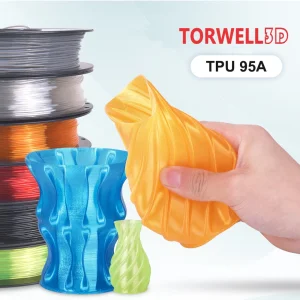
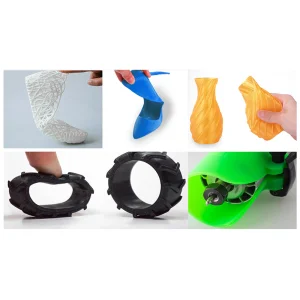
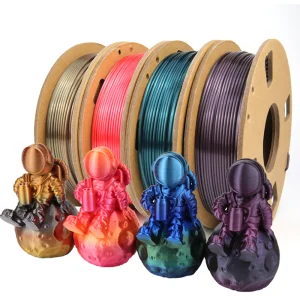
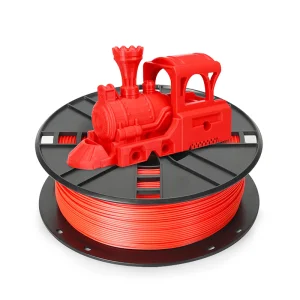
Complete your sourcing portfolio with our premium selection of flexible TPUs, high-gloss Silk PLAs, and technical FDM materials.
Technical and logistical answers compiled by our senior polymer engineering team for international buyers.