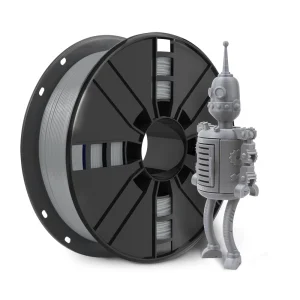
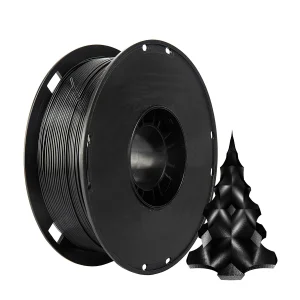
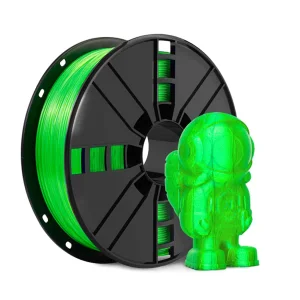
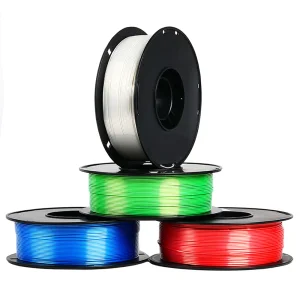
Explore our core engineering catalog produced under strict ±0.02 mm dual-axis laser diameter monitoring for immediate global distribution.
Understanding the fundamental chemical differences that make ASA 1.75mm the preferred thermoplastic over ABS, PETG, and PC for harsh environment end-use applications.
Unlike ABS which utilizes a polybutadiene rubber phase containing unsaturated double bonds ($C=C$), ASA incorporates a grafted acrylate elastomer matrix. Polybutadiene double bonds readily cleavage under ultraviolet light, causing embrittlement and discoloration. ASA's saturated acrylic rubber matrix eliminates photo-oxidation vulnerabilities, maintaining impact resistance across decade-long UV exposure.
ASA exhibits a high glass transition temperature ($T_g$) around $105^\circ\text{C}$. This mechanical stiffness enables printed parts to maintain structural integrity under high ambient heat, solar radiation absorption inside enclosed enclosures, and industrial heat stress without experiencing heat deflection or creep deformation.
Engineered ASA 1.75mm compounds feature optimized melt flow indices (MFI) tailored for Fused Deposition Modeling (FDM). Controlled polymer chain entanglement across print layers yields near-isotropic tensile strength, minimizing layer delamination under shear and mechanical impact loading.
| Polymer Parameter | ASA (Acrylonitrile Styrene Acrylate) | ABS (Acrylonitrile Butadiene Styrene) | PETG (Polyethylene Terephthalate Glycol) | PC (Polycarbonate) |
|---|---|---|---|---|
| UV Weatherability (ASTM G154) | Exceptional (>10,000 hrs) | Poor (Yellows / Embrittles) | Moderate | Moderate (Requires UV coating) |
| Glass Transition Temp ($T_g$) | 105 °C | 102 °C | 80 °C | 145 °C |
| Tensile Strength (ISO 527) | 42 - 48 MPa | 40 - 45 MPa | 45 - 50 MPa | 60 - 70 MPa |
| Flexural Modulus (ISO 178) | 2,100 - 2,400 MPa | 2,100 - 2,300 MPa | 2,000 - 2,150 MPa | 2,300 - 2,500 MPa |
| Print Bed Temp Requirement | 90 - 110 °C | 95 - 110 °C | 70 - 80 °C | 110 - 130 °C |
| Matte / Gloss Surface Finish | Satin Matte Finish | Slight Gloss / Matte | High Gloss | Glossy / Clear |
Where high-performance ASA 1.75mm filament excels across critical global industries, outperforming legacy materials in environmental resilience.
Automotive tier-1 suppliers and aftermarket customizers deploy China ASA 1.75mm filament for functional exterior parts including side mirror covers, roof rack mounting brackets, custom radiator grilles, and outdoor EV charging station cable hooks. ASA withstands continuous road grit exposure, automotive washing chemicals, fuel vapors, and intense sunlight without micro-cracking or fading.
In saltwater marine environments, metals suffer galvanic corrosion while traditional plastics yellow and become brittle. ASA 1.75mm is widely specified for marine radar housings, GPS antenna mounts, yacht deck access latches, underwater sensor brackets, and nautical Instrument bezels exposed to high humidity, UV reflection from water, and saline mist.
5G micro-cell outer radomes, IoT environmental sensor enclosures, remote weather monitoring stations, and smart power grid terminal boxes require materials transparent to radio frequencies while providing IP67 weather sealing. ASA 1.75 mm provides dielectric stability and long-term thermal resistance across extreme hot/cold diurnal cycles.
Unmanned Aerial Vehicles (UAVs) operating at high altitudes encounter intense UV radiation and rapid cooling/heating transitions. ASA 1.75mm is utilized for lightweight drone battery hatches, camera gimbal mounts, antenna fairings, and structural wingtip connectors due to its high strength-to-weight efficiency and low warping characteristics during rapid prototyping.
How China's integrated chemical manufacturing clusters deliver unrivaled production capacity, material consistency, and OEM brand responsiveness.
Chinese manufacturers benefit from direct industrial integration with petrochemical giants in Guangdong and Jiangsu. Sourcing raw virgin ASA resin in mega-tonnage bulk lots ensures consistent batch chemistry, lower monomer cost structures, and stable raw material availability even during global supply chain disruptions.
Modern Chinese filament factories operate automated twin-screw extrusion equipment fitted with gravimetric dosing systems. Dual-axis inline laser micrometers continuously sample filament diameter at 1,000 Hz, instantly adjusting puller speeds to enforce strict $\pm0.02\text{mm}$ roundness and tolerance controls.
From Pantone/RAL color matching within 5 business days to custom cardboard spools, private label carton printing, and specific net-weight configurations (250g, 1kg, 3kg, 5kg spools), Chinese suppliers offer flexible minimum order quantities (MOQs) tailored for global distributors and Amazon private labels.
By leveraging China's optimized port infrastructure (Shenzhen, Ningbo, Shanghai) and streamlined export documentation (CO, Form E, REACH/RoHS compliance certificates), global buyers reduce landed product costs by 30% to 45% compared to regional Western extruders while obtaining identical or superior tolerance tolerances.
How top-tier Chinese ASA manufacturers eliminate common filament defects such as moisture bubbles, tangles, and diameter drift.
Raw ASA resin pellets are dried in closed-loop hopper dryers at $80^\circ\text{C}$ for 4-6 hours to reach moisture levels below 0.02% before extrusion, preventing hydrolytic polymer chain degradation.
Precision melt pumps pass molten ASA polymer through ultra-fine stainless steel mesh screens to trap un-melted gels, foreign particulates, and pigment agglomerates.
Non-contact dual-axis optical lasers continuously scan 100% of the extruded 1.75mm strand. Any spool exceeding $\pm0.02\text{mm}$ or $0.02\text{mm}$ ovality is automatically flagged and rejected.
Microprocessor-controlled servo winders ensure uniform, edge-to-edge layer alignment across the spool, completely preventing overlapping turns and filament snaps during automated AMS printing.
Finished spools are immediately vacuum-sealed inside high-barrier foil bags with active silica desiccant packs, protecting the filament during multi-week ocean transit.
Emerging polymer enhancements set to define the next generation of ASA 3D printing materials in global markets.
With high-speed CoreXY 3D printers standardizing print speeds between 300 mm/s and 600 mm/s, chemical engineers are developing low-viscosity ASA formulations. Modified rheology additives increase melt flow rates (MFR) without reducing inter-layer thermal fusion or mechanical tensile strength.
Compounding ASA with 15-20% chopped high-modulus carbon fibers yields ASA-CF. Carbon fiber reinforcement further reduces volumetric thermal expansion to virtually zero, completely eliminating corner lifting/warping on large-format prints while imparting an industrial matte finish and higher heat deflection ($HDT > 110^\circ\text{C}$).
To support corporate ESG goals and European circular economy mandates, Chinese R&D centers are pioneering Post-Consumer Recycled (PCR) ASA matrices blended with bio-derived acrylate monomer building blocks, reducing product cradle-to-gate carbon footprints by up to 40%.
Ensuring complete regulatory peace of mind for global importers, distributors, and industrial enterprise procurement.
100% compliant with Regulation (EC) No 1907/2006 (REACH) and Directive 2015/863/EU (RoHS). Free of heavy metals, phthalates, and SVHC compounds.
Available in self-extinguishing flame-retardant grades rated UL94 V-0 for sensitive electrical component enclosures and public transit applications.
Comprehensive Safety Data Sheets (SDS) in English, German, French, and Spanish, accompanied by official Technical Data Sheets (TDS) for engineering validation.
Full DDP / FOB / CIF shipping options supporting sea freight containers, air express, and Amazon FBA direct delivery with custom barcode labelling.
Discover our extended wholesale 3D material lines designed for professional print farms, distributors, and industrial prototype labs.
Technical answers to common engineering, printing, and procurement questions curated by our polymer application engineers.
Optimal print settings for ASA 1.75mm are: Hotend Nozzle Temperature: 240°C to 270°C; Heated Bed Temperature: 90°C to 110°C; Print Cooling Fan Speed: 0% to 20% (low fan speed maximizes interlayer adhesion strength); Build Surface: PEI sheet coated with thin glue stick or ABS slurry. An enclosed build chamber (45°C to 60°C ambient) is highly recommended to prevent thermal warping during large structural prints.
ASA drastically outperforms ABS in outdoor UV resistance. ABS contains polybutadiene rubber, which deteriorates under solar UV radiation, resulting in yellowing, micro-fissures, and impact loss within 6 to 12 months. ASA replaces polybutadiene with a saturated acrylic rubber matrix that does not photo-oxidize, retaining its original color, surface gloss, and mechanical strength over 10+ years of direct sunlight exposure.
All ASA 1.75mm filament manufactured in our Chinese facilities is subjected to continuous dual-axis online laser micrometer gauging. We guarantee a tight diameter tolerance of ±0.02 mm and an ovality variance of less than 0.02 mm across the entire 1 kg spool, guaranteeing smooth feeding through PTFE tubes and high-speed AMS multi-material print systems.
Like ABS, ASA has a relatively high coefficient of thermal expansion ($80 \times 10^{-6} / \text{K}$). As warm printed layers cool down, volumetric contraction induces thermal strain that causes corner lifting. Warping can be eliminated by: (1) Using a heated bed at 100°C–105°C; (2) Printing inside an enclosed chamber to maintain stable ambient temperatures; (3) Applying brim or raft structures in slicing software; (4) Turning off part-cooling fans for the first 5–10 layers.
We provide complete OEM/ODM manufacturing services. This includes custom Pantone/RAL resin color matching, customized spool types (transparent polycarbonate spools, eco-friendly cardboard spools, high-temp reusable spools), private label vacuum bag and box printing, custom barcode integration, and pre-packaged technical documentation tailored to your brand's regional compliance mandates.
Yes, ASA is moderately hygroscopic and absorbs ambient moisture over time, leading to stringing, pop noises during extrusion, and diminished layer bond strength. If exposed to humidity, dry the ASA spool in a filament dryer or oven at 75°C to 85°C for 4 to 6 hours prior to printing.
Our ASA 1.75mm filaments strictly comply with European Union REACH standards (EC 1907/2006) and RoHS 3.0 directives (2015/863/EU). Safety Data Sheets (SDS) and Technical Data Sheets (TDS) compliant with GHS standards are provided with every wholesale shipment.