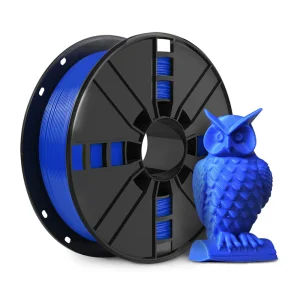
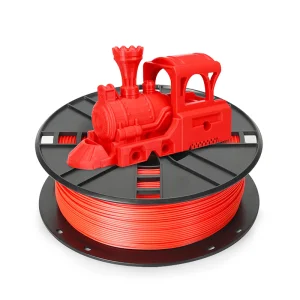
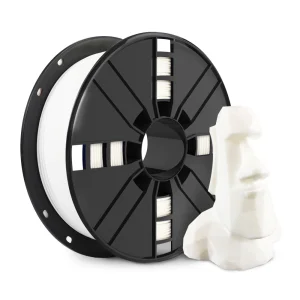
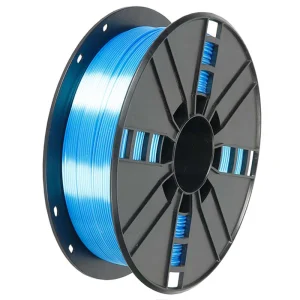
Direct from our ISO 9001:2015 certified extrusion facility. Every spool undergoes strict dual-axis laser diameter monitoring and zero-vacuum packaging.
Understanding the molecular dynamics, pigment thermal dispersion, and mechanical robustness of signal-red Acrylonitrile Butadiene Styrene in professional additive manufacturing.
Acrylonitrile Butadiene Styrene (ABS) represents one of the foundational thermoplastics in modern industrial manufacturing and additive rapid prototyping. When formulated as a high-chroma red filament, it fills a critical role across automotive, electronics, robotics, and consumer goods manufacturing. Unlike general-purpose PLA or basic PETG, engineering-grade red ABS filament balances thermal stability, impact toughness, and post-processing flexibility under harsh operational conditions.
From a chemical composition standpoint, ABS is a terpolymer synthesized from three distinct monomers, each contributing specific mechanical advantages to the final extruded filament strand:
In China's leading filament manufacturing facilities, the synthesis of premium Red ABS involves custom masterbatch compounding. High-purity organic red pigments (typically color-matched to RAL 3020 Traffic Red or Pantone 186C Signal Red) are pre-dispersed into carrier resins matching the base polymer's melt flow index (MFI). This prevents pigment migration, guarantees color consistency across production batches, and mitigates internal micro-stress points that could cause layer delamination during printing.
As 3D printing transitions from simple visual prototyping to high-speed digital manufacturing, material demands have shifted dramatically.
Modern print farms utilize high-acceleration CoreXY printers capable of speeds from 300 mm/s to 600 mm/s. Standard ABS resins often fail under high volumetric flow rates, causing layer separation or severe underextrusion. Next-generation red ABS formulations incorporate flow-enhancing rheology modifiers that reduce melt viscosity at high shear rates while maintaining physical impact strength once cooled.
Styrene emissions have historically posed air-quality concerns in enclosed print environments. Industrial suppliers in China are adopting vacuum-degassed ABS resins with residual monomer levels below 200 ppm. Combined with specialized low-odor red pigment carriers, these filaments release significantly fewer volatile organic compounds (VOCs) during continuous 24-hour manufacturing cycles.
Red polymers are notoriously sensitive to photo-oxidation, leading to surface chalking and color fading when exposed to UV radiation or harsh factory illumination. Modern formulations integrate Hindered Amine Light Stabilizers (HALS) and UV absorbers directly into the pigment matrix, maintaining high-chroma red aesthetics over years of service.
Global procurement teams are enforcing carbon-footprint mandates. Chinese manufacturing facilities are leading the transition from virgin ABS plastic spools to recyclable, precision-edged cardboard spools or high-durability master spools compatible with multi-material automatic material systems (AMS).
How concentrated petrochemical ecosystems, real-time automation, and quality control systems deliver unmatched commercial value to international buyers.
China's leadership in thermoplastic extrusion for additive manufacturing is built upon a vertically integrated industrial supply chain. From chemical monomer refining in petrochemical hubs to automated coiling lines, Chinese factories maintain tight control over resin purity, masterbatch blending, and export logistics.
Extrusion lines employ dual-axis high-speed laser micrometers that measure filament diameter 1,000 times per second. If the extruded strand deviates by more than ±0.02mm, gravimetric dosing units automatically adjust puller speed and melt pump pressure in real time.
By leveraging direct partnerships with polymer giants like Sinopec, Formosa Plastics, and LG Chem, Chinese factories secure virgin ABS resin at scale. This allows rapid custom color matching (Pantone/RAL) with minimum order quantities tailored for international distributors.
Filament tangles cause mid-print line halts. Industry 4.0 winding rigs utilize tension feedback sensors to lay down perfectly parallel strand layers. Immediately following coiling, spools pass into inline desiccant insertion and vacuum heat-sealing stations.
Evaluating regional enterprise demand patterns, compliance standards, and total cost of ownership (TCO) models for Red ABS procurement.
Across major global industrial centers, procurement requirements for red ABS filament vary based on localized regulatory frameworks and end-use application demands:
| Physical / Thermal Property | Red ABS (Engineering Grade) | Standard PLA+ | Industrial PETG | UV-Resistant ASA |
|---|---|---|---|---|
| Density (g/cm³) | 1.04 – 1.06 | 1.24 | 1.27 | 1.07 |
| Heat Deflection Temp (HDT @ 0.45 MPa) | 92°C – 98°C | 55°C – 60°C | 72°C – 75°C | 95°C – 100°C |
| Tensile Strength at Yield (MPa) | 40 – 48 | 55 – 65 | 45 – 50 | 42 – 50 |
| Flexural Modulus (GPa) | 2.1 – 2.4 | 3.1 – 3.8 | 1.9 – 2.1 | 2.0 – 2.3 |
| Notched Izod Impact Strength (kJ/m²) | 20 – 28 | 5 – 8 | 8 – 12 | 18 – 25 |
| Recommended Nozzle Temp (°C) | 230 – 260 | 190 – 220 | 230 – 250 | 240 – 270 |
| Recommended Heated Bed Temp (°C) | 90 – 110 | 45 – 60 | 70 – 85 | 90 – 110 |
| Chemical Post-Processing (Vapor Smoothing) | Acetone Soluble | Insoluble | Insoluble | Acetone Soluble |
From signal-red safety mechanisms to high-impact automotive prototypes, discover how industrial enterprises deploy red ABS across field applications.
Engineers utilize signal-red ABS to print functional prototype components such as dipstick handles, emergency latches, dashboard switch housings, and fluid reservoir caps. The high Heat Deflection Temperature (HDT ~98°C) allows test parts to endure hot engine bay evaluation environments without thermal creep.
Impact-resistant red ABS is ideal for printing protective bumpers, battery pack cases, and drill body shells. The butadiene rubber matrix absorbs drops and vibrational stress, while the high-chroma red tint serves as an instant visual safety marker in industrial workshops.
Custom robotic arm grippers, wire conduits, and sensor mounts require high strength-to-weight ratios and easy post-processing. Red ABS parts can be vapor-smoothed with acetone to eliminate layer lines, creating slick, non-porous surfaces that prevent dust accumulation in automated assembly lines.
Technical recommendations for procurement managers, print farm operators, and material engineers sourcing Red ABS from China.
To eliminate corner warping and bed delamination with Red ABS filament, maintain a heated bed temperature between 90°C and 110°C, and use a fully enclosed build chamber kept at 45°C–60°C. Ensure the build surface is clean PEI, smooth glass with ABS juice (dissolved ABS in acetone), or high-tack adhesive spray. Extrusion nozzle temperatures should be calibrated between 230°C and 250°C, with cooling fans turned OFF for maximum layer bonding strength.
When compounding is performed correctly in factory-controlled twin-screw extruders, organic red masterbatch pigments do not compromise tensile or impact properties. Modern suppliers utilize micro-dispersed pigment particles with identical melt-flow carriers to ensure the rubber butadiene phase remains homogeneous, preserving the standard 20–25 kJ/m² notched Izod impact strength.
Extrusion lines utilize continuous dual-axis laser micrometers operating at 1,000 Hz inspection frequency. Standard 1.75 mm and 2.85 mm red ABS filaments are produced within a tight tolerance of ±0.02 mm, with maximum ovality limited to <0.01 mm. Out-of-spec segments are automatically cut and discarded prior to spool coiling.
ABS is moderately hygroscopic, absorbing ambient atmospheric moisture over time. Absorbed water causes steam bubbles, stringing, popping noises in the nozzle, and reduced tensile strength. Prior to printing, spools should be dried in a blast oven or filament dryer at 70°C to 80°C for 4 to 6 hours until moisture content drops below 0.05%.
Yes. Red ABS is 100% soluble in acetone. Exposure to concentrated acetone vapor selectively melts the outer micro-layer of the print, completely eliminating step-layer lines and yielding a glossy, injection-molded surface aesthetic without changing the vividness of the red pigment.
Leading Chinese exporters supply complete documentation packages including RoHS 3.0 (Directive 2015/863/EU), REACH (SVHC 235 list compliance), UL94 HB/V-0 flame retardancy test reports, and detailed Safety Data Sheets (SDS) in accordance with GHS global standards.
Factories support full OEM/ODM customization: custom Pantone/RAL color matching, custom spool weights (250g, 500g, 1kg, 3kg, 5kg, 10kg), branded cardboard or plastic spools, custom die-cut retail packaging boxes, custom stickers, barcode labeling, and moisture-proof vacuum bags with silica desiccant.
When maintained in its original vacuum-sealed foil package with desiccant at temperatures between 15°C and 25°C, Red ABS filament has an un-opened shelf life exceeding 24 months without mechanical degradation or color shifting.
Browse our extensive line of standard, flexible, silk, and engineering composite materials tailored for global distribution channels.