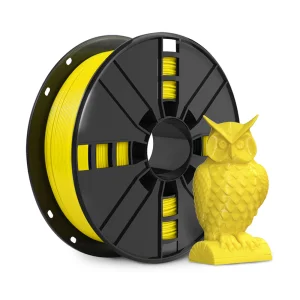
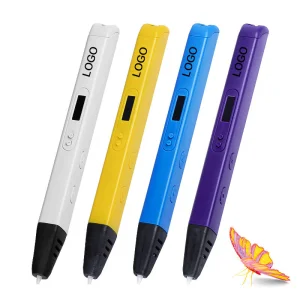
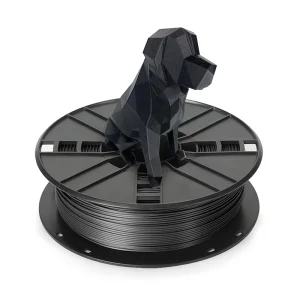
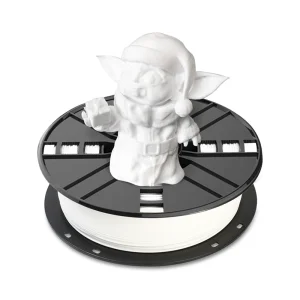
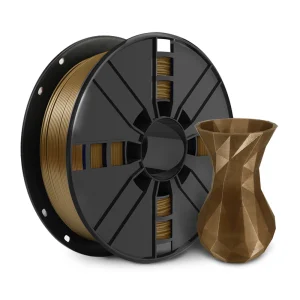
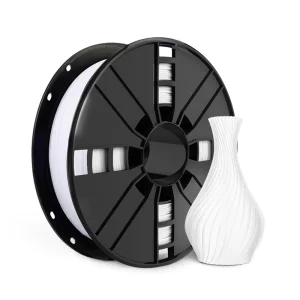
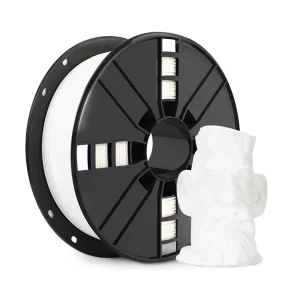
Factory-direct 3D printing filaments engineered to strict ±0.02mm diameter tolerance for professional, commercial, and desktop print ecosystems.
The global additive manufacturing ecosystem is undergoing an unprecedented paradigm shift from rapid prototyping toward large-scale industrial end-use production. As Fused Deposition Modeling (FDM) and Fused Filament Fabrication (FFF) hardware mature—achieving high acceleration speeds exceeding 20,000 mm/s² and volumetric melt flow rates above 30 mm³/s—the technological bottleneck has firmly shifted to polymer material science and supply chain consistency.
Today's enterprise procurement directors, contract manufacturers, OEM brand owners, and industrial print farm operators no longer evaluate 3D printing filament purely on price per spool. Instead, evaluation focuses on Melt Flow Index (MFI) predictability, interlayer tensile bond strength, cross-axis dimensional accuracy, and batch-to-batch colorimetric variance ($\Delta E < 0.5$).
Additive manufacturing is transitioning from desktop novelty to mission-critical tooling, automotive end-use ducting, medical orthotics, and consumer electronics shells. Consistently formulated thermoplastics are required to withstand harsh real-world mechanical and thermal stresses.
Over 78% of the world's commercial thermoplastic filament supply originates from China's specialized polymer manufacturing hubs. Tier-1 buyers demand direct factory integration to mitigate supply chain volatility, ensure regulatory compliance, and scale custom formulations.
Modern high-speed Kinematic printers (such as CoreXY systems running Klipper firmware) generate immense shear stress on molten filament. Formulations must maintain exceptional melt elasticity and thermal stability to prevent nozzle clogging and under-extrusion.
Understanding the molecular behavior of extruded polymers is crucial for selecting the optimal material for specific operational environments. Below is an engineering evaluation of primary additive manufacturing polymers synthesized at our manufacturing facility.
Derived from renewable agricultural starches (corn/cassava), standard PLA is prized for its ultra-low volumetric shrinkage rate (0.3%–0.5%) and high flexural modulus. However, standard unmodified PLA suffers from low impact toughness (~2.5 kJ/m²) and heat deflection limits around 55°C.
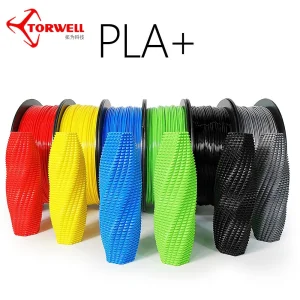
Our proprietary PLA+ Pro formulation incorporates elastomeric impact modifiers and nucleating agents. This alters the semi-crystalline morphology during cooling, boosting Izod impact strength up to 10.5 kJ/m² (a 400% enhancement) and significantly strengthening inter-layer adhesion under mechanical load.
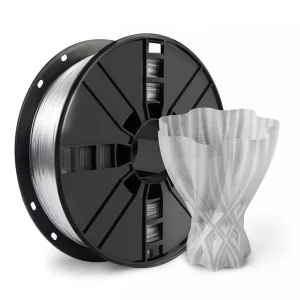
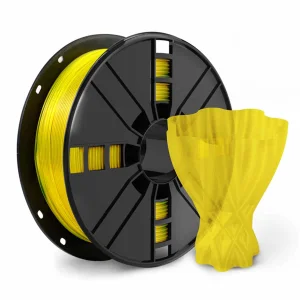
By introducing cyclohexanedimethanol (CHDM) into the polyethylene terephthalate polymer chain, crystallization is suppressed, resulting in an amorphous polymer with outstanding optical clarity, chemical resistance to acids/alkalis, and high ductility.
PETG bridges the gap between easy-printing PLA and durable ABS. Featuring a glass transition temperature ($T_g$) of 80°C and low moisture equilibrium rate when stored properly, it is the primary material choice for water-tight containers, functional protective enclosures, and outdoor mechanical components.
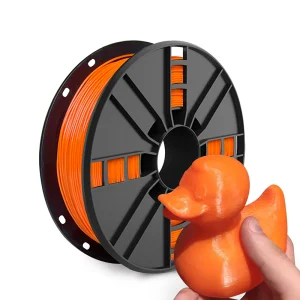
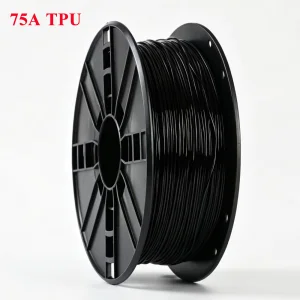
TPU block copolymers consist of alternating hard (diisocyanate) and soft (polyether or polyester) segments. By adjusting this ratio, we synthesize precise shore hardness levels ranging from flexible 75A to semi-rigid 95A.
Key properties include exceptional fatigue resistance, high elongation at break (>550%), and superior energy absorption. Precision tension control during extrusion is required to maintain a uniform diameter and prevent binding inside direct-drive or Bowden extruder drive gears.
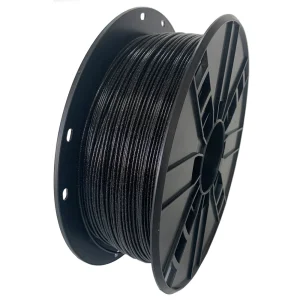
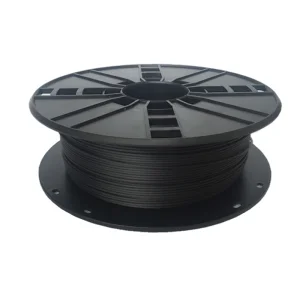
Compounding high-modulus chopped carbon fibers (typically 15%–20% by weight ratio, 5–10 μm length distribution) into base polymer matrixes drastically changes mechanical performance. Carbon fiber reinforcement increases tensile strength, minimizes warping to near-zero, and imparts a matte aesthetic.
Printed components exhibit exceptional stiffness-to-weight ratios, making them ideal for structural drone frames, custom automotive mounting brackets, and industrial end-of-arm robotic tooling.
| Polymer Grade | Extrusion Temp (°C) | Bed Temp (°C) | Tensile Strength (MPa) | Flexural Modulus (GPa) | HDT @ 0.45 MPa (°C) | Hygroscopic Sensitivity |
|---|---|---|---|---|---|---|
| Standard PLA | 190 - 215 | 20 - 60 | 58 - 65 | 3.1 - 3.5 | 55 | Low - Medium |
| Tough PLA+ Pro | 205 - 225 | 50 - 65 | 62 - 68 | 2.8 - 3.2 | 60 | Low |
| Optical PETG | 235 - 255 | 70 - 85 | 48 - 52 | 2.1 - 2.4 | 75 | Moderate |
| Flexible TPU 95A | 215 - 235 | 30 - 60 | 35 - 42 (Yield) | N/A (Elongation > 450%) | 60 | High (Requires Drying) |
| Carbon Fiber PLA | 210 - 230 | 50 - 65 | 75 - 85 | 5.2 - 6.0 | 68 | Low |
| ABS / ASA Industrial | 245 - 265 | 90 - 110 | 40 - 48 | 2.2 - 2.6 | 98 | Moderate |
How smart automated manufacturing, direct raw resin synthesis integration, and inline optical metrology eliminate quality variances in high-volume global distribution.
Every extrusion line operates continuous dual-axis optical laser micrometers. Diameter variations and ovality are sampled at 500 Hz. If dimensions exceed ±0.02mm, automated feedback loops adjust melt-pump rpm and cooling bath haul-off speeds instantaneously.
Hygroscopic resins absorb atmospheric moisture, leading to hydrolytic degradation during print extrusion (causing popping sounds, void formation, and weak layer adhesion). Our factory uses sealed desiccant hopper dryers keeping resin moisture levels below 0.02% (200 ppm) prior to melting.
Tangled filament leads to failed prints on 50+ hour industrial jobs. Our computerized traverse winding systems ensure tension-controlled, layer-by-layer spooling. Filaments smoothly unspool without cross-over knots, fully compatible with automated multi-material systems (AMS).
Building a top-tier additive manufacturing brand requires reliable private-label partnerships. We provide complete turnkey OEM/ODM solutions engineered to fit your target market's brand identity and legal standards.
We match custom Pantone, RAL, or physical target samples using inline industrial spectrophotometers ($\Delta E < 0.5$). Whether you require matte earthy tones, high-gloss silk dual-colors, metallic flakes, or glow-in-the-dark phosphorescence, our color chemists lock down exact batch consistency across re-orders.
Global export mandates rigorous environmental and chemical safety standards. All raw resin compounds and masterbatch additives are certified compliant with RoHS 3.0, REACH SVHC, and FDA 21 CFR food-contact guidelines, backed by comprehensive SDS/TDS documentation for frictionless customs clearance.
Filaments are vacuum-sealed with high-density active desiccant packs inside 4-layer aluminum barrier foil pouches. Packaging options include eco-friendly recycled cardboard spools, high-impact ABS spools, custom die-cut retail boxes, and drop-test certified outer shipping cartons.
From standard retail 1kg (2.2 lbs) spools to industrial 3kg, 5kg, and 10kg master spools designed for continuous print farm operation, we customize inner hub diameters, flange widths, and reel weights to your exact machine setup.
How leading global enterprises leverage our specialized thermoplastic formulations to solve end-use engineering and aesthetic challenges.
Using heat-resistant ASA and Carbon Fiber PETG, automotive engineers print light-weight assembly alignment jigs, custom dashboard ducting, and low-volume exterior trim components capable of withstanding ambient temperatures above 90°C and UV radiation without thermal degradation.
Medical device makers utilize ultra-clear PETG and bio-compatible PLA for pre-surgical planning models. Flexible TPU polymers (85A-95A) are extensively printed to create custom orthopedic insoles, soft prosthetic liners, and ergonomic patient supports.
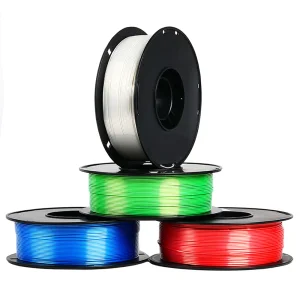
Design studios and retail brands deploy our Silk Dual-Color and Sparkle PLA lines to manufacture shimmering decorative art, cosplay accessories, and luxury product mockups that eliminate post-processing, painting, or polishing.
Explore our full range of specialty, high-strength, flexible, and aesthetic 3D printer materials.
Detailed answers regarding factory specifications, order minimums, printing performance, and OEM logistics.