The global Fused Deposition Modeling (FDM) and Fused Filament Fabrication (FFF) 3D printing industry is undergoing a structural paradigm shift. Once dominated by desktop rapid prototyping and consumer hobbyists, additive manufacturing (AM) has consolidated into a mainstream industrial production methodology. According to recent industrial market intelligence, the global polymer 3D printing filament market is expanding at a Compound Annual Growth Rate (CAGR) exceeding 21.4%, projected to surpass $15.2 Billion by 2030.
This macro-expansion is driven by key technological accelerations across global commercial and industrial sectors:
Modern CoreXY printers operating at speeds of 300mm/s to 600mm/s with accelerations over 20,000 mm/s² require filaments engineered with high Melt Flow Index (MFI) and instant thermal phase transition to prevent nozzle backpressure and under-extrusion.
Multi-spool automatic switching hubs demand absolute spool rim dimensional standardization, anti-tangle neat winding algorithms, and dust-free surface friction properties to ensure multi-color and multi-material printing reliability.
Corporate procurement is rapidly migrating toward modified polymer matrices—including Carbon Fiber reinforced composites (CF-PLA, CF-PETG, CF-PA), flame-retardant ABS/ASA, and ultra-flexible TPU—to replace machined aluminum and injection-molded parts.
For international buyers, distributors, Amazon brand owners, and industrial 3D print farms, selecting a qualified 3D printer filament supplier in China involves rigorous technical evaluation beyond unit pricing. Supply chain leaders evaluate manufacturers against four core criteria:
By establishing OEM/ODM partnerships directly with premier Chinese factories, procurement teams unlock total customization—from custom Pantone masterbatch formulation and eco-friendly cardboard spools to full private-label packaging and custom spool net weights (250g, 500g, 1kg, 3kg, 5kg, 10kg reels).
China's status as the world's primary hub for 3D printer filament manufacturing stems from an unmatched industrial cluster effect. The integration of high-purity virgin polymer synthesis (such as NatureWorks Ingeo PLA, Covestro TPU, and Sabic ABS resins), specialized masterbatch pigment synthesis, precision machinery engineering, and automated logistics creates an impenetrable efficiency advantage.
Modern Chinese factories utilize multi-stage screw extrusion lines featuring PLC closed-loop feedback. Quad-axis laser micrometers scan the extrudate 500 times per second, automatically adjusting puller capstan speed to eliminate necking and swelling in real time.
Operating multi-line automated production facilities enables raw polymer bulk purchasing at tier-1 pricing. Combined with continuous 24/7 operation and optimized thermal energy recovery systems, unit manufacturing costs are minimized while preserving quality.
Furthermore, supply chain resilience is bolstered by localized mold-making capabilities for specialized spools, robust freight forwarding connections, and flexible manufacturing setups that accommodate rapid prototyping orders alongside multi-container contract manufacturing.
Understanding the molecular dynamics and mechanical properties of raw polymers enables engineers and procurement teams to select the optimal material for target applications:
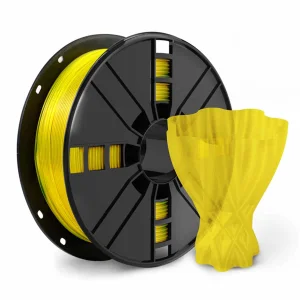
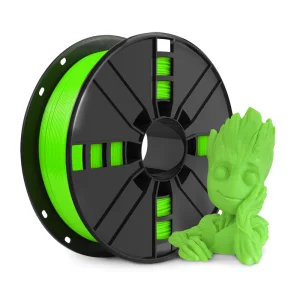
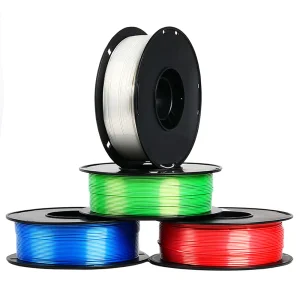
Poly-Lactic Acid (PLA) remains the cornerstone material of FDM printing due to its bio-based origin (cornstarch/sugar cane), zero toxic fume emissions, low glass transition temperature (Tg ~55–60°C), and virtually non-existent thermal shrinkage. Advanced PLA+ (PLA Pro) incorporates impact modifiers (acrylic impact modifiers or core-shell rubber elastomers) that boost Izod impact strength up to 4–5 times over raw PLA while improving inter-layer bond strength. Silk PLA blends thermoplastic polyester elastomers with optical micro-diffusers and pearlescent pigments to deliver high-gloss metallic visual finishes concealing layer lines.
By copolymerizing PET with cyclohexane dimethanol (CHDM), crystallization is suppressed, resulting in an amorphous polymer with outstanding optical clarity, chemical resistance to acids and alkalis, high impact strength, and low warping coefficient. PETG bridges the gap between easy-printing PLA and durable engineering ABS.
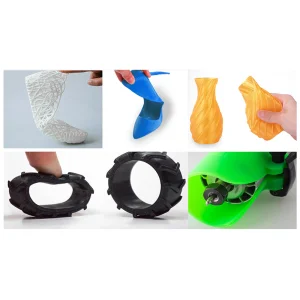
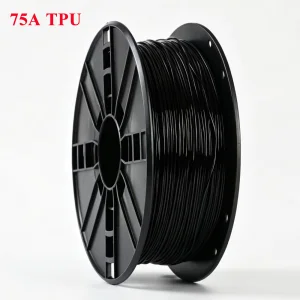
TPU consists of alternating hard polyurethane segments and soft polyether/polyester elastomer chains. Available across Shore hardness scales ranging from flexible 75A (high dampening, soft feel) to semi-rigid 95A (easy feeding through Bowden drives), TPU delivers extreme tear resistance, abrasion resistance, and elongation-at-break exceeding 500%.
For high-heat and structural applications, ABS delivers heat deflection temperatures (HDT) up to 95°C. ASA replaces butadiene rubber with acrylic rubber, rendering the material immune to UV degradation and outdoor weathering. Polycarbonate (PC) provides structural toughness and temperature resistance over 110°C, while Carbon Fiber (CF) composite filaments integrate chopped carbon fibers (10%–20% weight ratio) into base resins to dramatically increase flexural modulus, dimensional stability, and matte surface aesthetics.
| Material Family | Density (g/cm³) | Tensile Strength (MPa) | Heat Deflection (HDT @0.45MPa) | Nozzle Temp (°C) | Bed Temp (°C) | Primary Industrial Application |
|---|---|---|---|---|---|---|
| PLA / PLA+ | 1.24 | 55 – 68 | 55 °C | 190 – 220 | 0 – 60 | Rapid Concept Prototyping, Education, Consumer Goods |
| Silk PLA | 1.25 | 48 – 58 | 52 °C | 200 – 230 | 50 – 60 | Cosplay, Display Models, Aesthetic Packaging |
| PETG | 1.27 | 45 – 55 | 70 °C | 230 – 250 | 70 – 80 | Functional Housings, Fluid Containers, Mechanical Fixtures |
| TPU 95A / 75A | 1.21 | 32 – 45 | 60 °C | 210 – 240 | 30 – 60 | Gaskets, Seals, Dampeners, Wearable Orthotics |
| ABS | 1.05 | 40 – 50 | 85 – 95 °C | 230 – 260 | 90 – 110 | Automotive Trim, Tool Housings, Electronic Enclosures |
| ASA | 1.07 | 42 – 52 | 95 °C | 240 – 260 | 90 – 110 | Outdoor Fixtures, Commercial Signage, Marine Parts |
| Carbon Fiber PLA/PETG | 1.29 | 65 – 85 | 75 – 85 °C | 220 – 260 | 50 – 80 | Robotic Arms, Drone Structural Frames, Jigs & Fixtures |
Precision 3D printer filaments supplied by China's advanced manufacturing sector power diverse operational use cases globally:
Tier-1 automotive suppliers deploy ABS and ASA filaments to produce custom assembly jigs, check gauges, and ergonomic hand tools overnight, reducing tooling lead times from weeks to hours.
Commercial print farms running 200+ printers 24/7 depend on Torwell PLA and PETG spools for zero-tangle guarantees and smooth continuous feeding to maximize machine uptime and yield.
Surgical teams convert CT scan DICOM data into anatomically accurate PLA and TPU models for pre-operative rehearsal, patient consent visualization, and custom prosthetic socket fitting.
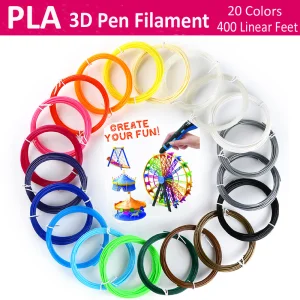
Private-label OEM brands package non-toxic PLA and low-temp 3D Pen filaments into branded retail boxes for global school districts, hobby channels, and e-commerce platforms.