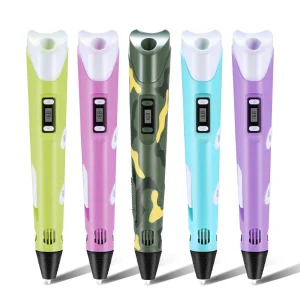
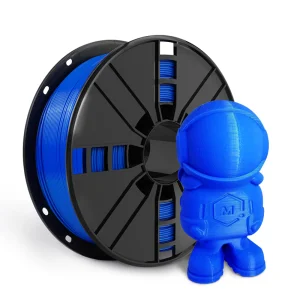
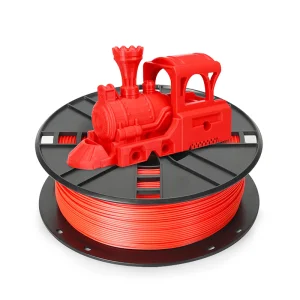
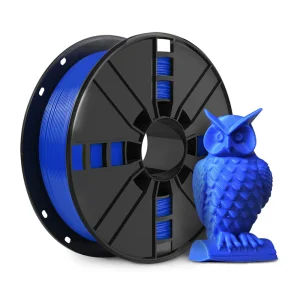
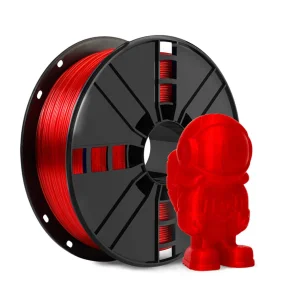
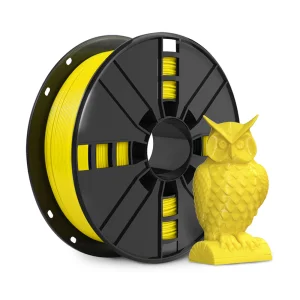
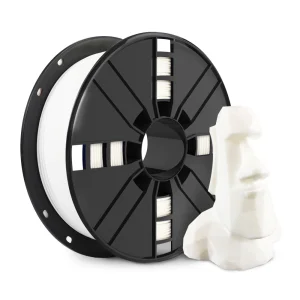
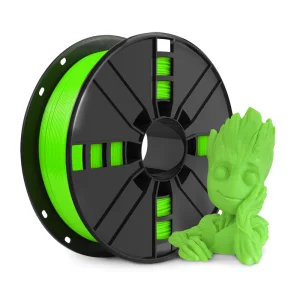
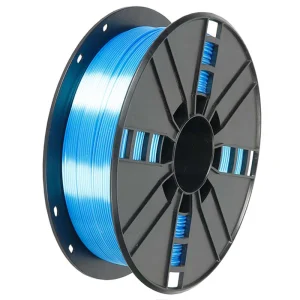
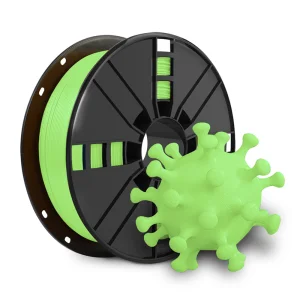
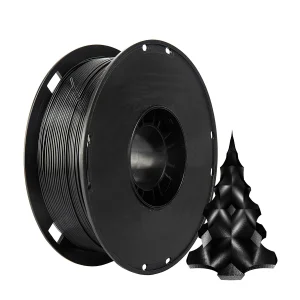
Explore Torwell’s core extrusion catalog engineered for high-performance additive manufacturing, rapid prototyping, and scalable B2B enterprise production.
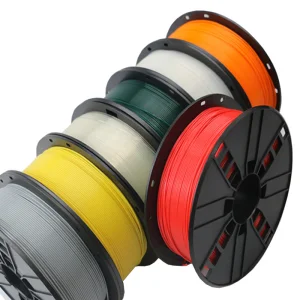
In the rapidly evolving landscape of additive manufacturing, standard flexible filaments such as Shore 95A and Shore 85A Thermoplastic Polyurethane (TPU) have become mainstream materials for semi-rigid gaskets, phone cases, and basic dampeners. However, next-generation engineering applications—ranging from biomimetic soft robotics and dynamic pneumatic seals to custom footwear midsoles—demand extreme tactile elasticity and superior shock absorption. This is where Shore 75A TPU Filament establishes its dominance.
Synthesized via block copolymerization, TPU consists of alternating linear hard segments (composed of organic diisocyanates and short-chain diols) and soft segments (long-chain polyether or polyester polyols). The durometer hardness of 75A represents a critical polymer threshold: by increasing the soft-segment ratio, the glass transition temperature ($T_g$) drops to as low as $-40^\circ\text{C}$, yielding an exceptionally high ultimate elongation at break exceeding 750% alongside rubber-like elastic recovery.
While Shore 75A TPU provides unprecedented flexibility, its extremely low flexural modulus ($E \approx 18-24\text{ MPa}$) introduces significant physical challenges during Fused Deposition Modeling (FDM). Standard extruders suffer from filament buckling, strand wrapping around drive gears, and extreme frictional drag inside PTFE guide tubes. Resolving these challenges requires precise raw material chemistry and zero-drift strand roundness.
As a specialized OEM factory, Torwell formulates two distinct 75A variants: Polyether-based TPU, offering outstanding hydrolytic stability, micro-fungal resistance, and extreme low-temperature flexibility (ideal for medical wearables and outdoor gear); and Polyester-based TPU, delivering superior oil, solvent, and mechanical abrasion resistance for industrial gaskets.
Unlike rigid polymers (such as PLA or ABS) that display pronounced anisotropic weakness across the Z-axis, TPU 75A maintains molecular mobility during thermal deposition. The polymer chains melt and entangle across adjacent layers, achieving near-isotropic mechanical strength with layer adhesion forces rivaling solid molded rubber parts.
As industrial additive manufacturing transitions from aesthetic prototyping to load-bearing functional production, material formulation for ultra-soft elastomers must continuously evolve. Torwell’s R&D laboratory is actively advancing four core technical vectors for TPU 75A:
Replacing petroleum-derived MDI/PTMEG prepolymers with bio-derived polyols extracted from non-food castor beans. This reduces net carbon emissions by up to 45% while preserving identical Shore 75A mechanical damping characteristics and thermal processability.
Traditional TPU 75A printing speeds are limited to 15–25 mm/s to prevent extrusion failure. Integrating internal slip-agents and micro-crystallization nucleating additives increases melt flow index (MFI), elevating stable print speeds to 60–100 mm/s on direct-drive printers.
Exploring thermoplastic vulcanizate (TPV) blends within the 75A matrix to enhance dynamic fatigue resistance. This guarantees zero permanent compression set even after undergoing 200,000 continuous cyclic compression loops under industrial conditions.
Formulating chemically recyclable TPU 75A grades. Waste spools and support structures can be depolymerized back into pure prepolymers without thermomechanical degradation, supporting true circular economy standards for global enterprise partners.
The unique elastomeric profile of Shore 75A TPU bridges the performance gap between traditional liquid silicone rubber (LSR) injection molding and fast FDM additive manufacturing. Key enterprise sectors leverage Torwell 75A filament for customized production:
Enables print-on-demand custom soft-robotic end-effectors, pneumatic suction grippers, dynamic dust boots, and low-frequency vibration isolation mounts. Shore 75A easily conforms to delicate geometry without marring sensitive payload surfaces during high-speed assembly line operations.
Suitable for custom patient-matched orthopedic brace linings, prosthetic socket cushion rings, and biocompatible wearable health sensors. Its soft texture minimizes skin shear stress, while polyether-grade resistance prevents degradation from sweat and body oils.
Applied in high-attenuation Noise, Vibration, and Harshness (NVH) dampers, flexible HVAC duct couplings, wire harness grommets, and weather-resistant door seals. Shore 75A maintains consistent elastomeric damping across broad temperature operating ranges ($-35^\circ\text{C}$ to $95^\circ\text{C}$).
Facilitates additive manufacturing of variable-density footwear midsoles, lattice insoles, high-friction sports grips, and impact-protective athletic gear. Designers can tune energy return and localized compliance within a single seamless CAD model.
Manufacturing ultra-flexible 75A TPU filament requires far more than basic extrusion equipment; it requires strict thermomechanical control across every meter of output. Established in 2011, Torwell Technologies operates a state-of-the-art 2,500 m² standardized manufacturing facility outfitted with 6 fully automated high-precision production lines.
Our extrusion lines utilize continuous inline dual-axis laser micrometers operating at 100 Hz sampling frequency. If diameter drift exceeds ±0.02 mm or ovality strays beyond threshold, the extruder screw RPM and haul-off puller speed automatically self-adjust in real time.
Flexible 75A filament easily stretches under mechanical tension during winding, leading to strand necking and uneven diameter. Torwell’s proprietary tensionless servo-spoolers ensure neat, layer-by-layer winding with zero pre-stretching, guaranteeing tangle-free feeding in automatic material systems (AMS).
TPU is highly hygroscopic; excess moisture results in severe hydrolytic degradation, bubbling, and stringing during printing. Prior to spooling, our raw TPU pellets undergo multi-stage desiccant rotor drying down to <0.02% water content. Each finished spool is immediately vacuum sealed with active silica gel desiccant bags in moisture-barrier foil pouches.
Torwell Technologies serves global 3D printer manufacturers, regional distributors, and industrial print farms across more than 75 countries. We offer flexible OEM/ODM programs tailored to your precise brand standards and logistics requirements:
Our color chemistry lab formulates custom solid, translucent, fluorescent, or metallic colors matched precisely to your target Pantone or RAL code, ensuring strict batch-to-batch color consistency with a color delta $E < 1.0$.
Select from 250g mini spools, standard 1kg retail rolls, up to 3kg, 5kg, or 10kg industrial bulk production spools. We offer eco-friendly recycled cardboard spools, high-temperature plastic spools, custom die-cut retail boxes, and private label branding.
With a monthly capacity of 50,000 to 60,000 kg, Torwell guarantees reliable lead times for full-container-load (FCL) orders. We support regional buffer inventory programs for long-term contract partners to mitigate supply chain disruptions.
Technical evaluation parameters measured in accordance with ISO and ASTM physical testing standards:
| Mechanical / Thermal Property | Torwell TPU 75A | Standard TPU 85A | Standard TPU 95A | Test Standard |
|---|---|---|---|---|
| Shore Hardness | 75 Shore A | 85 Shore A | 95 Shore A | ISO 868 / ASTM D2240 |
| Tensile Strength at Break | 32 MPa | 38 MPa | 45 MPa | ISO 37 / ASTM D412 |
| Ultimate Elongation at Break | 780% | 650% | 500% | ISO 37 / ASTM D412 |
| Tear Propagation Strength | 65 kN/m | 85 kN/m | 110 kN/m | ISO 34-1 / ASTM D624 |
| Glass Transition Temp ($T_g$) | $-42^\circ\text{C}$ | $-35^\circ\text{C}$ | $-25^\circ\text{C}$ | DSC ($10^\circ\text{C}/\text{min}$) |
| Abrasion Loss | $28\text{ mm}^3$ | $35\text{ mm}^3$ | $45\text{ mm}^3$ | ISO 4649 (DIN 53516) |
| Recommended Nozzle Temp | $205^\circ\text{C} - 225^\circ\text{C}$ | $215^\circ\text{C} - 235^\circ\text{C}$ | $225^\circ\text{C} - 245^\circ\text{C}$ | FDM Print Optimization |
| Flexural Modulus | $20\text{ MPa}$ | $45\text{ MPa}$ | $110\text{ MPa}$ | ISO 178 / ASTM D790 |
Torwell Technologies maintains comprehensive international quality certifications to facilitate hassle-free customs clearance and compliance verification for global OEM buyers:
Our TPU 75A formulations comply fully with EU REACH Regulation (EC 1907/2006), RoHS 3 Directive (EU 2015/863), and SVHC hazard screening. Formulations free of halogenated flame retardants, phthalates, and heavy metals are standard.
Every production batch undergoes comprehensive quality control logging—including melt flow rate (MFR) testing, tensile testing, and automated print validation—with full raw material lot traceability preserved for 36 months.
Our application engineering team provides customized slicer profiles (for Cura, PrusaSlicer, Bambu Studio, and IdeaMaker) along with direct-drive retrofitting guidelines to help enterprisewide print farms achieve high print yields with 75A TPU.
Expert solutions for engineering buyers, OEM managers, and additive manufacturing technicians operating with Shore 75A TPU filament.
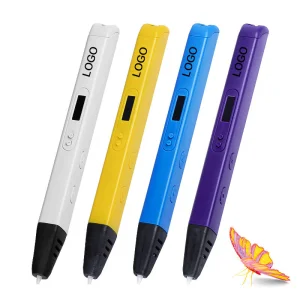
Pair your TPU orders with high-grade engineering polymers, silk finish filaments, and professional 3D drawing pens directly from our factory floor.