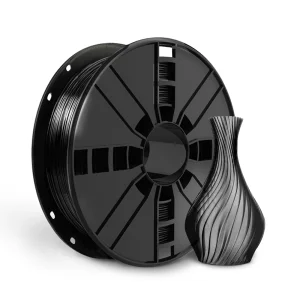
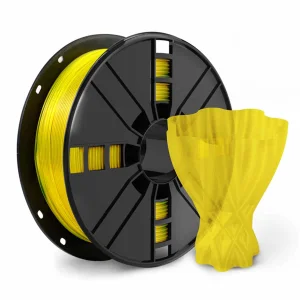
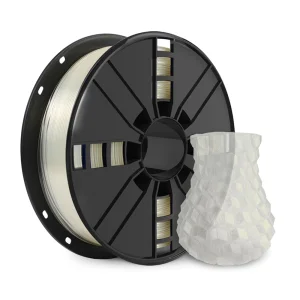
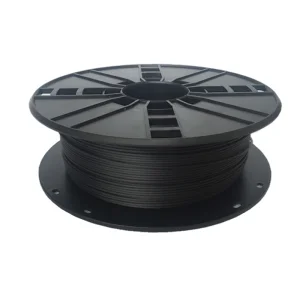
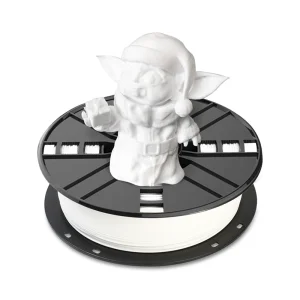
Explore our flagship OEM/ODM extrusion materials manufactured under strict ISO 9001 quality controls with inline dual-axis laser diameter monitoring.
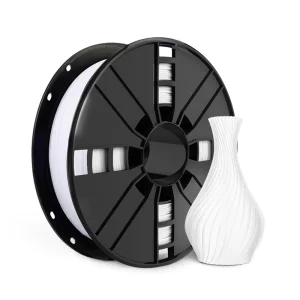
In the global additive manufacturing supply chain, white PLA (Polylactic Acid) filament represents the absolute baseline volume driver for commercial print farms, consumer desktop users, architectural modelers, and industrial design studios. However, engineering a pure, chalk-white, high-opacity PLA filament that maintains structural ductility without clogging hotends requires sophisticated polymer compounding and pigment dispersion science.
Polylactic Acid is an aliphatic polyester derived from renewable plant starches such as corn, sugarcane, or cassava via bacterial fermentation into lactic acid, followed by ring-opening polymerization of lactide monomers. In its virgin, unmodified state, semi-crystalline PLA exhibits a translucent, yellowish-clear optical property. Converting virgin resin into commercial-grade PLA White requires precise masterbatch integration, primarily utilizing ultra-fine Rutile Titanium Dioxide (TiO₂) particles.
Tier-1 OEM manufacturers select Rutile-phase Titanium Dioxide over Anatase phase due to its higher refractive index ($n = 2.73$ vs $n = 2.55$). This allows complete visual opacity at lower weight loadings (typically 2.0% to 2.5% TiO₂ by mass), preserving the intrinsic tensile modulus of the PLA matrix while avoiding embrittlement associated with over-filled mineral masterbatches.
| Physical / Mechanical Metric | Standard Test Method | Torwell OEM White PLA Benchmark | Industrial Significance |
|---|---|---|---|
| Density | ISO 1183 / ASTM D792 | 1.24 g/cm³ | Optimal mass-to-volume ratio for standard 1kg spools |
| Melt Flow Index (MFI) | ISO 1133 (210°C / 2.16kg) | 7 – 11 g / 10 min | High fluid liquidity for ultra-high-speed printing (>400 mm/s) |
| Glass Transition Temp (Tg) | ISO 11357 (DSC) | 57°C – 62°C | Determines bed adhesion requirements and heat deflection limit |
| Melting Temperature (Tm) | ISO 11357 (DSC) | 155°C – 170°C | Defines extrusion hotend thermal envelope |
| Tensile Strength at Yield | ISO 527 / ASTM D638 | 58 – 65 MPa | Ensures high structural integrity under static load |
| Charpy Impact Strength (Unnotched) | ISO 179 | 16 – 20 kJ/m² | Prevents filament snap in reverse-bowden PTFE tube pathways |
Maintaining a tight distribution of $TiO_2$ micro-particles within the molten polymer matrix during extrusion prevents pigment agglomeration. Agglomerated pigment clusters greater than 50 microns act as stress concentrators and thermal blockages inside 0.4mm brass or hardened steel nozzles, causing microscopic backpressure spikes, partial clogs, and surface sheen inconsistencies.
Global procurement directors and private label 3D printing brands rely heavily on specialized China wholesale PLA white manufacturers and factories. The Pearl River Delta hub (incorporating Shenzhen, Dongguan, and Huizhou) represents the world's most concentrated cluster for additive manufacturing polymer processing.
Direct supply contracts with top global lactide fermenters (e.g., NatureWorks Ingeo, TotalEnergies Corbion) secure high-purity virgin resin batches, shielding international buyers from raw material spot-price volatility.
Factories operating 6 to 12 closed-loop extrusion lines equipped with vacuum calibration tanks, melt pumps, and active tension control deliver monthly outputs exceeding 50 metric tons with minimal labor overhead.
Continuous dual-axis or tri-axis laser optical micrometers measure diameter continuously at 500 Hz. Automated feedback loops adjust pull-unit speeds instantly to maintain $\pm 0.02\text{ mm}$ tolerance.
Understanding the multi-stage extrusion cycle explains why certified Chinese manufacturing facilities achieve superior batch-to-batch stability compared to regional small-scale extruders:
The global 3D printing filament market is undergoing a structural transition driven by hardware evolution. The era of slow 50 mm/s printing has been replaced by CoreXY high-speed desktop printers capable of acceleration up to 20,000 mm/s² and volumetric flow rates exceeding 30 mm³/s.
Standard legacy PLA white formulations suffer from flow starvation and layer adhesion failure when forced through high-speed hotends at print speeds exceeding 300 mm/s. When the dwell time of the polymer inside the melt zone drops below 100 milliseconds, standard white pigments insulate heat transfer, preventing complete melt core fluidization.
Advanced wholesale PLA white factories counter this by modifying the molecular chain architecture through mild chain branching agents (e.g., organic peroxides or epoxy-functionalized acrylic oligomers). This raises the Melt Flow Rate (MFR) without reducing the ultimate mechanical tensile strength, giving high-speed white PLA exceptional inter-layer fusion even under rapid layer cooling fans.
With the rapid adoption of multi-material systems (Bambu AMS, Anycubic ACE Pro, Creality CFS), white filament is most frequently paired as a primary background or highlight color alongside dark filaments. High-quality wholesale PLA White must demonstrate precise thermal cutoff performance:
European and North American buyers increasingly require sustainable OEM packaging formats. Leading factories now offer:
White PLA is not merely a generic printing material; it serves as a specialized functional baseline across diverse commercial sectors:
Architects require extreme color uniformity and sharp geometric edge definition. High-opacity PLA white prevents internal LED light bleed-through, delivering clean visual contrast for scale urban planning models.
Non-patient contact anatomical bone structures, orthopedic surgical planning models, and dental study casts printed in white PLA provide high visual clarity for preoperative simulation and patient education.
Designers validating structural housing fits for white appliances, smart home sensors, and medical devices utilize white PLA as a primary draft medium due to its post-processing sandability and acrylic paint adhesion.
Contract printing facilities operating 50+ machines demand spool-to-spool color consistency (Delta E < 0.5) to ensure large multi-part assemblies maintain identical shade white across separate print beds.
When selecting a long-term wholesale manufacturing partner for PLA White filament, procurement teams must evaluate suppliers against a structured quality control matrix rather than relying solely on per-kilogram price quotes.
Tier-1 factories offer comprehensive brand customization: customized Pantone/RAL shade matching, private label spool stickers, custom artwork inner cartons, QR-coded batch serial numbers, and customized spool weights (from 250g mini spools up to 5kg / 10kg industrial master spools).
In-depth technical and logistical answers to help procurement managers evaluate wholesale PLA white suppliers.
Expand your product catalog with our full spectrum of specialized polymer 3D printing filaments manufactured under factory-direct conditions.