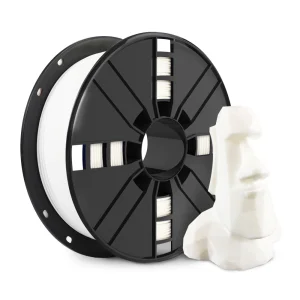
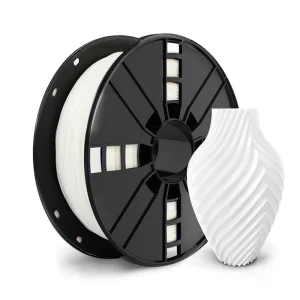

1. Polymer Chemistry & Material Science of White PETG 1.75mm
Polyethylene Terephthalate Glycol-modified (PETG) stands as one of the most versatile thermoplastic polymers in additive manufacturing. By incorporating 1,4-cyclohexanedimethanol (CHDM) into the polyethylene terephthalate (PET) molecular backbone during polymerization, the material suppresses crystallization. This modification results in an amorphous, highly ductile resin that resists brittle fracture while offering exceptional chemical inertness and dimensional stability.
When engineering Wholesale PETG Filament 1.75 White for commercial distribution, material scientists face a specific challenge: achieving absolute optical opacity (Signal White RAL 9003 grade) without undermining the polymer's tensile strength or inducing nozzle abrasion. Standard white masterbatches often rely on heavy loadings of low-grade calcium carbonate ($CaCO_3$) or coarsely ground pigments, which degrade layer adhesion and cause severe nozzle clog incidents during continuous 72-hour print farm operations.
Our direct factory formulations employ surface-passivated sub-micron Rutile Titanium Dioxide ($TiO_2$) particles coated with alumina-silica shells. This specialized compounding architecture delivers key technical advantages:
- High Opacity at Low Concentration: Achieving total light opacity at just 1.8% to 2.4% pigment loading weight, preserving PETG's structural toughness.
- Zero Abrasiveness: Sub-micron Rutile particles prevent internal wall erosion in 0.4mm brass nozzles, maintaining precision orifice diameter over thousands of print hours.
- Enhanced Thermal Stability: The alumina-silica barrier prevents polymer chain scission during extended high-temperature extrusion (230°C–260°C).
Crystallinity Suppression
CHDM monomer integration prevents physical crystallization during cooling, eliminating shrinkage warping and ensuring zero internal voiding.
Sub-Micron TiO2 Matrix
AdvancedRutiled dispersion guarantees bright, non-yellowing white coloration that resists UV degradation and industrial chemical exposure.
High Melt Flow Index
Engineered melt viscosity allows high-speed print farm extrusion rates exceeding 300 mm/s on modern CoreXY Motion Platforms.
2. High-Speed Flow Dynamics & Bambu/Voron CoreXY Compatibility
The rapid evolution of high-speed desktop and industrial FDM/FFF 3D printers (such as Bambu Lab X1/P1 series, Creality K1 Max, Voron 2.4, and industrial multi-nozzle print farms) requires filaments with tailored rheological properties. Traditional PETG filaments often exhibit severe oozing, stringing, and melt-bank starvation when pushed beyond 100 mm/s print speeds.
Our 1.75mm White PETG is modified with dynamic melt-strength enhancers that optimize the shear-thinning behavior of the polymer melt. Under high shear rates inside the hotend heatbreak, the melt viscosity drops predictably, permitting volumetric flow rates up to 24 mm³/s at 250°C. Once deposited through the nozzle, the melt recovers its structural viscosity rapidly, locking down crisp overhangs and eliminating bridging sag.
3. China Factory Supply Chain & Precision Telemetry Manufacturing
China's Guangdong industrial cluster remains the global epicentre of 3D printing polymer technology. By leveraging fully integrated raw material supply chains—from virgin petro-chemical resin synthesis to masterbatch compounding—our facility eliminates intermediary markups while maintaining rigorous Quality Assurance protocols.
Our 2,500 m² factory runs 6 automated, continuous-extrusion production lines operating under cleanroom positive-pressure air filtration. To guarantee that every spool meets strictly enforced OEM specifications, we deploy closed-loop dual-axis laser telemetry micrometers on every line:
| Quality Control Metrics | Standard Commercial Grade | Our Factory OEM Standard | Impact on Printing Performance |
|---|---|---|---|
| Diameter Tolerance | ±0.05 mm | ±0.02 mm (Real-time Closed Loop) | Eliminates under/over-extrusion artifacts, prevents hotend jams. |
| Ovality / Roundness Ratio | ≤ 92% Roundness | ≥ 98% Roundness | Ensures uniform drive-gear engagement and smooth PTFE tube passage. |
| Raw Material Moisture Content | < 0.15% H₂O | < 0.02% H₂O (Dehumidified Vacuum Dry) | Prevents steam micro-bubbling, popping sounds, and weak layer bonds. |
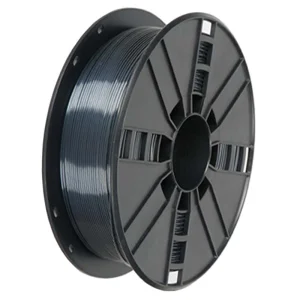
| Spool Winding Mechanism | Manual / Semi-Auto Winding | Tension-Controlled Servo Auto-Layering | Guarantees 100% tangle-free feeding in multi-material AMS units. |
4. Global Enterprise Procurement & Private Label OEM Solutions
For international brands, regional wholesalers, and Amazon e-commerce seller networks, establishing a resilient product line requires flexible manufacturing capabilities. As a dedicated OEM/ODM manufacturer, we offer comprehensive white-label production workflows tailored to regional market demand.
Custom Spooling & Packaging Options:
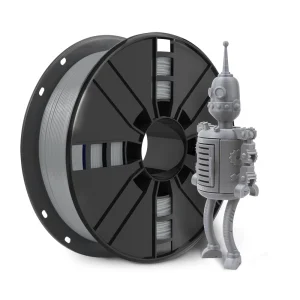
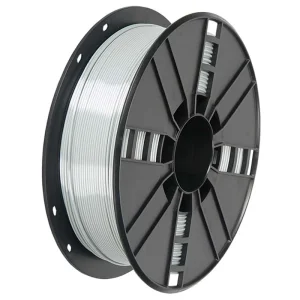
- Standard Retail Spools: 1.0 kg (2.2 lbs) transparent polycarbonate or eco-friendly high-density cardboard spools compatible with AMS automatic spool changers.
- Mass Production Farm Reels: 2.5 kg, 5.0 kg, and 10.0 kg master spools engineered for continuous multi-day industrial production runs, reducing spool change downtime.
- Custom Pantone White Shades: Beyond standard Signal White (RAL 9003), we formulate custom optical profiles including Warm Architectural White, Cold Blue-White, and Translucent Opal White upon request.
- ESG Sustainable Packaging: 100% recyclable cardboard spools, FSC-certified outer cartons, and biodegradable desiccant packs designed to meet strict European Union environmental mandates.
5. Specialized Industry Applications for White PETG 1.75mm
Due to its balance of mechanical toughness, chemical resistance, aesthetic purity, and thermal endurance, White 1.75mm PETG is heavily utilized across diverse commercial sectors:
Medical & Sanitary Fixtures
Resistant to isopropyl alcohol, quaternary disinfectants, and mild acids. Ideal for non-invasive medical device housings and cleanroom organizing fixtures.
Architectural Scale Mockups
High TiO2 loading delivers crisp white surface finishes that retain color stability without yellowing under ambient indoor lighting or fluorescent displays.
Food-Contact Prototyping
Formulated with virgin, non-toxic raw resins compliant with international food-contact safety standards for custom container tooling and dispenser parts.
6. Comprehensive Material Technical Comparison Matrix
To assist procurement managers and FDM print farm engineers in material selection, the following data table compares our White PETG 1.75mm against other standard industrial 3D printing thermoplastics:
| Physical / Mechanical Property | White PETG | White PLA | White ABS | White ASA |
|---|---|---|---|---|
| Tensile Strength at Yield (MPa) | 50 MPa | 62 MPa | 43 MPa | 45 MPa |
| Flexural Modulus (GPa) | 2.1 GPa | 3.1 GPa | 2.3 GPa | 2.2 GPa |
| Izod Impact Strength (kJ/m²) | 8.5 kJ/m² | 3.4 kJ/m² | 18 kJ/m² | 15 kJ/m² |
| Glass Transition Temp ($T_g$) | 81 °C | 58 °C | 105 °C | 100 °C |
| UV Weathering Resistance | Good | Poor | Very Poor | Excellent |
| Enclosure Requirement | Not Required | Not Required | Mandatory | Mandatory |