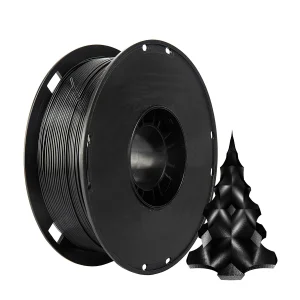
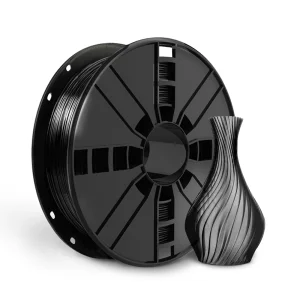
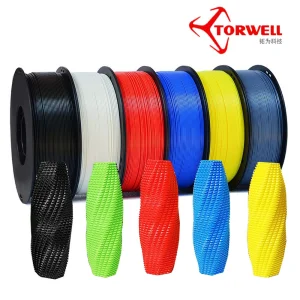
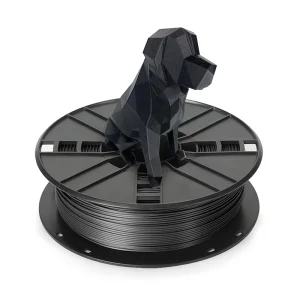
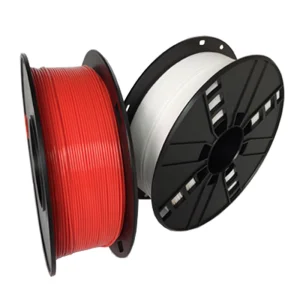
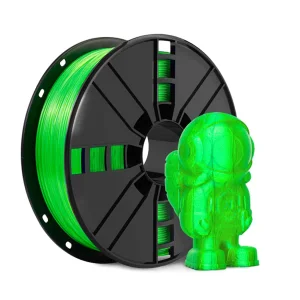
Direct factory wholesale distribution of engineered FDM materials calibrated for OEM brands, additive manufacturing farms, and global industrial procurement.
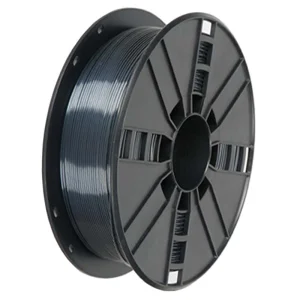
An in-depth analysis of polymer matrix compounding, structural reinforcement mechanisms, and Fused Deposition Modeling (FDM) process stability.
In the rapidly maturing landscape of additive manufacturing, industrial users and enterprise brand owners require FDM (Fused Deposition Modeling) materials that bridge the gap between low-cost commodity plastics and expensive ultra-polymers. Standard Polyethylene Terephthalate Glycol (PETG) has long been prized for its impact toughness, chemical resistance, and ease of processing. However, unreinforced PETG exhibits structural limitations, specifically regarding flexural modulus, creep deformation under sustained loading, and lower heat deflection temperatures (HDT) when subjected to mechanical strain.
PETG Carbon Fiber Filament (PETG-CF) represents a breakthrough composite synthesis. By compounding high-purity, modified amorphous PETG copolymer resin with precisely milled micro-carbon fibers (typically ranging from 15% to 20% by weight ratio with controlled aspect ratios of 5–10 μm strand diameter), manufacturers convert a ductile thermoplastic into a high-modulus, ultra-rigid engineering material.
When high-aspect-ratio carbon fibers pass through an FDM extrusion nozzle, shear stress aligns the fibers parallel to the filament deposition path. This directional alignment creates an internal lattice that dramatically increases tensile and flexural modulus along the X/Y axes while significantly attenuating volumetric thermal expansion (isotropic stability).
For wholesale buyers, distributors, and OEM brand operators, sourcing high-grade PETG-CF requires an acute understanding of resin purity, fiber surface sizing chemistry, and inline extrusion calibration. Inferior carbon fiber filaments suffer from structural void formation, nozzle clogging, brittle filament snapping on the spool, and severe Z-axis layer delamination. Professional-grade manufacturing addresses these failure points through dual-screw co-rotating compounding technology, precise melt-flow index (MFI) control, and continuous laser diameter feedback.
Unmatched supply chain integration, raw material synthesis, precision extrusion automation, and scalable OEM white-label capabilities.
China controls over 65% of global polymer resin production and advanced carbon fiber precursor processing. Direct access to high-purity terephthalic acid, cyclohexane dimethanol (CHDM), and surface-treated chopped carbon fiber strands enables our manufacturing base to eliminate middleman margins while maintaining strict raw material consistency.
Carbon fiber loading increases melt viscosity and potential surface roughness. Our 2,500 m² standardized facility utilizes high-precision twin-screw extruders equipped with dual-axis laser optical micrometers that monitor diameter and ovality 500 times per second, ensuring a tight ±0.02 mm tolerance to prevent printer jams.
Micro-carbon fibers can introduce micro-voids if moisture is present during extrusion. Our manufacturing process features 4-hour online desiccant dehumidification drying prior to melt compounding, followed by automated tension-controlled spooling to guarantee zero-tangle layer alignment compatible with modern high-speed AMS systems.
We provide complete B2B customized branding services: Pantone-matched masterbatch formulation, custom spool designs (cardboard, high-temp ABS, transparent PC), moisture-proof triple-layer aluminum vacuum foil packaging, custom retail boxing, and pre-printed barcode compliance labels.
Empirical laboratory test data comparing mechanical strength, thermal deflection, and dimensional stability across common 3D printing filaments.
| Mechanical & Thermal Property | PETG Carbon Fiber (PETG-CF) | Standard PETG | PLA Carbon Fiber (PLA-CF) | Nylon Carbon Fiber (PA-CF) | Standard ABS |
|---|---|---|---|---|---|
| Tensile Strength (MPa) | 68.5 - 75.0 | 45.0 - 50.0 | 60.0 - 65.0 | 85.0 - 110.0 | 40.0 - 44.0 |
| Flexural Modulus (GPa) | 4.8 - 5.5 | 1.9 - 2.1 | 4.0 - 4.5 | 6.5 - 8.2 | 2.1 - 2.4 |
| Heat Deflection Temp (HDT @ 0.45MPa) | 82°C - 88°C | 68°C - 72°C | 60°C - 65°C | 140°C - 175°C | 82°C - 86°C |
| Moisture Absorption (24h ambient) | Very Low (< 0.2%) | Low (< 0.35%) | Low (< 0.4%) | High (> 1.8%) | Moderate (< 0.6%) |
| Volumetric Shrinkage / Warping | Near Zero (< 0.1%) | Low (0.4%) | Extremely Low | Moderate (Requires Enclosure) | High (Requires Heated Chamber) |
| Surface Finish & Aesthetics | Matte Satin / Hidden Layers | Glossy / Visible Layers | Matte / Stiff | Rough Texture | Slight Gloss / Fumes |
| Ease of Printing (FDM Equipment) | High (Open Bed Capable) | Very High | Very High | Moderate (High Temp Nozzle) | Moderate (Warps easily) |
*Data derived from standardized ASTM D638 (Tensile) and ASTM D648 (HDT) testing performed on 100% infill 3D printed specimens at 240°C nozzle temperature.
Transforming rapid prototyping into low-volume direct digital manufacturing across high-demanding commercial sectors.
Assembly line workers require lightweight, non-marring tools that can withstand continuous mechanical strain and chemical exposure to shop-floor oils. PETG-CF's high flexural strength prevents deformation, while its matte surface prevents component scratching during gauge checks and welding assembly aligners.
In automated pick-and-place systems, reducing payload weight on robotic arms increases acceleration speeds and reduces motor wear. PETG Carbon Fiber delivers a high strength-to-weight ratio, allowing robotic integrators to print custom pneumatic grippers, sensor brackets, and cable guides in-house within hours.
High-speed FPV racing frames, agricultural monitoring drone arms, and camera gimbals demand maximum rigidity to suppress high-frequency motor vibrations. The internal carbon fiber matrix dampens acoustic resonant frequencies, producing smoother flight control telemetry and stable video capture.
Outdoor electronic junction boxes and handheld diagnostic equipment enclosures printed with PETG-CF resist moisture ingress, environmental UV degradation, and impacts. The natural matte black finish gives 3D-printed end products a professional, injection-molded appearance straight off the build plate.
Rigorous multi-stage audit protocols designed to simplify compliance verification for international buyers and enterprise distributors.
Procuring 3D printing consumables at scale requires zero compromise on batch stability. A single spool variation in diameter or melt viscosity can halt print farm operations or cause costly line downtime. Our facility adheres to strict ISO 9001:2015 quality management procedures across every shift:
We supply fully compliant documentation packages to streamline customs clearance and fulfill corporate environmental compliance mandates across Europe, North America, and Asia-Pacific:
How composite chemistry is evolving to match next-generation 500 mm/s high-speed 3D printing platforms.
The rapid adoption of high-speed CoreXY 3D printers (such as Bambu Lab, Creality K1 series, Voron, and industrial high-flow FDM systems) has shifted performance demands. Traditional carbon fiber filaments designed for slower 40–60 mm/s speeds suffer from heat-zone starvation, severe nozzle backpressure, and weak layer adhesion when extruded at volumetric flow rates exceeding 20 mm³/s.
Our engineering R&D team has upgraded our wholesale PETG Carbon Fiber formulation to support High-Flow Rheology (HFR):
Modified polymer chain distribution lowers melt viscosity under high shear rates, permitting smooth continuous flow at printing speeds of up to 350 mm/s without requiring excessive hotend temperatures.
Specially formulated compatibilizers improve polymer interdiffusion across printed layers despite rapid cooling fan airflow, retaining over 85% of Z-axis tensile adhesion strength.
By utilizing micro-spherical carbon fiber additives blended with fiber strands, nozzle friction is reduced by 30%, extending the operational lifespan of hardened steel and ruby nozzles.
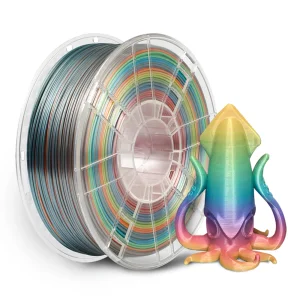
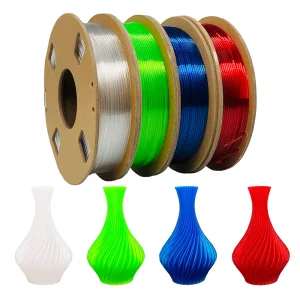
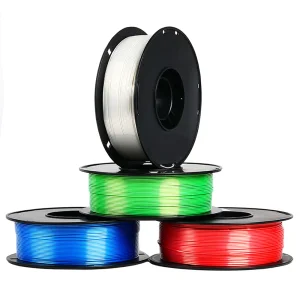
Explore our full range of specialty, high-gloss, flexible, and engineering thermoplastic options manufactured for global suppliers.
Expert answers to technical procurement questions, printing parameters, packaging, and custom OEM manufacturing options.
Because PETG-CF contains abrasive chopped micro-carbon fibers, standard brass nozzles will experience rapid orifice erosion. We strongly recommend equipping your 3D printer with a hardened steel nozzle, tungsten carbide nozzle, or ruby-tipped nozzle (minimum diameter 0.4 mm, though 0.6 mm is ideal for maximum flow rates). Additionally, a direct-drive extruder and a wear-resistant gear system (such as hardened dual-gears) are recommended. A heated print bed capable of reaching 70°C–80°C is required, but an enclosed chamber is optional as PETG-CF exhibits extremely low thermal contraction.
Optimal print parameters depend on your printer hotend design, but typical benchmark settings include:
PETG-CF provides an ideal balance of high rigidity, excellent dimensional stability, and ease of printing without the extreme hygroscopic challenges of Nylon (PA-CF). While PA-CF offers higher heat deflection (up to 150°C+), it absorbs ambient moisture rapidly, warps significantly without an actively heated chamber, and requires continuous high-temperature drying. PETG-CF can be printed on standard open-bed FDM printers with zero warping, minimal moisture absorption, and immediate structural usability at a lower wholesale cost point.
While PETG-CF absorbs moisture far slower than Nylon or TPU, moisture absorption can still cause surface oozing, stringing, and micro-voids in the extrusion path over long exposure. We ship all spools vacuum-sealed with high-capacity silica gel desiccant. If exposed to ambient humid air for an extended period, dry the spool in a filament dryer or oven at 60°C – 65°C for 4 to 6 hours before printing.
For standard stock spools, our MOQ starts at 50 kg. For customized OEM private label projects (including custom branded cardboard/plastic spools, custom color retail boxes, bespoke net spool weights from 250g to 5kg, and custom lab documentation), our standard MOQ is 300 kg per SKU. We offer full graphic design support and Pantone matching services for custom composite formulations.
Yes. Our standard spools are engineered with precise flange dimensions and edge tolerances to fit smoothly inside multi-material feed systems like Bambu Lab AMS and automatic color changers. We offer both smooth-edge cardboard spools and high-temperature ABS plastic spools designed to prevent dust accumulation on feeder rollers.