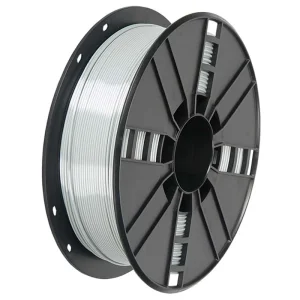
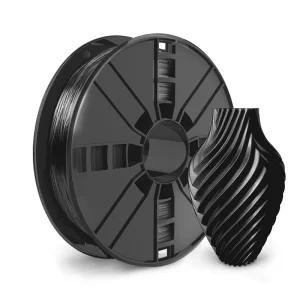
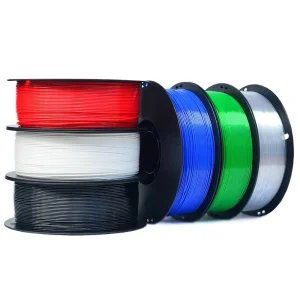
Factory-direct 1.75mm and 2.85mm thermoplastic filaments engineered with ±0.02 mm laser tolerance control for seamless high-speed extrusion.
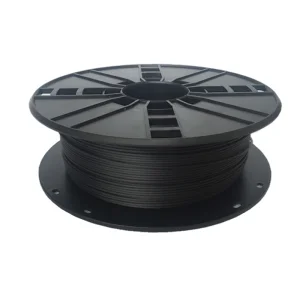
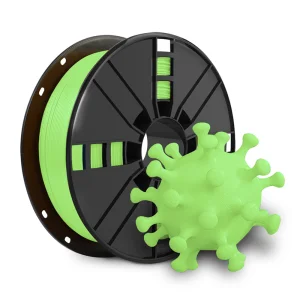
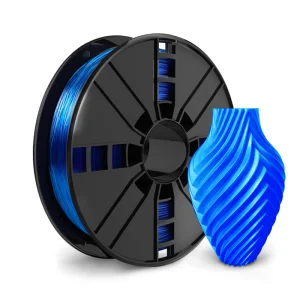
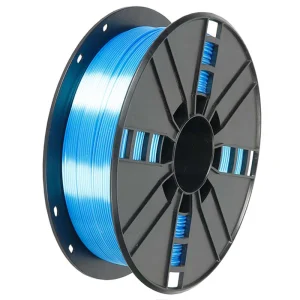
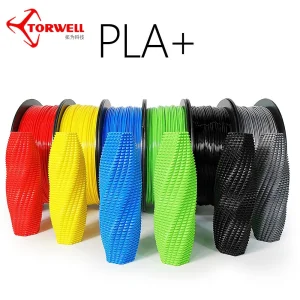
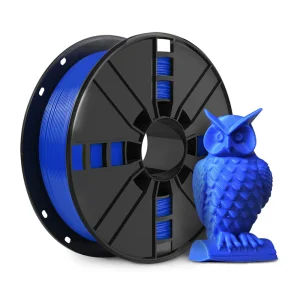
Analyzing the shift from amateur desktop rapid prototyping to industrial-grade additive manufacturing and continuous 24/7 print farm infrastructure.
The global 3D printing industry has undergone a structural paradigm shift. Modern Fused Deposition Modeling (FDM) 3D printers operate at speeds exceeding 500 mm/s with accelerations over 20,000 mm/s². Standard PLA formulations engineered for legacy 50 mm/s print speeds fail under high volumetric flow demands, causing severe hotend clogging, layer delamination, and under-extrusion. B2B buyers now require optimized high-flow Melt Flow Index (MFI) PLA resins to supply next-generation print farms and automated retail channels.
Polylactic Acid (PLA) remains the dominant thermoplastic resin in additive manufacturing, capturing over 45% of total volumetric market share worldwide. Derived from renewable starch sources such as corn and sugarcane, PLA provides a carbon-neutral baseline compliance profile for international brands. Modern procurement guidelines enforce strict non-toxic fume emissions, REACH compliance, and bio-degradability under industrial composting standards (DIN EN 13432).
Understanding molecular polymer chain structures, crystallization behavior, and thermal properties that separate premium engineering-grade filament from low-cost commodities.
Premium PLA filament relies exclusively on virgin resin grades (such as NatureWorks Ingeo™ 4032D or 3052D). Virgin resins maintain uniform molecular weight distribution, eliminating thermal degradation voids, unwanted brittleness, and erratic melt temperatures. Lower-tier suppliers frequently mix unverified post-industrial scrap, causing nozzle clogging and severe batch-to-batch color shifting.
Standard PLA exhibits an amorphous polymer state with a glass transition temperature ($T_g$) around 55–60°C. Advanced formulations, such as PLA+ (Pro PLA), incorporate specialized nucleating agents and impact modifiers. When post-annealed at 80–100°C, the polymer develops semi-crystalline structures, boosting Heat Deflection Temperature (HDT) up to 90°C and doubling Izod impact strength.
Ovality drift is the primary cause of feeding resistance inside Teflon PTFE bowden tubes and automated multi-material systems (AMS). High-precision production lines utilize dual-axis inline optical laser micrometers running at 500 Hz feedback frequencies. This ensures strict adherence to target diameters (1.75 mm / 2.85 mm) with max tolerance thresholds capped at $\pm 0.02\text{ mm}$.
Compare physical, mechanical, and thermal characteristics across major 3D printing filament classifications to optimize portfolio selection for your customer base.
| Filament Type | Tensile Strength (MPa) | Flexural Modulus (GPa) | Heat Deflection Temp (°C) | Print Speed Range (mm/s) | Primary Industrial Use Case |
|---|---|---|---|---|---|
| Standard Virgin PLA | 60 - 65 | 3.5 - 3.8 | 55 - 60 | 50 - 300 | Rapid visual models, educational STEM, architectural scale models |
| PLA+ (Pro High Toughness) | 65 - 70 | 3.8 - 4.1 | 65 - 90 (Annealed) | 100 - 500+ | Functional end-use components, assembly jigs, consumer products |
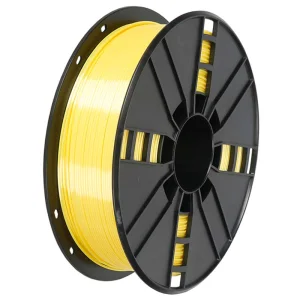
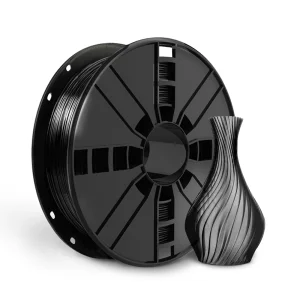
| Silk Pearlescent PLA | 50 - 55 | 2.8 - 3.1 | 52 - 55 | 40 - 200 | Cosplay accessories, display art, high-finish retail packaging |
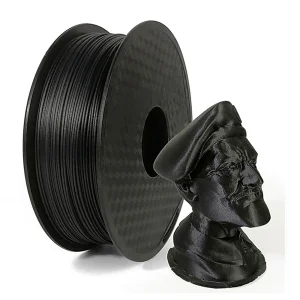
| Carbon Fiber PLA (PLA-CF) | 75 - 85 | 5.2 - 6.0 | 68 - 75 | 60 - 350 | Robotic arm effectors, drone frames, lightweight structural brackets |
| PETG Engineering Grade | 48 - 52 | 2.1 - 2.4 | 70 - 75 | 50 - 250 | Water-tight containers, chemical enclosures, outdoor housings |
| Flexible TPU 95A | 35 - 40 (Shore 95A) | N/A (Elongation >450%) | 60 | 20 - 80 | Gaskets, vibration dampers, protective bumpers, footwear soles |
Unlocking economies of scale, raw material vertical integration, and continuous automated quality control from Guangdong's advanced polymer cluster.
Raw polymer resins are highly hygroscopic, absorbing ambient moisture that causes hydrolytic degradation during melting. Our automated factory infrastructure features centralized dehumidifying resin dryers maintaining dew points below -40°C. Coupled with 6 automated high-output extrusion lines operating 24/7, raw melt viscosity remains unvarying across thousands of spools per day.
Every production lot undergoes rigorous 5-stage laboratory verification before release:
1. Melt Flow Index (MFI) Verification: Ensuring identical melt viscosity.
2. Moisture Content Titration: Capped strictly under 0.05% moisture.
3. Tensile & Impact Testing: Verifying mechanical load thresholds.
4. Automated Level Winding: Eliminating crossed lines and tangles.
5. Test Printing Farms: 24-hour continuous print trials on Bambu Lab, Creality, and Prusa systems.
Empowering international brands, Amazon sellers, and regional distributors with turnkey OEM manufacturing, custom color matching, and retail packaging solutions.
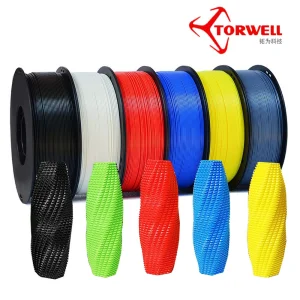
Maintain total brand alignment with precise Pantone, RAL, or physical sample color replication. Utilizing computer-controlled masterbatch dosing systems, we achieve batch-to-batch color variance of $\Delta E < 1.0$, ensuring identical color matching across reorders.
Choose from classic high-transparency PC spools, lightweight ABS spools, or 100% recyclable heavy-duty cardboard spools optimized for automated AMS systems. Custom laser-engraved spool flanges and custom die-cut retail outer boxes available.
Ocean container transport exposes cargo to severe temperature swings and high humidity. Each spool is immediate dried, wrapped with a high-capacity active silica gel desiccant pack, and vacuum sealed inside thick nylon-PE barrier bags to ensure zero hydrolysis upon arrival.
Ensuring full regulatory compliance across North American, European, and Asia-Pacific markets with verified technical documentation and customs clearance readiness.
Distributing polymer products globally demands strict adherence to chemical and environmental safety standards. Our PLA products are independently tested and certified for:
• RoHS 2.0 (Directive 2011/65/EU): Free from heavy metals, lead, cadmium, and PBB/PBDE flame retardants.
• REACH SVHC (EC 1907/2006): Screened against over 235 Substances of Very High Concern.
• FDA 21 CFR Compliance: Select natural PLA grades comply with food-contact material safety criteria.
• EN 71-3 Safety of Toys: Migration testing approved for educational and children's toy manufacturing.
Seamless international customs clearance is supported with proper Harmonized System (HS) code documentation (HS Code 3916.90 for monofilament plastics or 3926.90). Standardized pallet packing (800x1200 mm Euro-pallets or 1100x1100 mm industrial pallets) maximizes container volume utilization, reducing per-spool ocean freight costs by up to 18% on FCL shipments.
From commercial production hubs to academic research labs, see how targeted PLA formulations satisfy diverse functional demands.
Mass production hubs running hundreds of 3D printers non-stop require absolute filament consistency. Zero diameter fluctuation prevents nozzle jams and extruder gear stripping, maximizing uptime and overall yield.
Odorless extrusion, low processing temperatures (190–210°C), and non-toxic bio-based formulations make PLA the default safe choice for elementary schools, universities, and makerspaces.
Ultra-sharp corner reproduction and minimal thermal shrinkage allow architects and medical technicians to produce scale topographical models and patient-specific anatomical visual aids with zero warping.
Exploring the next generation of eco-polymers, composite micro-reinforcements, and co-extrusion visual aesthetics driving consumer re-order rates.
Next-generation 3D printers demand melt rates exceeding 30 mm³/s. Polymer chemists are engineering rapid-phase-change PLA resins that melt instantly inside high-wattage ceramic hotends and solidify rapidly upon fan cooling, preserving sharp overhangs at 600 mm/s print speeds.
Dual-color, tri-color, and pearlescent Silk PLA co-extrusions represent the fastest-growing consumer retail category. By extruding two or three distinct color streams parallel along a single strand, printed models dynamically change color when viewed from different angles.
Infusing 15–20% chopped carbon fibers or glass micro-spheres into specialized PLA matrices creates stiff, lightweight materials with high tensile modulus and a rich matte surface finish that completely hides FDM layer lines.
Clear, authoritative technical answers to common B2B procurement, production, and quality control inquiries.
For standard stock PLA colors, minimum orders start as low as 50 spools per color. For custom Pantone color matching or custom branded packaging (private label boxes/labels), our standard MOQ is 500 kg per SKU. We offer tiered volume discounts for full container load (20ft/40HQ) orders.
We employ closed-loop dual-axis laser micrometers positioned directly downstream of the cooling bath. The laser gauge measures filament diameter and roundness 500 times per second, automatically adjusting the haul-off puller speed in real time to maintain dimensional accuracy within ±0.02 mm.
Yes. Our cardboard spools feature rolled rim edges and smooth pressed side flanges that eliminate cardboard dust shedding and prevent roller slippage inside high-speed AMS feeder drive wheels.
When stored in an unopened, vacuum-sealed barrier bag with active desiccant in a cool, dry warehouse environment (15–25°C), our PLA filament maintains optimal mechanical properties and moisture-free print quality for up to 24 months from the production date.
Complete your catalog with high-performance ABS, flexible TPU, specialty Silk PLA, and engineering PETG formulations.