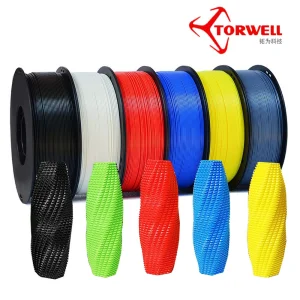
Precision-extruded thermoplastic materials manufactured to strict ±0.02 mm diameter tolerances, tested for zero-bubble consistency and high-speed flow stability.
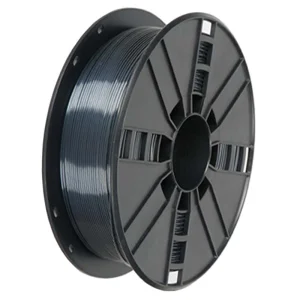
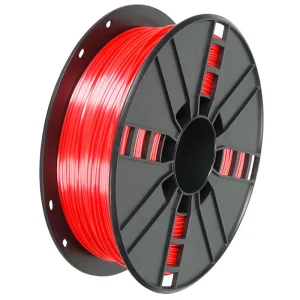
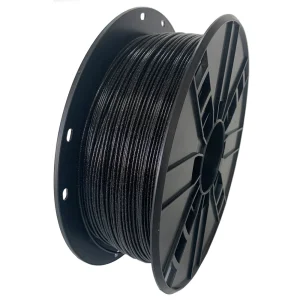
How co-extruded dichromatic filaments are transforming consumer additive manufacturing aesthetic economics, eliminating post-processing bottlenecks, and expanding profit margins for global distributors.
Founded in 2011, Torwell Technologies operates a state-of-the-art 2,500 m² facility with 6 automated high-precision lines dedicated to polymer extrusion mastery, producing 50 to 60 metric tons of premium filament monthly.
Equipped with real-time dual-axis inline laser measuring gauges, Torwell guarantees precise ±0.02 mm diameter tolerances across all dual-color spools, preventing extruder clogs and hotend pressure fluctuations.
Serving OEM brands, e-commerce leaders, and enterprise print farms in over 75 countries with custom Pantone color matching, private-label branding, and sea-freight barrier packaging.
The rapid maturation of desktop and industrial Fused Deposition Modeling (FDM) 3D printing has forced a shift in consumer and industrial expectations. Single-color prints increasingly require manual priming, sanding, and hand-painting to achieve commercial product viability. Dual-color co-extrusion—wherein two distinct molten resin strands are combined longitudinally in a 50/50 split ratio prior to nozzle exit—delivers dynamic dichromatic visual shifts dependent on light angle and object geometry. For print farms and consumer products, this technology slashes post-processing costs by up to 80% while enabling premium retail pricing.
A granular technical analysis of melt temperature synchronization, interfacial tension control, and micro-split co-extrusion die design in dichromatic filament fabrication.
Producing a stable 50/50 dual-color filament requires absolute parity in Melt Flow Index (MFI) between the two color batches. If Masterbatch A exhibits a lower viscosity than Masterbatch B under shear stress, the softer phase will envelope the harder phase inside the extruding die. Torwell's proprietary thermal formulation matches the MFI of both color channels within ±0.3 g/10min (at 210°C / 2.16kg), preventing spiral distortion and color phase imbalance during high-speed printing.
Delamination between color segments during printing ruins mechanical integrity. By controlling laminar flow within our dual-manifold co-extrusion nozzles and regulating cooling bath temperatures across three distinct thermal stages, we induce inter-molecular polymer chain entanglement along the internal color boundary. This results in zero split-failure under 45° tensile and torsional loading tests.
Standard dual-extrusion systems often introduce ovality due to uneven thermal shrinkage rates across different pigment densities. Torwell's optical monitoring suite measures 360-degree roundness every 5 milliseconds. Any variation exceeding an ovality threshold of 0.015 mm triggers automated closed-loop adjustment of tractor pulling speed and vacuum calibration pressure.
Direct efficiency analysis comparing pre-combined dichromatic co-extrusion single-strand printing against multi-channel automatic material switching systems (AMS / MMU).
| Operating Metric | Torwell Dual-Color Co-Extrusion | Multi-Spool AMS / MMU Systems | Manual Multi-Part Assembly |
|---|---|---|---|
| Material Purge Waste | 0 Grams (Zero Purge Tower) | 15 to 45 Grams per Color Transition | Negligible |
| Print Time Overhead | Standard Single-Extrusion Speed | +200% to +400% (Retract/Purge Cycles) | High Assembly Time Required |
| Hardware Complexity | Works on standard single-nozzle hotends | Requires multi-feeders, PTFE splitters | Standard single-nozzle printer |
| Visual Effect Style | Dichromatic Iridescent Gradient Shift | Sharp Layer/Block Color Boundaries | Segmented Monolithic Blocks |
| Print Farm Cost/Unit | Lowest Total Production Cost | High (Spool Waste + Extended Machine Time) | High (Manual Labor Assembly Costs) |
From rapid architectural modeling in Western Europe to mass-market consumer gifts across North America, explore how different commercial sectors leverage dual-color filaments.
E-commerce storefronts and Amazon FBA sellers utilize Silk Dual Color PLA to print high-margin home decor, vases, desk ornaments, and fashion accessories. The metallic luster and color-changing illusion command 200–300% retail markups over basic monochrome prints.
The tabletop gaming, anime figurine, and prop manufacturing sectors benefit from dynamic optical highlights. Curved surfaces printed with Dichromatic Blue/Purple or Red/Gold display natural shadows and metallic sheen without secondary painting.
Industrial designers use high-toughness PLA Pro dual-color formulations for visual ergonomic verification, highlighting contours, parting lines, and structural stress zones in preliminary hand-held device prototypes.
Torwell's long-term technical vision for advancing composite multi-material co-extrusion technology over the next decade.
Scaling 120-degree triple-split extrusion geometry (Tri-Color Silk PLA), enabling 3D printed objects to exhibit three distinct dynamic color transitions across X, Y, and Z viewing vectors.
Formulating dual-color co-extruded PETG, ASA, and TPU materials. Bringing weatherable outdoor UV stability and flexible elastomeric dampening into the dichromatic visual ecosystem.
Developing co-extruded strands that combine conductive micro-polymers with structural carbon-fiber reinforced bases, allowing single-strand 3D printing of structural parts with built-in circuit pathways.
Comprehensive OEM packaging, private-label branding, and international freight protection engineered to support global brands and high-volume importers.
Our in-house masterbatch compounding facility matches custom Pantone, RAL, or physical color swatches with batch-to-batch color variance guaranteed under Delta E < 1.0 spectrophotometer verification.
Choose between eco-friendly high-strength cardboard spools or transparent PC spools, packed in customized branded die-cut cartons, barcode labels, and vacuum-sealed desiccant pouches.
Every manufacturing run undergoes 5 strict inspection stage gates: raw pellet moisture desiccation, extrudate melt tension check, inline dual-axis diameter tracking, automated spool winding tension control, and seal integrity testing.
From creative drawing pens to engineering-grade ABS, ASA, and Silk dual-tone materials available for bulk wholesale orders.
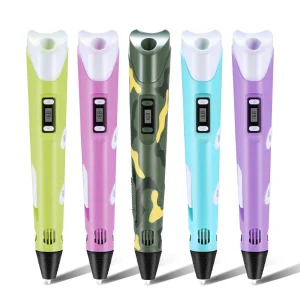
In-depth technical answers addressing operational slicing parameters, material storage protocols, OEM ordering minimums, and shipping logistics.
Dual-color co-extruded filament features two distinct color resin halves running continuously along the length of a single 1.75 mm strand. When fed into a standard single-nozzle hotend, both colors exit the nozzle tip simultaneously without mixing into a muddy brown or gray. As the printhead moves along the X and Y axes, the exterior orientation of the filament shifts relative to the model's geometry, creating an iridescent dichromatic effect that changes based on viewing angle.
To achieve optimal visual consistency, set your slicer to align layer seams along a single axis (e.g., Aligned or Rear Seam placement) rather than Random. Maintain printing temperatures between 200°C and 220°C for Silk PLA dual-color grades, with print speeds between 50 mm/s and 150 mm/s. Utilizing a 0.4 mm or 0.6 mm hardened brass nozzle delivers sharp color separation along outer perimeter walls.
For standard stocked dichromatic dual-color PLA formulations, minimum order quantities start at 100 kg per SKU. For custom Pantone color matching and fully private-label packaging (custom branded spools and cartons), the standard MOQ is 500 kg per color batch. Production lead times average 10 to 15 business days following sample approval.
Every spool is dried in industrial dehumidifying ovens prior to spooling to achieve moisture content below 0.05%. Spools are immediately vacuum-packed in high-barrier foil/poly bags alongside a 10g active desiccant packet. Individual cartons are stacked and shrink-wrapped on heavy-duty export pallets with moisture-proof corner protectors to withstand oceanic transport humidity.