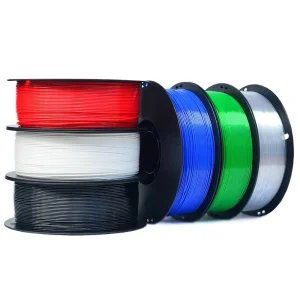
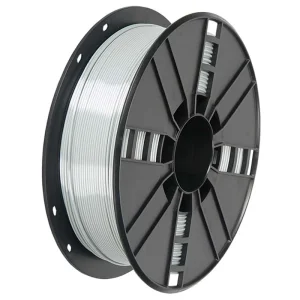
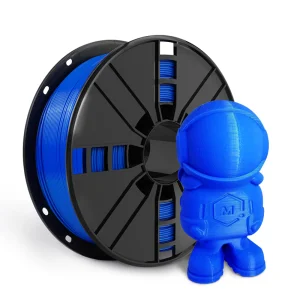
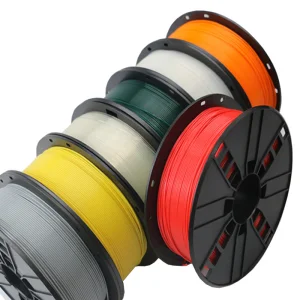
Direct from our 2,500 m² automated production facility. Standardized reels, custom tolerances, and premium grade raw resin formulations for global B2B procurement.
In the evolving additive manufacturing ecosystem, Clear PLA (Clear Polylactic Acid) filament represents a specialized intersection of bio-polymer chemistry, optical engineering, and cost-effective prototyping. Unlike opaque colored PLA filaments that use organic or inorganic pigments to mask resin variations, clear PLA filament demands an exceptional level of raw resin purity and thermal processing precision during extrusion. As global industries move toward sustainable, bio-derived plastics to meet stringent carbon reduction mandates, demand for high-transparency clear PLA has accelerated across North American, European, and Asia-Pacific markets.
From a chemical composition standpoint, clear PLA is derived from high-purity L-polylactic acid (L-lactide isomer content typically >99.5%). The inherent optical transparency of the polymer is heavily governed by its crystalline structure. During Fused Deposition Modeling (FDM) extrusion, polylactic acid cools rapidly, freezing the polymer chains into an amorphous state that minimizes light scattering at crystal boundaries (spherulites). When processed correctly by premier clear PLA filament manufacturers, the resulting strand achieves up to 92% light transmittance, rivaling traditional non-renewable clear plastics such as polystyrene (PS) and clear acrylic (PMMA).
Global procurement directors and B2B brand owners face distinct challenges when sourcing bulk clear PLA filament. The most prevalent quality failure in low-grade transparent PLA is thermal discoloration—often caused by uncontrolled heat profiles in legacy single-screw extruders. As an established manufacturer founded in 2011, Torwell Technologies utilizes precision multi-stage temperature control and inline degassing melt pumps to guarantee that every batch of clear PLA retains pure optical neutrality, free from yellow hue distortion or carbonized particulate contamination.
How state-of-the-art extrusion factories eliminate haze, stringing, and dimensional variation in clear PLA production.
Virgin virgin resin undergoes dual-stage desiccant rotor drying down to less than 200 ppm moisture content prior to extrusion, preventing hydrolytic cleavage and micro-bubbles.
Continuous inline dual-axis quad-beam laser micrometers monitor filament diameter at 100 Hz sampling rates, maintaining a strict target tolerance of ±0.02 mm across 1.75mm and 2.85mm spools.
Custom Melt Flow Index (MFI) tailoring ensures optimal viscosity (6–10 g/10min at 210°C/2.16kg), allowing adjacent printed layers to fuse completely for superior optical light transmission.
Servo-driven traverse winding mechanisms maintain constant line tension, producing neat, parallel filament layers compatible with modern high-speed automatic material systems (AMS).
Each reel is immediately heat-sealed in high-barrier vacuum pouches containing active silica gel desiccants, safeguarding against atmospheric humidity during ocean transits.
Every lot undergoes melt strength, tensile yield, heat deflection temperature (HDT), and 24-hour continuous FDM print validation before releasing factory compliance certification.
Unlocking new design possibilities across medical, architectural, automotive, and fast-moving consumer goods sectors.
Used extensively by LED lighting engineers and product designers to prototype custom light pipes, diffusers, lenses, and backlit signage housings where controlled translucency is required.
Medical researchers and hydraulic engineers employ clear PLA to print transparent manifold blocks, fluidic channels, and pump housings to visually inspect internal liquid pathways during test runs.
Packaging designers create transparent cosmetic jars, clear blister shells, and food container prototypes, enabling rapid aesthetic evaluations without investing in costly injection molds.
Cosplay creators and film prop studios leverage transparent PLA to craft crystal-like gems, futuristic armor components, ice sculptures, and illuminated stage elements.
Evaluate physical properties, optical clarity, printability, and eco-impact to guide bulk procurement decisions.
| Material Grade | Light Transmittance (%) | Tensile Strength (MPa) | Heat Deflection (°C) | Printability Rating | Biodegradability / Eco |
|---|---|---|---|---|---|
| Torwell Clear PLA (Optical) | 90% – 92% | 62 – 65 MPa | 55°C – 58°C | Excellent (Low Warp) | Bio-Based (Compostable) |
| Clear PETG (Copolyester) | 88% – 90% | 48 – 52 MPa | 68°C – 72°C | Good (Stringing Risk) | Petroleum Recyclable |
| Clear Polycarbonate (PC) | 86% – 89% | 72 – 75 MPa | 110°C – 125°C | Difficult (High Enclosure Temp) | Non-Biodegradable |
| Clear Transparent Resin (SLA/DLP) | 93% – 95% | 50 – 55 MPa | 50°C – 65°C | Moderate (Post-Curing Reqd) | Synthetic Chemical Resin |
As a leading clear PLA filament factory and B2B manufacturer, Torwell Technologies provides scalable white-label and private-label solutions tailored to international distributors, regional e-commerce brand owners, and industrial print farms. Our 2,500 m² factory operates 6 fully automated extrusion lines capable of delivering 50,000 to 60,000 kg of high-grade 3D filament monthly.
Addressing the most critical questions asked by procurement managers, print farm engineers, and 3D printing distributors.
Achieving glass-like clarity requires optimizing three key 3D printing variables: layer height, nozzle temperature, and cooling speed. Printing at larger layer heights (e.g., 0.25mm to 0.3mm) with 100% rectilinear infill oriented in a single direction minimizes internal refraction gaps. Raising the nozzle temperature to the higher end of the range (215°C–225°C) with low cooling fan speeds (20%–40%) allows the extruded PLA strands to remelt completely into a solid, bubble-free monoblock structure.
"Natural PLA" is un-pigmented resin that typically exhibits a semi-translucent, milky-white or pale yellowish tone due to standard polymer crystallinity. "Clear PLA" (Optical Grade) utilizes specially selected, highly pure L-lactide resins processed with optical clarifiers to suppress micro-crystallites, resulting in a crystal-clear, water-white transparent strand without milky cloudiness.
While PLA is generally less hygroscopic than Nylon or TPU, clear PLA is extremely sensitive to moisture from a visual standpoint. Absorbed water causes steam micro-popping inside the hotend, introducing thousands of microscopic air bubbles into the print path that ruin optical transparency and cause stringing. Torwell packages all wholesale clear PLA in heavy-duty vacuum-sealed foil pouches with active silica gel, guaranteeing extended shelf life during long-distance maritime freight.
Yes. In addition to our standard 1kg retail reels, we offer industrial-scale spooling formats including 3kg, 5kg, and 10kg spools designed to reduce reel swap downtime in high-throughput 3D printing farms. Custom inner hub diameters are also available to fit specialized automatic material feed systems.
For standard stocked clear PLA spools, our MOQ starts as low as 50 to 100 kg for distributors. For fully customized private-label packaging, custom box printing, or custom Pantone translucent color matching, our standard factory MOQ is 500 kg per SKU.
Absolutely. All Torwell clear PLA filaments are manufactured from 100% virgin bio-based PLA resin. Our products comply with EU REACH, RoHS directive standards, and contain zero hazardous heavy metals, phthalates, or toxic plasticizers. Technical Data Sheets (TDS) and Safety Data Sheets (SDS) are provided with every order.
Complement your inventory with our comprehensive range of specialty, flexible, and engineering-grade polymers.