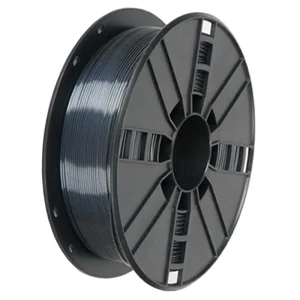
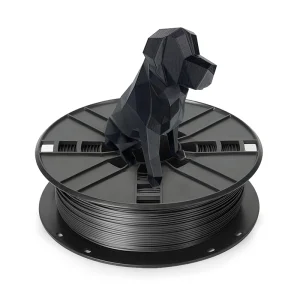
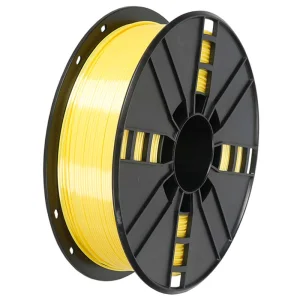
Precision-extruded thermoplastic filaments manufactured under strict ISO 9001 compliance for global supply chains.
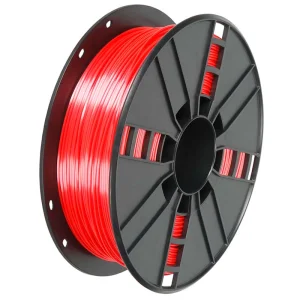
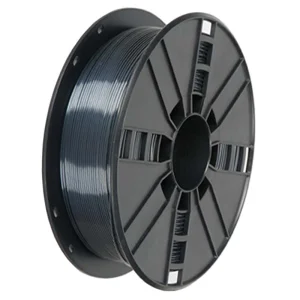
In the rapidly advancing landscape of industrial additive manufacturing, Carbon Fiber 1.75 PETG (Polyethylene Terephthalate Glycol reinforced with Short Chopped Carbon Fiber) represents a structural leap forward over unreinforced commodity polymers. By compounding high-purity PETG resin matrix with micro-scale carbon fibers (typically 15% to 20% by weight loading ratio), material engineers successfully bridge the gap between easy-to-print standard thermoplastics and high-performance engineering compounds.
Incorporating short carbon fibers dramatically increases structural stiffness (Flexural Modulus up to 4.8 GPa) while reducing longitudinal thermal expansion. The micro-fibers act as internal structural beams, intercepting crack propagation across layer lines and raising overall tensile strength up to 75 MPa.
Standard PETG exhibits moderate thermal shrinkage during volumetric phase transitions. Carbon fiber reinforcement virtually eliminates z-axis warping and perimeter deformation, permitting large-format industrial 3D printing without heated enclosures or high bed temperatures.
The microscopic disperse distribution of fiber particulates light-refracts surface reflections. This produces an aesthetic, rich satin-matte finish that naturally conceals extrusion layer steps, drastically reducing post-processing and surface sanding labor.
| Physical & Mechanical Property | Standard Virgin PETG | Reinforced Carbon Fiber 1.75 PETG (15% CF) | Testing Protocol / Standard |
|---|---|---|---|
| Tensile Strength (MPa) | 48 – 52 MPa | 72 – 78 MPa | ISO 527 / ASTM D638 |
| Flexural Modulus (GPa) | 2.1 GPa | 4.8 – 5.2 GPa | ISO 178 / ASTM D790 |
| Heat Deflection Temp (HDT @ 0.45MPa) | 68 °C | 82 – 86 °C | ISO 75 / ASTM D648 |
| Density (g/cm³) | 1.27 g/cm³ | 1.22 g/cm³ (Lightweighting effect) | ISO 1183 |
| Diameter Tolerance Precision | ±0.03 mm | ±0.02 mm (Laser Inline Measurement) | In-line 2-Axis Laser Optical Gauge |
| Recommended Extrusion Nozzle | Brass, Stainless Steel | Hardened Steel, Ruby, Tungsten Carbide | Abrasion Prevention Metric |
Sourcing Wholesale Carbon Fiber 1.75 PETG directly from leading Chinese extrusion facilities provides global B2B buyers, distributor networks, and OEM brands with unmatched cost-efficiencies, rigorous quality management, and immense scalable output.
Our China manufacturing center utilizes co-rotating twin-screw extruders specifically modified to prevent fiber shear degradation. By controlling melt temperature gradients and screw element geometry, short carbon fibers are homogeneously dispersed throughout the PETG matrix without causing premature fiber fragmentation.
To guarantee smooth feeding through Bowden tubes and Direct-Drive extruders (especially in Automatic Material Systems / AMS), every meter of Carbon Fiber 1.75 PETG is scanned by dual-axis optical lasers. Out-of-spec segments (>±0.02 mm or ovality anomalies) are automatically flagged and rejected online.
We provide turn-key OEM solution services for global 3D filament brands: custom reel weights (250g, 500g, 1kg, 3kg, 5kg), eco-friendly cardboard spools, high-barrier vacuum seal packaging with customized silica desiccants, and tailor-made master carton branding.
The additive manufacturing domain has transitioned from rapid prototyping to direct functional part production. Market data indicates a compound annual growth rate (CAGR) exceeding 22% for carbon-fiber-reinforced polymer filaments. Buyers across North America, Europe, and Asia-Pacific are increasingly standardizing on 1.75mm Carbon Fiber PETG due to several critical market factors:
Modern high-speed FDM printers (operating at speeds of 300 mm/s to 600 mm/s) require filaments with predictable rheology and rapid thermal dispersion. Our engineered PETG-CF formulation maintains stable melt viscosity, preventing nozzle back-pressure build-ups during high-volume production runs.
Environmental regulations in the EU (such as REACH and RoHS standards) drive demand for sustainable packaging. Factory production options include 100% recyclable heavy-duty paperboard spools engineered to withstand multi-material system unwinding friction without shedding dust.
Industrial design teams leverage PETG-CF to replace CNC-machined aluminum 6061 and POM/Nylon blocks. Weight reductions of up to 40% are routinely achieved while eliminating multi-axis machining lead times and lowering overall assembly production costs.
Carbon Fiber 1.75 PETG is selected across diverse engineering disciplines where mechanical rigidity, chemical resistance to oils and solvents, and high dimensional fidelity are mandatory requirements.
Used extensively on automotive assembly lines for robotic arm End-of-Arm Tooling (EOAT), check gauges, and ergonomic hand-held positioning jigs that require zero flex under mechanical clamping loads.
Drone frame structural arms, motor mounts, camera gimbal brackets, and protective shell housings benefit from PETG-CF’s high strength-to-weight ratio and vibrational damping qualities.
Outdoors-deployed sensor housings, junction boxes, and handheld ruggedized terminal frames resist chemical exposure, moisture degradation, UV atmospheric stress, and drop impacts.
Press brake tooling, thermoforming molds, and work-holding collets requiring high compressive strength under repetitive cyclic mechanical loads in factory automation setups.
When high-volume distributors and international brand owners evaluate Wholesale Carbon Fiber 1.75 PETG Suppliers & Factory Partners, verifying production standards and operational compliance is essential for long-term supply stability.
Every production batch must utilize traceable virgin PETG resin and standardized carbon fiber tow. Factory COA (Certificate of Analysis) documentation guarantees consistent glass transition temperatures (Tg ~80°C) and uniform melt flow indices (MFI).
PETG matrix polymer is inherently hygroscopic. Factory procedures must integrate multi-stage desiccant hoppers prior to extrusion, followed by immediate inline vacuum sealing (<0.05% moisture content) with commercial-grade aluminized film to eliminate steam bubble defects during printing.
International ocean and air freight requires robust protection. Standard export master cartons use reinforced 5-ply corrugated walls, corner protectors, and palletized stretch wrapping to resist humidity fluctuations and mechanical impact during transit.
Comprehensive technical insights and commercial guidelines for global buyers, distributors, and engineering procurement leads.
For optimal layer bond strength and smooth surface extrusion: Nozzle Temperature: 240°C – 265°C; Print Bed Temperature: 75°C – 85°C; Printing Speed: 40 mm/s – 150 mm/s (up to 300 mm/s on modern high-speed FDM platforms); Bed Surface: PEI sheet, glass with adhesive glue stick, or textured build plate. Cooling Fan Speed: 20% – 50% (lower fan speed improves z-layer adhesion strength).
Carbon fiber micro-particles are extremely abrasive. Standard brass nozzles will experience rapid internal orifice erosion within printing just 250g to 500g of material, expanding nozzle diameter from 0.4mm to over 0.6mm and causing extrusion instability. We recommend hardened steel, tungsten carbide, or ruby-tipped nozzles for long-term production reliability.
Our standard factory MOQ for stock black Carbon Fiber 1.75 PETG is 100 kg. For custom private-label branding, customized spool colors, or specific cardboard spool printing, the typical starting MOQ is 500 kg per SKU. OEM sample spools are available for qualified B2B enterprise buyers upon request.
Yes. Our Carbon Fiber 1.75 PETG is extruded with strict diameter control (±0.02mm) and wound onto high-precision spools engineered to prevent tangling or binding. When using cardboard spools, we recommend utilizing plastic edge adapter rings to reduce unwinding friction inside multi-material AMS units.
While PA-CF offers higher ultimate thermal resistance (HDT >140°C) and impact toughness, it is significantly more hygroscopic and requires active chamber heating and continuous drying at 80°C+. PETG-CF provides superior printability, negligible moisture sensitivity during printing, zero bed warping, and a lower total material cost, making it the preferred choice for general industrial tooling and fixtures under 85°C working environments.
Every production lot undergoes rigorous quality checks: 1) Continuous dual-axis laser diameter optical measurement; 2) Melt flow index testing; 3) Moisture content titration; 4) Tensile & flexural stress destruction testing; and 5) Test-printing of complex geometry benchmark components for surface finish evaluation.
In sealed original vacuum packaging with active desiccant, the shelf life exceeds 24 months. If the spool is exposed to ambient air humidity above 50% RH for extended periods, we recommend pre-drying the filament in a dedicated filament dryer or oven at 65°C for 4 to 6 hours before printing.
Explore our factory-direct technical polymer lineup designed for diverse global market demands.