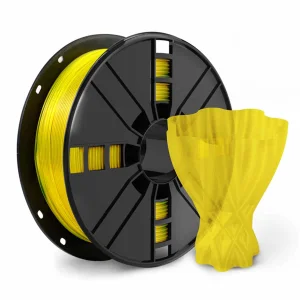
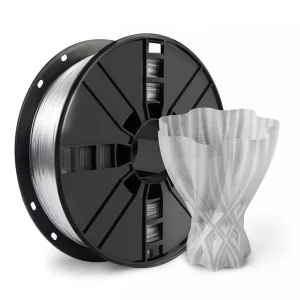
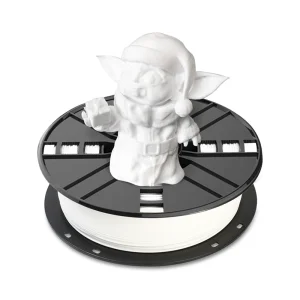
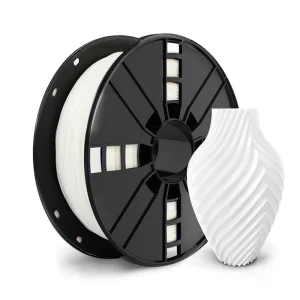
Factory-direct thermoplastic filament spools engineered under ISO 9001 quality management systems with tight inline diameter tolerance control.
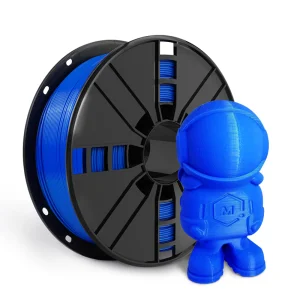
Acrylonitrile Styrene Acrylate (ASA) represents a vital evolution in outdoor-grade additive manufacturing materials. Understanding its chemical architecture explains why global enterprises are migrating from standard ABS to engineered ASA formulations for long-term field deployment.
Standard Acrylonitrile Butadiene Styrene (ABS) derives its impact resistance from a polybutadiene rubber phase. However, the unsaturated carbon-carbon double bonds ($C=C$) in butadiene are exceptionally vulnerable to ultraviolet radiation and atmospheric photo-oxidation. Prolonged solar exposure causes chain scission, micro-cracking, yellowing, and severe mechanical embrittlement within months.
ASA solves this degradation pathway by replacing butadiene rubber with an acrylate ester elastomer (typically polybutyl acrylate). Because the acrylic ester matrix contains saturated chemical bonds, ASA exhibits outstanding resistance to UV degradation, thermal oxidation, and environmental stress cracking. When produced by a premier wholesale ASA 3D filament supplier, the material retains up to 92% of its initial Izod impact strength after 3,000 hours of accelerated Xenon-Arc weathering (ISO 4892-2).
| Polymer Parameter | ASA (Acrylonitrile Styrene Acrylate) | ABS (Standard Engineering Grade) | PETG (Glycol-Modified Polyester) | Polycarbonate (PC) |
|---|---|---|---|---|
| UV Resistance (Solar/Outdoor) | Exceptional (10+ Years) | Poor (Chalks/Brittle < 6 mos) | Moderate (Slight embrittlement) | Moderate to Poor (Requires UV coating) |
| Heat Deflection Temp (0.45 MPa) | 98°C – 102°C | 95°C – 98°C | 68°C – 72°C | 135°C – 142°C |
| Layer Adhesion Strength | High (OptimizedSAN ratio) | High | Very High | Moderate (Prone to warpage) |
| Weathering Color Fastness ($\Delta E$) | < 2.5 (3000h Accelerated) | > 14.0 (Severe yellowing) | < 5.0 (Translucent fogging) | > 8.0 (Yellowing/Haziness) |
| Chemical Resistance | Alcohols, Hydrocarbons, Acids | Moderate Hydrocarbons | High Acids/Alkalis | Sensitive to Solvents |
The global market for additive manufacturing polymers is experiencing a structural pivot. Industrial end-users are moving away from purely rapid prototyping toward distributed manufacturing of end-use production parts, driving exponential demand for high-reliability wholesale ASA 3D filament suppliers.
Tier-1 automotive component vendors utilize ASA filament for low-volume production of side-mirror housings, roof rack end-caps, sensor brackets, and radiator grille prototypes. ASA's resistance to road salts, automotive fluids, and intense solar radiation makes it the baseline polymer for vehicle functional testing.
Deployments of 5G micro-cells, IoT environmental sensors, and smart electrical grid enclosures require radome materials that do not degrade under UV exposure. ASA provides radio-frequency transparency combined with IP65-grade housing longevity for long-term field infrastructure.
Commercial marine equipment manufacturers and UAV drone builders utilize high-purity ASA filament for customized navigation housings, boat fittings, and agricultural spraying drone frames. The material resists saltwater hydrolysis and impact stress under freezing or tropical temperatures.
Consistently high-grade FDM 3D printing requires strict control of polymer viscosity, volatile content, moisture levels, and filament roundness. Torwell Technologies enforces a strict 5-stage extrusion protocol across all 6 automated production lines.
Raw ASA resin undergoes twin-tower desiccant dehumidification drying to bring moisture content below < 0.02% before entering the extruder melt zone, eliminating moisture bubbles and stringing.
Dual-axis high-speed laser micrometers Continuously measure diameter and ovality at 500 Hz. Automated feedback loops adjust capstan puller speeds dynamically to maintain a strict ±0.02 mm tolerance limit.
Multi-stage warm water immersion baths prevent rapid thermal quenching of the extrudate, relieving internal polymer chain stresses and ensuring flat, non-warping spool performance.
Tension-controlled servo winding machines lay filament strands uniformly side-by-side. This eliminates crossed layers, preventing feed jams on automatic material systems (AMS) and print farms.
Extruding ASA successfully requires optimal machine calibration. As an experienced OEM factory supplier, we supply standardized slicing profiles and thermal setup windows to ensure peak interlayer adhesion and structural isotropy.
One major manufacturing advantage of ASA filament over non-styrenic polymers is its solvency profile. ASA printed components can be smoothed using acetone vapor bath processes, melting surface micro-lines to achieve a mirror-gloss, waterproof finish indistinguishable from injection molding.
Additionally, parts can be easily joined using solvent adhesives (such as methyl ethyl ketone or acetone) to assemble extra-large structural components for outdoor signage, architectural displays, and automotive body panels.
Torwell Technologies offers turnkey B2B manufacturing partnerships for global distributors, e-commerce brand owners, and industrial suppliers. We provide full technical documentation and tailored OEM/ODM packaging options.
All ASA masterbatches and raw resins comply with strict global safety regulations, including RoHS 3 (EU 2015/863), REACH SVHC 235 list, and UL94 HB flame retardancy guidelines, ensuring smooth customs clearance and market compliance in Europe, North America, and Japan.
Beyond stock Black, White, Grey, and Natural colors, our chemical laboratory offers custom color formulation matched against Pantone, RAL, or physical plastic samples. Achieve precise brand consistency across high-volume orders with zero shade drift between production lots.
We supply private label options including customized eco-friendly cardboard spools, high-barrier vacuum seal bags, moisture-indicating desiccant packs, die-cut branded retail boxes, and customized master carton packaging designed for freight stability.
Essential answers for sourcing directors, quality engineers, and wholesale purchasers evaluating ASA 3D printing materials.
ASA replaces the polybutadiene rubber component found in ABS with polybutyl acrylate elastomer. Butadiene contains carbon-carbon double bonds that quickly degrade, yellow, and embrittle under UV rays. Acrylate rubber lacks these vulnerable bonds, allowing ASA to maintain its physical strength, impact resistance, and color fidelity over years of harsh weather and sun exposure.
We run automated 2-axis high-speed laser measurement systems inline on every extrusion line. The equipment logs diameter and ovality data continuously at 500 Hz. If dimensions deviate beyond target tolerances (±0.02 mm), the puller unit automatically adjusts speed. Off-spec filament is flagged and removed before spooling.
For standard stock colors (Black, White, Natural, Light Grey), our baseline wholesale MOQ starts at 100 kg. For custom Pantone color matching or specialized private label spools/cartons, the typical MOQ is 300 kg to 500 kg per SKU to optimize masterbatch mixing and extrusion efficiency.
Yes. ASA requires a heated bed capable of reaching 90°C to 110°C. For large industrial components, printing inside an enclosed chamber maintained at 40°C to 60°C is highly recommended to control thermal shrinkage and eliminate corner warping.
Every spool is vacuum-sealed inside a thick aluminum-foil or high-barrier PE vacuum bag immediately after quality inspection. Each package includes a fresh silica gel desiccant pack. Vacuum sealed spools are packed into sturdy individual cardboard boxes and stacked inside reinforced export master cartons on wrapped pallets.
Yes. Because ASA contains a styrene-acrylonitrile matrix, it reacts to acetone vapors similarly to ABS. Exposing parts to controlled acetone vapor dissolves surface layer lines, creating a glossy, watertight outer surface while improving overall layer adhesion strength.
Yes. We provide complete Technical Data Sheets (TDS) detailing tensile strength, flexural modulus, HDT, and density, alongside comprehensive Safety Data Sheets (SDS/MSDS) and RoHS/REACH compliance certification documents for all materials.
Torwell Technologies operates a 2,500 m² factory equipped with 6 fully automated high-speed extrusion lines. Our monthly capacity ranges between 50,000 kg and 60,000 kg of high-precision filament, allowing us to maintain stable lead times even during peak order cycles.
Explore our full line of specialty 3D printing filaments engineered for professional distribution and end-use industrial applications.