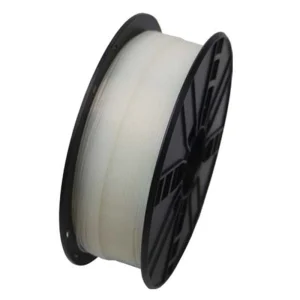
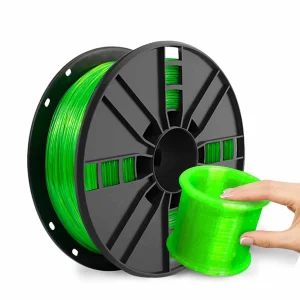
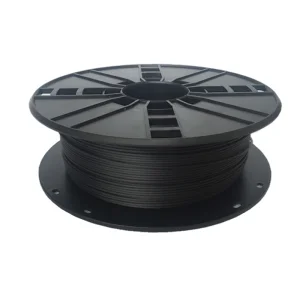
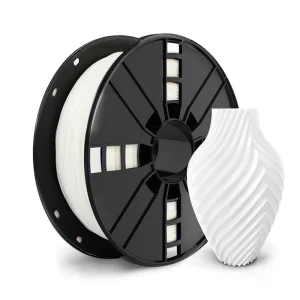
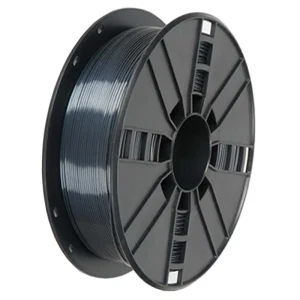
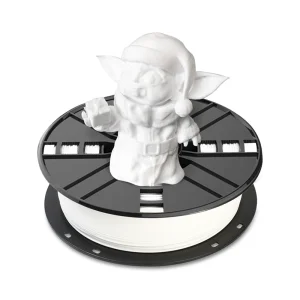
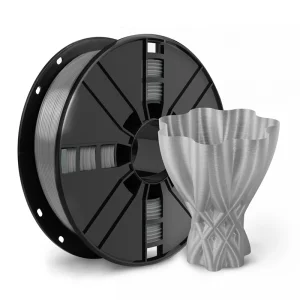
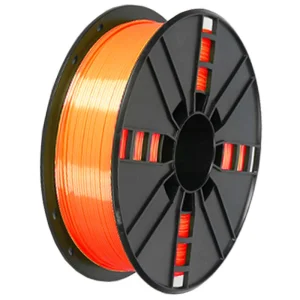
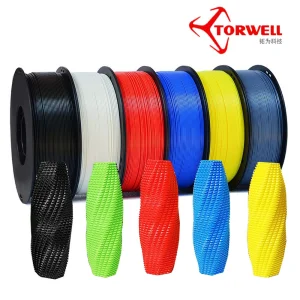
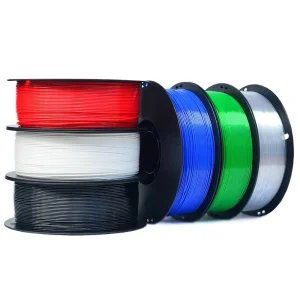
Explore our export-ready 3D printing filament series. Extruded with inline dual-axis laser diameter monitoring for unmatched layer consistency and zero tangles.
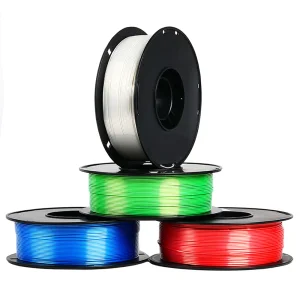
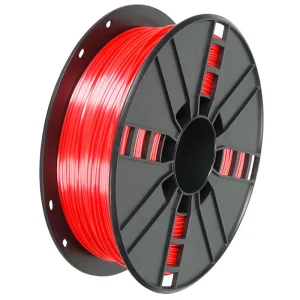
A comprehensive examination of Thermoplastic Polyurethane elastomer chemistry, optical transparency mechanisms, melt rheology, and industrial supply chain integration.
Thermoplastic Polyurethane (TPU) is a linear block copolymer consisting of alternating soft polymer segments (which provide flexibility and elasticity) and hard urethane segments (which act as mechanical crosslinks and impart tensile strength). Achieving true 1.75mm Clear Transparent TPU requires raw material synthesis with near-zero phase-separation micro-crystallinity. When soft polyether polyol chains align seamlessly with aliphatic diisocyanate hard blocks during low-shear extrusion, light scattering is minimized, producing crystal-clear transparency with light transmittance metrics exceeding 91.5%.
Unstabilized clear TPU polymers suffer rapid photo-oxidative degradation when exposed to ambient ultraviolet light or processing heat, resulting in undesirable yellowing. Premium China factory extrusions integrate specialized Hindered Amine Light Stabilizers (HALS) alongside secondary phosphite anti-oxidants. This keeps the initial Yellowness Index (YI < 1.5 according to ASTM D1925) ultra-low, ensuring long-term optical brilliance for commercial products, outdoor flexible seals, and transparent prototypes.
For industrial procurement managers, material selection dictates product longevity. Polyether-based Clear TPU offers superior hydrolytic stability, microbial resistance, and low-temperature flexibility, making it ideal for medical components and outdoor applications. Polyester-based Clear TPU provides higher tensile strength and chemical resistance against oil and fuels, perfect for automotive gaskets and industrial machinery boots.
How direct OEM production hubs in China optimize cost structures, raw resin quality, and high-precision laser extrusion lines for global distributors.
China's Pearl River Delta chemical manufacturing corridor benefits from direct integration with global tier-1 polymer chemical suppliers (including Wanhua, Covestro, and BASF). By sourcing pure virgin elastomer pellets without recycled additives, factories ensure absolute batch-to-batch consistency and uniform melt flow index (MFI).
Standard quality controls check filament diameter manually. Industrial China factories deploy automated dual-axis laser micrometers operating at 500Hz sampling frequencies. If a strand deviates beyond ±0.02 mm tolerance or exhibits ovality, real-time feedback loops adjust haul-off speed automatically.
Flexible polymers such as 85A and 95A TPU are prone to stretching under winding tension. Specialized servo-driven coiling mechanisms maintain ultra-precise tension control. This delivers neat, layer-by-layer spooling that eliminates tangles and overlapping loops during high-speed 3D printing.
Comprehensive engineering data comparing Shore Hardness grades of clear TPU filament to streamline technical material selection.
| Polymer Parameter | TPU 85A Clear | TPU 95A Clear (Industry Standard) | TPU 98A / 64D Rigid Clear | Testing Standard |
|---|---|---|---|---|
| Shore Hardness | 85 Shore A | 95 Shore A | 98 Shore A / 64 Shore D | ISO 868 / ASTM D2240 |
| Nominal Diameter | 1.75 mm (±0.02 mm) | 1.75 mm (±0.02 mm) | 1.75 mm (±0.02 mm) | Inline Laser Inspection |
| Density / Specific Gravity | 1.18 g/cm³ | 1.21 g/cm³ | 1.23 g/cm³ | ISO 1183 / ASTM D792 |
| Tensile Strength at Ultimate Break | 38 MPa | 52 MPa | 58 MPa | ISO 527 / ASTM D638 |
| Elongation at Break (%) | 580% | 490% | 380% | ISO 527 / ASTM D638 |
| Tear Strength | 95 N/mm | 125 N/mm | 150 N/mm | ISO 34-1 / ASTM D624 |
| Light Transmittance (1mm Sheet) | > 92.0% | > 91.5% | > 89.5% | ASTM D1003 |
| Extruder Nozzle Temperature Range | 205°C – 225°C | 215°C – 235°C | 225°C – 245°C | Internal Rheology Test |
| Heated Bed Temperature | 30°C – 50°C (PEI / Glass) | 40°C – 60°C (PEI / Glass) | 50°C – 70°C (PEI / Glass) | Direct Platform Test |
From medical device prototypes to high-performance footwear, discover how global enterprises leverage 1.75mm clear TPU filament.
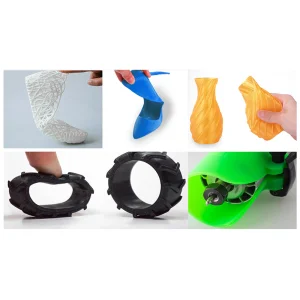
Transparent TPU is critical for rapid prototyping of flexible clear medical tubing manifolds, fluidic inspection valves, patient-specific orthotic insoles, and anatomical surgical guides. High optical clarity allows engineers and clinicians to observe internal fluid dynamics during fluidic simulations.
Automotive engineers utilize clear TPU 95A to print flexible weather-stripping seals, wire harness protective boots, transparent fluid reservoir caps, and low-frequency dampening grommets that resist grease, oil, and continuous impact shock.
Crystal-clear protective covers for smartphones, wearable smartwatch bumpers, drop-resistant audio casing dampeners, and LED light-pipe diffusers benefit from TPU's high tear resistance, high elasticity, and non-yellowing aesthetic finish.
Automated manufacturing lines demand soft-touch pneumatic grippers, clear suction cups, and flexible joint coverings. Clear TPU 1.75mm allows technical staff to inspect internal mechanical wear without disassembling protective boots.
Global athletic footwear brands rely on clear TPU filament for 3D-printed translucent midsoles, high-rebound cushioning structures, and durable outer sole tread patterns designed for maximum shock absorption and abrasion endurance.
Commercial print farms producing custom flexible parts on scale require high-speed printability without nozzle clogging. Torwell's consistent ±0.02 mm diameter ensures unattended overnight operation across hundreds of FDM machines.
Tailored manufacturing options for international brands, Amazon sellers, regional distributors, and industrial volume buyers.
We provide full-spectrum OEM branding support to turn key raw filament into export-ready consumer or industrial products:
Ensuring smooth overseas customs clearance and zero product degradation during ocean freight transit:
Engineering recommendations to eliminate micro-bubbles, prevent extruder jamming, and achieve glass-like optical transparency.
TPU is highly hygroscopic, absorbing moisture from ambient air in as little as 2 hours. Absorbed water vaporized inside the hotend creates steam micro-voids, stringing, and cloudy opaque prints. Drying Protocol: Bake spool at 65°C for 4 to 6 hours in a dedicated filament dryer prior to printing.
Because flexible 1.75mm TPU can buckle like spaghetti under compression, direct-drive extruders with a constrained, fully enclosed filament path are highly recommended. Maintain PTFE tube tolerances tight to the dual drive gears to eliminate filament binding.
To produce transparent components rather than hazy translucent prints:
Key tech shifts driving high-speed TPU extrusion, bio-based polyols, and smart material integration.
Next-generation 3D printers operate at speeds exceeding 500 mm/s with accelerations up to 20,000 mm/s². Traditional soft elastomers jam under high volumetric flow rates. China material R&D is pioneering shear-thinning modified clear TPU resins that drop melt viscosity during high-shear nozzle pass-through while immediately regaining elastomeric structural memory upon deposition.
Environmental regulations across the EU and North America are accelerating the shift toward circular polymers. Advanced China manufacturing plants are scaling Bio-TPU formulations utilizing up to 45% bio-based polyol content synthesized from non-food castor oil derivatives, reducing carbon footprint while maintaining ASTM D1003 optical transparency metrics.
In-depth responses to essential engineering, material compliance, and bulk order questions.
Yellowing in clear TPU is primarily caused by photo-oxidative degradation triggered by UV exposure and thermal oxidation during extrusion. Unstabilized aromatic TPU polymers form quinoid structures under sunlight. Torwell utilizes premium aliphatic diisocyanate polyurethane resins blended with Hindered Amine Light Stabilizers (HALS) and primary antioxidants, achieving a yellowing index of YI < 1.5 (ASTM D1925) for exceptional clarity over time.
Polyether-based clear TPU offers superior resistance to hydrolysis (water absorption breakdown), excellent microbial protection, and flexibility in cold environments. It is preferred for medical devices, footwear, and outdoor seals. Polyester-based clear TPU exhibits higher mechanical tear strength, superior abrasion resistance, and greater resistance to oils and fuels, making it optimal for automotive gaskets and industrial machinery components.
Extruding flexible polymers at tight tolerances requires precise thermal and tension control. Our production lines feature multi-stage temperature-controlled water cooling troughs and dual-axis laser scanning micrometers operating at 500Hz. The laser gauge provides continuous closed-loop feedback to servo-driven haul-off pulling wheels, making micro-adjustments in real-time to eliminate diameter drift and ovality.
Yes. Shore 95A clear TPU can be printed reliably on high-speed direct-drive 3D printers. While rigid filaments (PLA/PETG) print at 300+ mm/s, flexible TPU should be tuned to volumetric speed limits (typically 6–10 mm³/s, equating to 40–80 mm/s print speeds) to prevent backpressure swelling inside the hotend. Note: Flexible materials should bypass automatic multi-material systems (like AMS) and feed directly from a top spool mount or dry box.
Torwell offers end-to-end OEM manufacturing including custom Pantone color matching (transparent, translucent, solid), customized spool dimensions (250g, 500g, 1kg, 3kg, 5kg), private label sticker designs, custom-printed retail boxes, branded vacuum bags, and technical datasheet customization (TDS/SDS) tailored for your target market regulatory requirements.
Filament is inline dried prior to coiling to achieve equilibrium moisture content below 0.05%. Spools are immediately heat-sealed inside heavy-duty multi-layer aluminum foil vacuum bags with active silica gel desiccants. Master cartons are sealed with moisture-resistant tape and stretch-wrapped on pallets to ensure 100% protection during 30–45 day sea shipping transit times.
Shore 95A is the industry standard for 3D printing because it strikes the perfect balance between flexibility and printability, making it compatible with almost all direct-drive FDM printers. Shore 85A is noticeably softer and provides greater shock absorption and rubber-like elasticity, but requires precise extruder feeding control and slower print speeds.
To minimize internal light refraction: 1) Thoroughly dry the filament at 65°C for 5 hours; 2) Increase layer height to 0.28mm using a 0.6mm or 0.8mm nozzle; 3) Set infill to 100% aligned rectilinear or use single-wall continuous extrusion (vase mode); 4) Print at 230°C at slow speed (20-25 mm/s) with the cooling fan set to 0-20%.
Explore our engineering-grade materials, PLA+ series, PETG, ABS, and flexible TPU variants available for direct wholesale dispatch.