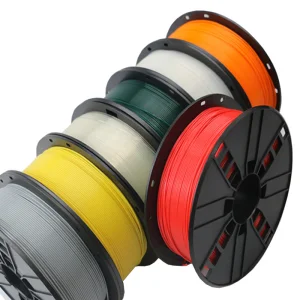
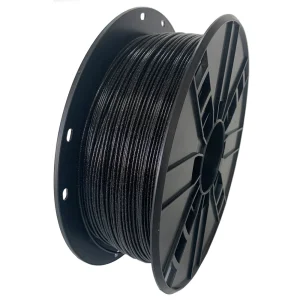
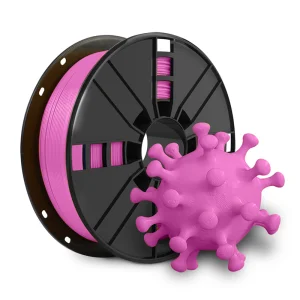
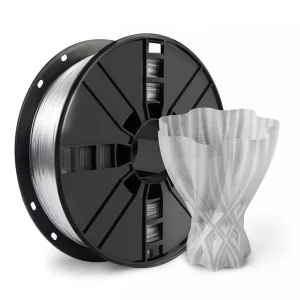
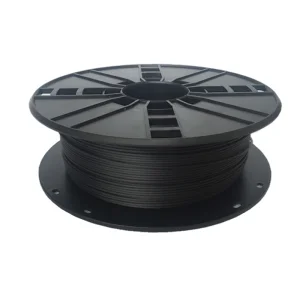
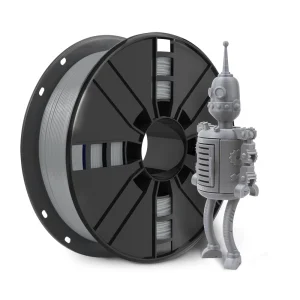
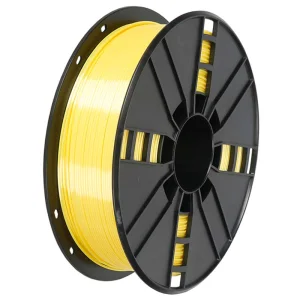
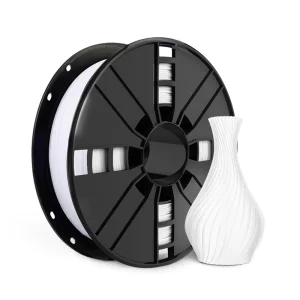
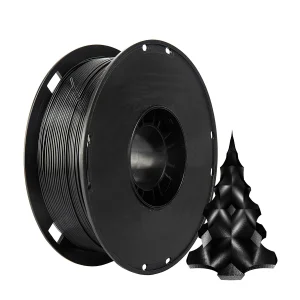
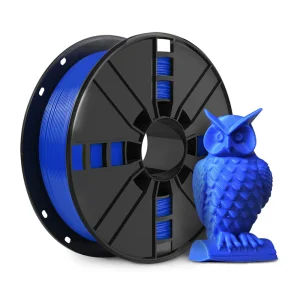
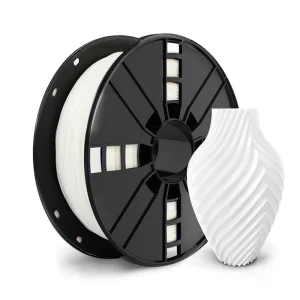
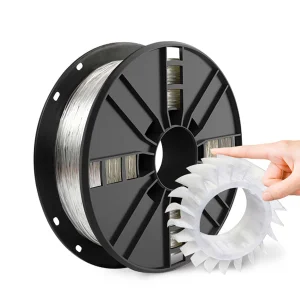
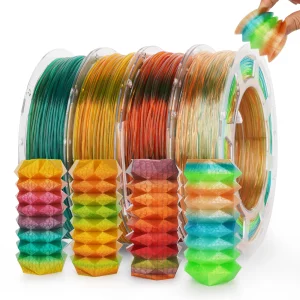
Explore high-precision filaments manufactured in our 2,500 m² automated facility with inline ±0.02 mm laser diameter control.
Understanding the molecular dynamics, phase separation, and mechanical equilibria that make Shore 95A the industrial standard for elastic additive manufacturing.
Thermoplastic Polyurethane (TPU) represents a unique class of linear multiblock copolymers composed of alternating flexible soft segments and rigid hard segments. In the domain of industrial additive manufacturing, Shore 95A TPU flexibility has emerged as the definitive sweet spot between elastic tactile performance and mechanical extrudability. Unlike softer elastomers (such as Shore 80A or 85A), which frequently buckle within 3D printer drive gears, or harder elastomers (such as Shore 64D), which lack sufficient compliance, Shore 95A strikes an optimal balance. It offers a flexural modulus of approximately 65–85 MPa and an elongation at break exceeding 450% to 600%.
SEO Insight & Technical Reality: Polymer buyers and additive manufacturing engineers seeking "China TPU 95A Flexibility Suppliers & Factory" require materials engineered at the molecular level. Standard extrusion processes often suffer from physical property degradation if moisture content, melt flow index (MFI), and hard-to-soft segment phase separation are not strictly monitored during synthesis.
When sourcing industrial TPU 95A filament from Chinese factories, distinguishing between Polyether-based TPU and Polyester-based TPU is vital for application performance:
Synthesized via polyether polyols (such as PTMEG) combined with diisocyanates (MDI). Polyether formulations provide superior hydrolytic stability, outstanding resistance to microbial fungal attack, and exceptional flexibility down to sub-zero temperatures (-40°C). Ideal for medical devices, outdoor aquatic seals, pneumatic tubing, and footwear insoles.
Formulated using polyester polyols reacting with isocyanates. Polyester TPU delivers significantly higher tensile strength (up to 45–55 MPa), extreme tear propagation resistance, and exceptional resistance to oils, greases, fuels, and non-polar solvents. Standard choice for industrial gaskets, automotive bushings, tool grips, and wear plates.
How direct additive manufacturing of elastomeric components is disrupting traditional injection molding across key global sectors.
The global market for flexible 3D printing filaments has transitioned from low-volume hobbyist prototyping into rapid direct digital manufacturing (DDM). Traditionally, producing flexible rubber or polyurethane components required high-capital aluminum or steel injection molds costing anywhere from $10,000 to $50,000 per SKU, accompanied by lead times of 6 to 12 weeks.
OEM tier-1 suppliers utilize TPU 95A for direct production of custom wire harness grommets, air intake ducts, vibration dampening mounts, and noise-isolation pads capable of surviving under-hood temperatures (-30°C to +105°C).
In automated assembly lines, custom soft robotics grippers, suction cups, and flexible end-of-arm tooling (EOAT) are printed using TPU 95A to handle delicate items without marring surfaces during high-speed pick-and-place operations.
Podiatrists and orthotic labs deploy TPU 95A to print patient-matched foot orthotics featuring variable lattice density infills, balancing structural heel support with dynamic arch flexibility.
Why sourcing directly from integrated Chinese factories provides decisive technical, economic, and operational advantages for international brands.
China commands over 45% of the global polyurethane raw material production capacity, anchoring upstream raw chemical production (such as pure MDI and specialty polyols from domestic chemical titans like Wanhua Chemical, Covestro China, and Sinopec) directly into extrusion conversion lines.
Direct physical proximity between raw chemical synthesis plants and filament extrusion factories eliminates double-handling transport costs and raw material degradation. Bulk resin compounding allows Torwell Technologies to customize melt index parameters directly at the polymer reactor level.
Our 2,500 m² factory runs 6 automated high-speed extrusion lines equipped with dual-axis laser diameter monitoring operating at 500 Hz sampling rates. This closed-loop system automatically adjusts capstan puller speed, ensuring a tight ±0.02 mm tolerance on 1.75 mm and 2.85 mm spools.
Furthermore, high-speed 3D printing systems (such as Bambu Lab AMS, Raise3D, and Prusa XL) require continuous filament concentricity. Poorly wound or moisture-laden flexible filaments lead to binding inside feeding tubes. China’s advanced automated tension-controlled spooling systems guarantee zero-tangle layer winding, enabling uninterrupted long-run production in commercial print farms.
In-depth technical analysis of TPU 95A in specialized localized environments and high-stress industrial operations.
Modern high-speed CoreXY 3D printers operating at speeds of 150–250 mm/s generate significant backpressure in hotends. Standard TPU filaments tend to bulge and buckle under high acceleration. Torwell TPU 95A incorporates rheological flow improvers that lower melt viscosity under shear stress, enabling fast flex-printing without extruder jamming.
Because of its high burst pressure strength and elastic recovery, TPU 95A is printed directly into custom fluidic manifolds, seal rings, and pneumatic bellows. The high layer-to-layer adhesion ensures airtight seals up to 6 bar pressure when printed with a 100% solid perimeter shell wall setup.
For ruggedized handheld terminals, military-grade drones, and outdoor survey equipment, TPU 95A provides unmatched drop-impact absorption. The polymer dissipates shock waves across its crystalline hard-segment matrix, protecting sensitive microelectronics from 3-meter drop forces.
Next-generation polymer formulations engineered to meet rising regulatory standards and industrial requirements.
As global mandates for carbon footprint reduction tighten, chemical research in China is advancing bio-derived polyols sourced from castor oil and bio-succinic acid. Next-generation TPU 95A formulations achieve up to 45% bio-based carbon content without compromising mechanical tensile strength, fulfilling European Union Eco-design directive standards.
Standard elastomers are inherently flammable. Advanced halogen-free flame retardant (HFFR) additives are being grafted into TPU 95A backbones. This development yields self-extinguishing flexible filaments certified for commercial aerospace cabins, mass transit interiors, and high-voltage EV battery enclosure seals.
By incorporating functional multi-walled carbon nanotubes (MWCNTs) or conductive carbon black, ESD-safe TPU 95A maintains a controlled surface resistivity ($10^6 \text{ to } 10^9 \ \Omega/\text{sq}$). Essential for manufacturing flexible semiconductor transport trays and explosive atmosphere (ATEX) seals.
To keep pace with 500 mm/s high-acceleration FDM hardware, novel molecular weight distribution (MWD) tuning reduces polymer melt viscosity at high shear rates while preserving high melt strength upon deposition, enabling warp-free flexible printing at high volumetric speeds.
Comparative technical data comparing Torwell TPU 95A against standard engineering polymers for additive manufacturing selection.
| Property Parameter | Test Standard | Torwell TPU 95A | Soft TPU 85A | Engineering PETG | Carbon Fiber PLA |
|---|---|---|---|---|---|
| Shore Hardness | ISO 868 / ASTM D2240 | 95A (46D) | 85A (35D) | 78D | 83D |
| Tensile Strength (MPa) | ISO 527 / ASTM D638 | 48 MPa | 35 MPa | 50 MPa | 65 MPa |
| Elongation at Break (%) | ISO 527 / ASTM D638 | 520% | 650% | 120% | 3.5% |
| Tear Strength (kN/m) | ISO 34-1 / ASTM D624 | 125 kN/m | 90 kN/m | N/A (Rigid) | N/A (Brittle) |
| Taber Abrasion Loss (mg) | ISO 4649 (10N load) | 25 mg | 35 mg | 85 mg | 110 mg |
| Flexural Modulus (MPa) | ISO 178 | 75 MPa | 28 MPa | 2,100 MPa | 5,400 MPa |
| Printability Index (1-10) | In-House Standard | 9.5 / 10 | 6.0 / 10 | 9.8 / 10 | 9.0 / 10 |
Comprehensive support for global brand owners, Amazon private label sellers, and regional industrial distributors.
Our in-house color laboratory provides precise Pantone and RAL color matching within 3 to 5 business days using micro-pellet masterbatch compounding, maintaining batch-to-batch visual color consistency ($\Delta E < 0.8$).
Flexible TPU is hygroscopic. Every Torwell spool undergoes a 6-hour vacuum dehumidification process prior to being vacuum-sealed in heavy-gauge aluminum foil barrier bags with high-capacity desiccant pouches to guarantee pristine printability upon global arrival.
Full documentation suites are supplied with container export orders: REACH (SVHC 235+ compliant), RoHS 3.0 (2015/863/EU), FDA 21 CFR 177.2600 (Food Contact Rubber Articles), and ISO 9001:2015 factory quality audit records.
Technical guidance for print operators, procurement managers, and OEM partners sourcing TPU 95A from China.
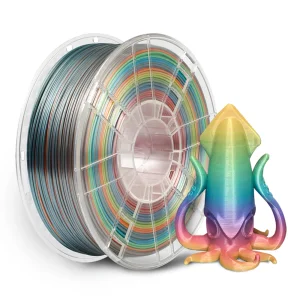
Explore our wide array of high-grade filaments including PC, ABS, Rainbow TPU 95A, and PLA composites.