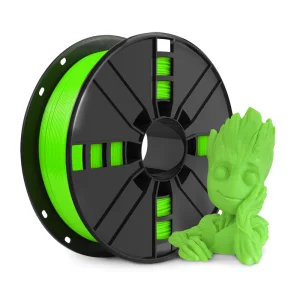
Engineering-grade Thermoplastic Elastomers, Precision Extrusion Rheology, Global Supply Chain Resilience, and OEM OEM Manufacturing Excellence
Explore our high-precision OEM catalog engineered for global distributors, print farms, and industrial end-users.
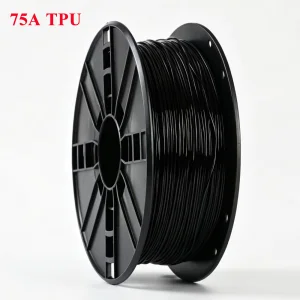
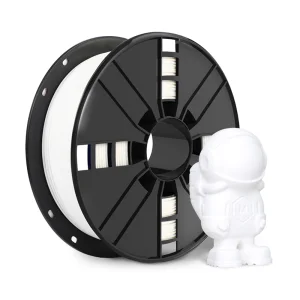
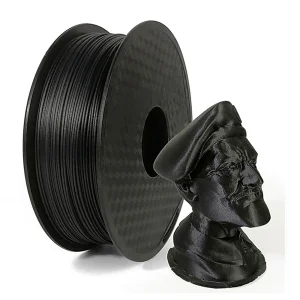
A rigorous engineering evaluation of Styrenic Block Copolymers (SEBS) versus Polyurethanes in additive manufacturing.
As additive manufacturing shifts from visual prototyping to direct end-use industrial component production, the demand for high-performance elastomeric filaments has experienced exponential growth. Among flexible Fused Deposition Modeling (FDM) materials, TPE (Thermoplastic Elastomer) 1.75mm filament represents the gold standard for applications requiring high tactile comfort, acoustic dampening, chemical inertness, and precise elastic hysteresis.
While often confused in commercial terminology, TPE and TPU possess distinctly different macromolecular architectures. Standard 3D printing TPE is typically compounded from Styrene-Ethylene-Butylene-Styrene (SEBS) or Styrenic Block Copolymers (SBC). These polymers feature physical cross-links created by domain segregation between hard polystyrene end-blocks and soft elastomeric mid-blocks. In contrast, TPU (Thermoplastic Polyurethane) relies on urethane linkages connecting hard aromatic/aliphatic segments and soft polyether or polyester chains.
This fundamental distinction in polymer chemistry delivers critical operational benefits for engineers selecting 1.75mm TPE filament from qualified Chinese manufacturing facilities:
TPE formulations exhibit lower permanent set under cyclic compression, retaining shape fidelity over millions of flexural cycles compared to standard TPUs.
Through precise compounding in Chinese factories, TPE 1.75mm can be tailored from ultra-soft 50A to rigid 95A, whereas TPU becomes notoriously sticky and unprintable below 75A.
SEBS-based TPE contains no hydrolytically sensitive ester or ether groups, resulting in exceptional resistance to acids, bases, alcohols, and ambient humidity absorption.
| Material Property | TPE 1.75mm (SEBS Compound) | TPU 95A (Polyether) | Silicone Rubber (Liquid Molded) | Vulcanized EPDM Rubber |
|---|---|---|---|---|
| Shore Hardness Range | Shore 50A – 90A | Shore 75A – 98A | Shore 10A – 80A | Shore 40A – 90A |
| Tensile Elongation at Break (%) | 550% – 850% | 400% – 600% | 300% – 700% | 250% – 500% |
| Specific Gravity (g/cm³) | 0.89 – 0.95 (Ultra-Lightweight) | 1.18 – 1.22 | 1.10 – 1.35 | 1.15 – 1.40 |
| Moisture Absorption (24h immersion) | < 0.05% (Hydrophobic) | 0.35% – 0.80% (Hygroscopic) | < 0.10% | < 0.15% |
| Dynamic Coefficient of Friction | 0.25 – 0.45 (Soft-Touch, Non-Sticky) | 0.60 – 0.85 (High Tack) | 0.80 – 1.10 | 0.50 – 0.70 |
| Max Flexural Fatigue Cycles | > 2,000,000 Cycles | ~ 800,000 Cycles | > 5,000,000 Cycles | ~ 1,000,000 Cycles |
| FDM 3D Printability Index | High (Requires Constrained Feed) | Very High | Not Printable (FDM) | Not Printable (FDM) |
How leading Chinese OEM factories engineer filament feedability through mathematical compression mechanics and laser-guided tolerance control.
Manufacturing soft elastomer filament in the standardized 1.75mm diameter format introduces extreme mechanical engineering challenges. Because flexible filaments act as structural columns pushing liquid melt through a constrained heating block nozzle, soft materials are prone to mechanical buckling before reaching the melt zone.
The critical force ($P_{cr}$) at which a flexible filament buckles inside the 3D printer drive mechanism is governed by Euler’s Column Buckling Formula:
Where E is the elastic flexural modulus of the TPE polymer, I is the area moment of inertia ($\pi d^4 / 64$), and L is the unguided length between the extruder drive gear and the melt zone entry point. Because diameter $d = 1.75\text{mm}$ is fixed, soft TPE polymers with low Young’s modulus ($E$) buckle effortlessly if unguided.
Continuous closed-loop optical feedback monitoring at 500 Hz maintains strict ±0.02 mm dimensional accuracy and ovality tolerance below 0.01 mm, preventing gear jamming.
Proprietary micro-textured surface modification reduces kinetic friction inside PTFE Bowden tubes by up to 42%, dramatically improving print speeds up to 100 mm/s.
Automated servo-driven traverse spoolers prevent tensile stretching during winding, ensuring the 1.75mm nominal cross-section is preserved intact on the spool.
Unpacking the structural economic and industrial cluster advantages of sourcing polymer filaments directly from Guangdong manufacturing hubs.
Global procurement directors and 3D printing brand owners face continuous pressures regarding lead times, batch consistency, raw material price volatility, and packaging customization. Sourcing China TPE Filament 1.75mm directly from top-tier original equipment manufacturers delivers distinct competitive moats:
Unlike secondary re-spoolers in Western markets, tier-1 Chinese factories formulate customized TPE pellets directly from base SEBS polymers, mineral oils, and nano-fillers. This in-house compounding cuts material costs by 30-40% while ensuring complete control over Shore hardness (60A–95A) and melt flow dynamics.
Equipped with high-torque twin-screw compounding extruders, multi-stage water cooling bath tanks with thermal regulation, non-contact laser diameter feedback, and automatic tension control winders, Chinese facilities achieve continuous 24/7 manufacturing with zero manual intervention drift.
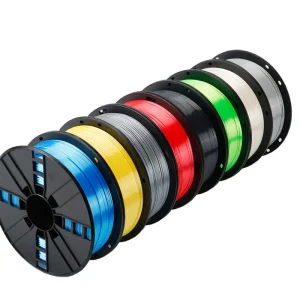
From custom Pantone color formulation and custom spool weights (250g, 500g, 1kg, 3kg, 5kg bulk spools) to high-barrier aluminum vacuum foil packaging with silica gel desiccants and customized master cartons, Chinese manufacturing partners offer full turn-key brand private labeling.
Real-world engineering implementations across medical devices, automotive tooling, industrial automation, and consumer tech.
Custom door gaskets, wire harness grommets, window channels, and anti-vibration mounts printed in TPE 1.75mm resist UV degradation, ozone attack, and extreme thermal cycling (-40°C to +110°C).
Biocompatible, ISO 10993-compliant soft TPE grades allow orthotics laboratories to FDM-print patient-specific prosthetic liners, heel cups, and shoe insoles with variable density lattice infills.
Pneumatic soft robotics require high flexural fatigue resistance and zero air permeability. TPE 1.75mm enables additive printing of compliant robotic fingers that gently handle delicate food or glass items.
Soft-touch watch bands, ergonomic ear-hook cushions, underwater acoustic dampening housings, and protective rugged smartphone cases leverage TPE's silky non-tacky tactile finish.
Pioneering advancements in smart elastomeric polymers, high-speed extrudability, and sustainable compounding.
The additive manufacturing landscape is evolving rapidly. Next-generation FDM printers operating at high motion speeds (300 mm/s – 600 mm/s with high acceleration) necessitate complete re-formulation of standard elastomeric filaments. Chinese R&D centers are currently advancing four key technical vectors:
Integrating shear-thinning rheological modifiers allows TPE 1.75mm to melt instantaneously inside high-volumetric flow hotends (e.g., Bambu Lab, Voron, Creality K1), enabling print speeds up to 250 mm/s without layer delamination.
By uniformly dispersing multi-walled carbon nanotubes (MWCNTs) or conductive carbon black within the SEBS matrix, novel TPE 1.75mm filaments deliver surface resistivity ranges from $10^4$ to $10^7 \ \Omega/\text{sq}$ for ESD-safe electronics packaging.
Replacing petroleum-derived mineral oils with bio-based hydrogenated plant-derived oils and incorporating up to 40% post-industrial recycled TPE compound lowers carbon footprint while retaining 95%+ of virgin mechanical properties.
Ensuring complete regulatory peace of mind for B2B buyers importing into North America, the European Union, and Asia-Pacific markets.
All TPE 1.75mm raw materials undergo rigorous GC-MS laboratory testing to guarantee total absence of heavy metals (Pb, Cd, Hg, Cr VI), polybrominated biphenyls (PBB/PBDE), and phthalate plasticizers listed under EU SVHC regulations.
Specific specialized TPE grades comply with FDA 21 CFR 177.2600 for repeated use rubber articles. Optional UL94 V-0 flame-retardant formulations are available for mass transit and aerospace applications.
Every 1.75mm TPE spool is vacuum-sealed inside high-density moisture barrier foil bags with active silica gel desiccant packs, protecting against ocean freight humidity spikes and maintaining <0.05% moisture content upon arrival.
Expert engineering and commercial answers to assist OEM buyers and purchasing managers.
TPE is typically a SEBS-based rubber compound offering lower density, hydrophobic chemical resistance, smooth non-sticky surface finish, and softer Shore hardness options (down to 50A). TPU is a polyurethane block copolymer with higher abrasion resistance, higher tensile strength, but greater moisture absorption and stiffer minimum Shore hardness (~75A–95A).
While Direct Drive extruders with constrained filament paths are strongly recommended for soft TPE (below 80A), our anti-friction surface treated TPE 1.75mm (85A–95A) can be reliably printed on Bowden setups when feed rates are kept consistent (20–35 mm/s) and retraction distance is minimized.
Precision factories utilize non-contact dual-axis optical laser sensors positioned right after the precision vacuum cooling bath. The laser feeds real-time diameter measurement data back to the haul-off tractor capstan, adjusting pulling speeds dynamically at 500 Hz to prevent swelling or stretching.
We provide comprehensive OEM packaging: custom-printed cardboard or transparent polycarbonate spools, branded foil vacuum bags, custom color cardboard boxes, barcoding/FNSKU labeling, and reinforced master shipping cartons designed for sea/air freight palletization.
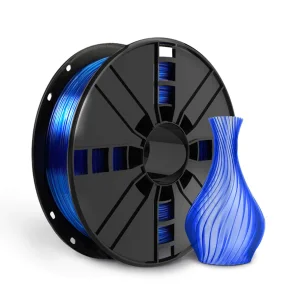
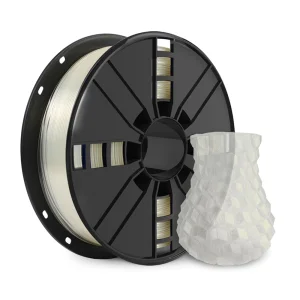
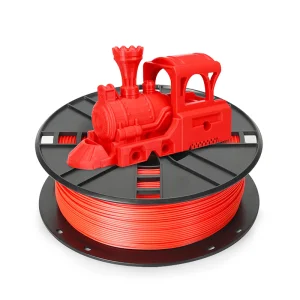
For standard stock colors (Black, White, Red, Blue, Natural), MOQ starts at just 50-100 spools. For custom Pantone color matching, raw material masterbatch compounding typically requires an MOQ of 300 kg to 500 kg per color batch.
No. SEBS-based TPE is fundamentally hydrophobic, absorbing less than 0.05% moisture under standard ambient humidity. However, vacuum packing with desiccant is still mandatory to eliminate surface moisture condensate during transatlantic ocean transport.
Explore additional high-demand 3D printer filaments direct from our Chinese manufacturing lines.