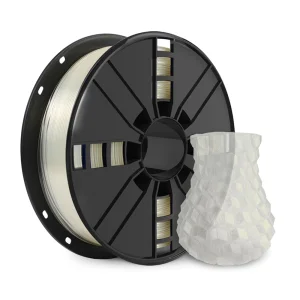
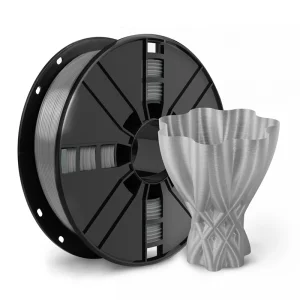
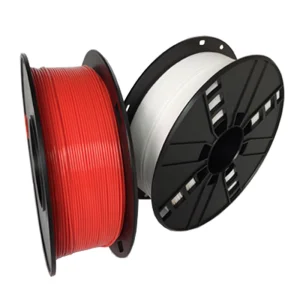
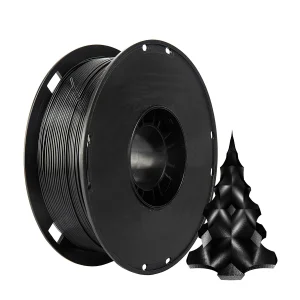
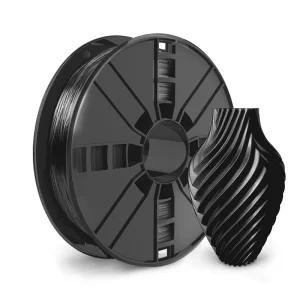
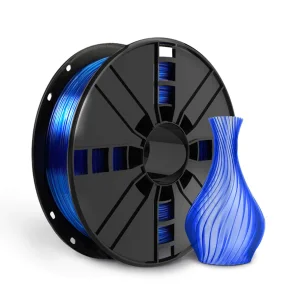
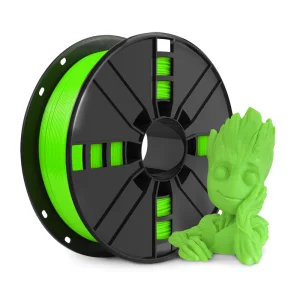
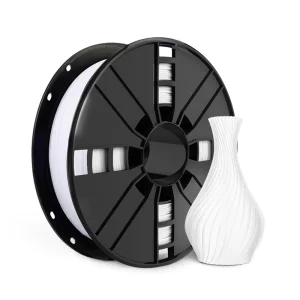
Explore our core extrusion lineup engineered in-house under continuous laser monitoring and automated tension control.
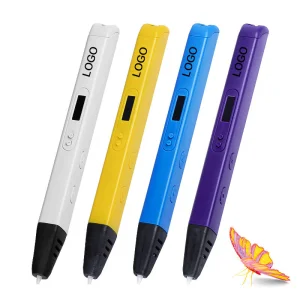
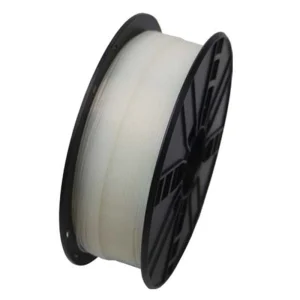
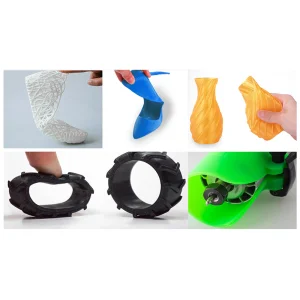
Analyzing molecular architecture, elastomer dynamics, and why 1.75mm precision extrusion has unlocked industrial-grade flexible production.
In the rapid expansion of Fused Deposition Modeling (FDM) and Fused Filament Fabrication (FFF), rigid polymers like PLA, ABS, and PETG dominated early adoption. However, as additive manufacturing transitioned from conceptual prototyping to industrial end-use production, the market demand shifted toward functional elastomeric polymers. Among these, Thermoplastic Elastomers (TPE) engineered in 1.75mm diameter represent a crucial breakthrough in material science, bridging the gap between vulcanized rubber resilience and thermoplastic processability.
Historically, extruding flexible materials at a standardized 1.75mm diameter posed massive engineering hurdles. Unlike rigid filaments that possess high flexural modulus and column strength, elastomeric filaments tend to buckle under compression within extruder drive gears—a physical phenomenon governed by Euler’s Column Buckling Equation. When pushing soft strands through a restricted nozzle orifice, the force required often exceeds the mechanical rigidity of the 1.75mm strand, leading to severe jams, wrapping around drive gears, and inconsistent flow rates.
To solve this, advanced manufacturers in China integrated customized Styrenic Block Copolymer (SEBS/SBS) chemistry and altered melt flow dynamics. Unlike Thermoplastic Polyurethanes (TPU), which often exhibit higher surface friction and stiffer tactile properties, TPE formulations provide a softer feel (ranging from Shore 70A to 90A), superior flexural fatigue resistance, and enhanced dampening capabilities. The evolution of precision dual-axis extrusion technology has made 1.75mm TPE filament a commercial reality for global OEM clients.
Understanding the rheological and mechanical trade-offs between elastomeric material families for targeted industrial application engineering.
| Material Metric | TPE (Styrenic Block Copolymer) | TPU (Thermoplastic Polyurethane) | TPC (Thermoplastic Copolyester) |
|---|---|---|---|
| Shore Hardness Range | Shore 50A - 90A (Ultra-Soft to Medium) | Shore 85A - 98A (Medium to Hard) | Shore 45D - 72D (Semigloss Hard) |
| Tactile Surface Feel | Matte, soft-touch, anti-slip rubbery finish | Glossy, smooth, high-friction surface | Semi-rigid, smooth plastic finish |
| Dampening & Hysteresis | Exceptional energy absorption & dampening | High energy return & elastic rebound | Moderate dampening capability |
| Chemical Resistance | High resistance to acids, bases, alcohols | Superior resistance to oils & greases | Excellent thermal & chemical endurance |
| Extrusion Sensitivity (1.75mm) | Requires precise direct-drive constraints | Moderate feeding tolerance | Easy printing similar to PETG |
For B2B buyers and product designers, selecting 1.75mm TPE over TPU comes down to tactile requirements and shock absorption profiles. TPE exhibits lower density and superior vibration attenuation, making it the material of choice for industrial gaskets, automotive acoustic seals, and ergonomic hand grips. However, extruding pure SEBS-based TPE into a consistent 1.75mm filament strand requires tight control over thermal expansion and draw-down ratios during extrusion.
From automotive components to medical wearable technologies, see how enterprise procurement teams leverage custom 1.75mm flexible filaments.
OEM automakers replace traditional rubber tooling with 3D printed custom weatherstripping, cable grommets, dust covers, and acoustic vibration isolators using oil-resistant 1.75mm TPE grades.
Skin-safe, ISO 10993-compliant TPE formulations enable rapid additive manufacturing of patient-customized prosthetic lining pads, orthopedic insoles, and biocompatible medical device bumpers.
Automation integrators print compliant soft robotic grippers, pneumatic suction cups, and flexible joint bellows that absorb mechanical shock while retaining high elastic recovery across millions of cycles.
Global apparel and footwear brands utilize lattice-structured 3D printed midsoles and custom ergonomic tool handles, leveraging TPE’s lightweight density and soft-touch tactile aesthetic.
Inside China's advanced polymer extrusion facilities—combining closed-loop laser feedback, zero-tension spooling, and direct export agility.
Extrusion lines incorporate high-frequency optical gauges measuring output diameter across X and Y axes 500 times per second. Deviations beyond ±0.02mm automatically adjust haul-off speed and melt pump pressure in real-time.
Flexible 1.75mm strands stretch easily under standard winding tension, causing ovality. Chinese automated lines use magnetic dancer tension feedback, ensuring neat, non-overlapping winding with zero stretch deformation.
TPE raw resins undergo double-stage desiccant rotor drying down to <200 ppm moisture before melt processing. Spools are immediately vacuum-sealed with high-absorption desiccants in multi-layer aluminum foil pouches.
How international buyers, private label brands, and industrial distributors mitigate supply chain risks when sourcing Chinese 1.75mm TPE filament.
Navigating global resin sourcing demands absolute clarity on quality control protocols, batch consistency, and international regulatory compliance. When partnering with a premier China TPE filament manufacturer, commercial procurement teams evaluate suppliers across three core pillars:
Industrial applications often require exact Pantone or RAL color fidelity. Advanced Chinese factories utilize spectrophotometer color matching system achieving Delta-E (ΔE) < 0.8 consistency between production lots. Furthermore, non-bleeding pigments ensure colorants do not migrate into adjacent components when overmolded or co-extruded.
To support global retail brands and enterprise print farms, factories provide customizable spooling solutions ranging from standard 1kg retail rolls to 3kg, 5kg, and 10kg master industrial bobbins. Recyclable cardboard spools treated with anti-dust edge coating prevent fiber contamination inside high-speed 3D printers.
Leading Chinese exporters maintain comprehensive documentation packages including REACH (SVHC) compliance, RoHS 3 (EU 2015/863) heavy metal limits, halogen-free reports, and FDA 21 CFR 177.2600 food-contact safety clearances where required for consumer products.
Explore our complete export catalog engineered for high-performance prototype and end-use manufacturing applications.
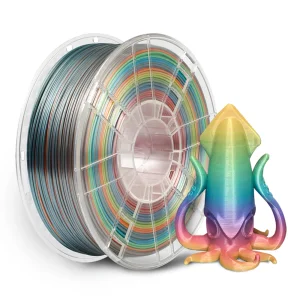
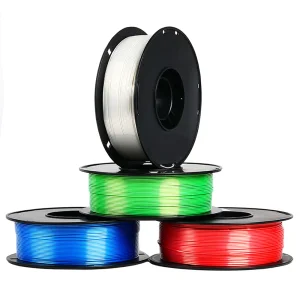
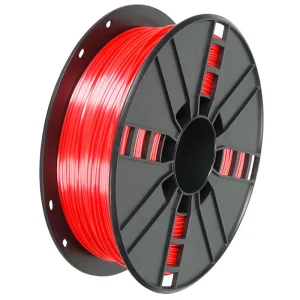
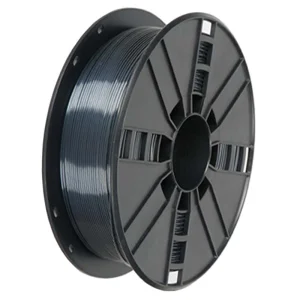
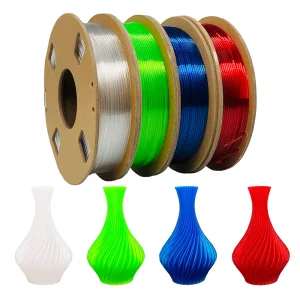
Recommended nozzle kinematics, retraction profiles, and build-plate conditioning for flawless elastomeric extrusion.
Extruding soft 1.75mm TPE filament cleanly requires adjusting standard print slicer profiles to account for material elasticity and melt-chamber pressure delay. Engineers should implement the following baseline parameters during setup validation:
Direct-drive extruders equipped with dual constrained drive gears yield optimal stability. Minimize the constrained PTFE path distance between the drive gear nip point and the thermal break to prevent column buckling under backpressure.
Target nozzle temperatures between 210°C – 235°C based on Shore hardness. Soft TPE grades (80A–85A) require slightly lower melt temperatures to control thermal stringing and minimize nozzle droop during non-print travel moves.
Maintain print speeds between 15mm/s to 35mm/s for standard hotends. Modern high-flow hotends featuring constrained melting zones can achieve 60mm/s+ by calibrating Linear Advance (K-Factor = 0.08–0.14) to manage elastic hysteresis.
Addressing engineering, procurement, and technical queries regarding 1.75mm flexible TPE filament sourcing from China.
While both are flexible thermoplastic elastomers, TPE is primarily based on Styrenic Block Copolymers (SEBS), offering a softer tactile feel (Shore 70A to 85A), superior matte finish, lower density, and better vibration absorption. TPU (Thermoplastic Polyurethane) is inherently stiffer (Shore 85A to 98A), offers high gloss, higher abrasion resistance, and greater strength. TPE feels closer to natural rubber, while TPU feels like flexible structural plastic.
While Direct Drive extruders are highly recommended for soft materials, medium-hardness TPE (Shore 85A–90A) can be printed on Bowden systems if the PTFE tube is tightly tolerance-matched (1.9mm inner diameter) and print speeds are kept conservative (15–20 mm/s) with retraction completely disabled or set to sub-millimeter distances.
Precision manufacturers utilize closed-loop extruders featuring dual-axis high-speed laser micrometers. Flexible polymers are extruded into multi-stage temperature-controlled water baths equipped with non-contact vacuum sizing tanks. Automated haul-off pullers adjust tension dynamically using optical sensor feedback to prevent stretching or ovality during cooling.
Yes. Chinese OEMs specialize in full custom contract manufacturing. This includes matching physical samples or Pantone/RAL color codes with Delta-E < 0.8 accuracy, custom spool printing (cardboard, recycled plastic, or high-temp ABS bobbins), customized die-cut retail packaging boxes, and private-label vacuum bag printing.
For standard stocked colors (Black, White, Clear, Red, Blue), MOQs typically start as low as 50–100 kg. For custom compound formulations, special Shore hardnesses, or custom Pantone color matches, factory MOQs usually range between 300 kg to 500 kg per batch run to optimize extrusion purging and laser calibration efficiency.
Filaments are dehumidified using industrial desiccant rotors down to micro-moisture levels (<200 ppm) prior to spooling. Each spool is immediately vacuum-sealed inside high-density 4-layer aluminum foil pouches containing active silica gel desiccant packs. Outer shipping cartons are reinforced with double-wall corrugated cardboard and moisture-barrier pallet wrapping to prevent ocean humidity ingress.
Top-tier Chinese suppliers manufacture TPE using virgin SEBS resins that comply fully with EU REACH (SVHC) and RoHS 3 directives. Specific medical or food-contact grades certified to ISO 10993 or FDA 21 CFR 177.2600 standard requirements can be produced upon request for specialized B2B applications.